This post was originally published on here
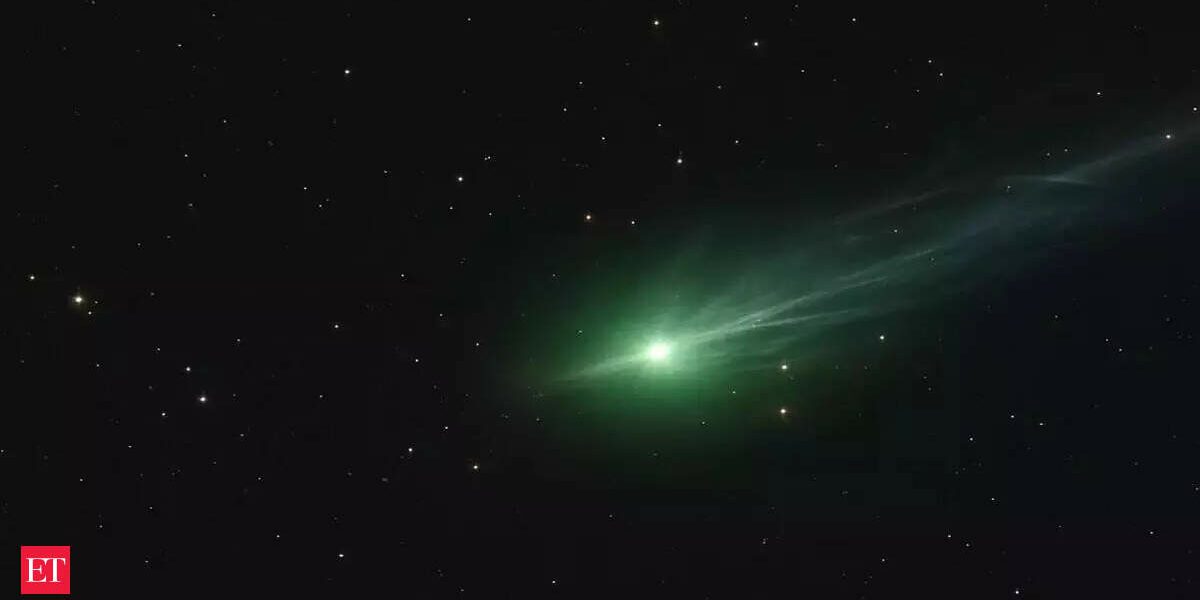
A peculiar interstellar comet 3I/ATLAS is passing through our Solar system and has baffled the scientists with its sunward tail and unusual composition. The comet’s unique characteristics have sparked discussions about potential non-natural origins. Amid the wild theories, Harvard scientist Avi Loeb has claimed that not only does 3I/ATLAS potentially have alien origins, but that this wouldn’t be the first time extraterrestrials have visited our planet. Avi Loeb has proposed a groundbreaking theory that interstellar objects, like 3I/ATLAS, could be sent by advanced civilisations to “seed” life on Earth, according to New York Post.
Avi Loeb, a well-known astrophysicist, has already pointed out several anomalies with the interstellar object 3I/ATLAS, which is currently passing through our solar system, and suggested that it might not be naturally occurring.
What Avi Loeb said on comet 3I/ATLAS
Avi Loeb suggests that the unusual trajectory and physical characteristics of 3I/ATLAS may indicate it is a technological artefact, potentially acting as a “seed” carrier in a cosmic distribution network. “There were plenty of opportunities for residents of previous stars to visit our place,” Loeb told the Post. “It really depends on their agenda. But if there is an interstellar gardener, then obviously it could have intervened….it could have seeded the various forms of life on Earth intentionally.”
ALSO READ: IndiGo flights to be cancelled on Saturday? CEO Pieter Elbers shares an update as airline faces massive crisis
The researcher wrote in his Medium blog post that it’s highly improbable that, in the 4.6 million years that Earth has been in existence, we haven’t received at least one cosmic interloper. “I explained that meter-scale rocks from interstellar space may impact the Earth roughly once per decade, adding up to half a billion such collisions over the Earth’s history,” he wrote. “If any of these interstellar rocks carried resilient forms of life that survived the interstellar journey, Earth could have been exposed to extraterrestrial forms of life.”And, since most stars formed a billion years before the sun, an “ambitious gardener from an earlier star” would’ve had plenty of time to affect the history of life on our planet, the researcher claimed.
“We often consider the history of Earth as isolated from its galactic environment, but this may not be the case,” said Loeb.
Unfortunately, we likely wouldn’t have documented evidence of this cosmic incursion, given that recorded human history is only around 6,000 years old, per Loeb. He added that we’ve been effectively monitoring the sky for only a small fraction of that time. “In terms of interstellar objects, it’s only over the past decade that we started finding them,” Loeb told the Post, noting that we’re somewhat limited by technology that’s unable to see super far-flung interstellar objects.
ALSO READ: ‘Dhurandar’ not inspired by Mohit Sharma, but on India’s largest covert operations against Pakistan? All about Ranveer Singh’s film
Interstellar comet 3I/ATLAS sparks buzz
Ever since comet I/ATLAS has been discovered in July, the interstellar object has become quite a cosmic celebrity with all space agencies focusing their space assets towards it to get more details about the object, which is expected to be closest to Earth on December 19. But NASA referred to it as a comet when it released data about the object last month.
So far, there have only been three recorded interstellar objects in our solar system to date: 1I/ʻOumuamua in 2017, 2I/Borisov in 2019, and 3I/ATLAS in 2025. 3I/ATLAS is moving at a speed of 244,800 km/h, roughly one-third the top speed of NASA’s Parker Solar Probe. Loeb highlights anomalies, like a retrograde orbit, unusual metal composition, and mysterious acceleration, suggesting it may not be a natural comet. Recently, he claimed that 3I/ATLAS boasts a “heartbeat”-like pulse that could provide evidence of its artificial origins.
“We may have a family of technological civilizations like ours or intelligence civilizations that we are not aware of,” he told the Post. “These are siblings that we have, and the most accomplished among them are the ones that managed to leave their home planet with the birth planet that hosted them early and spread them.”
ALSO READ: IndiGo flights cancelled: Harsh Goenka’s quirky post on IndiGo’s ‘name change’ amid massive chaos goes viral
“I explained that meter-scale rocks from interstellar space may impact the Earth roughly once per decade, adding up to half a billion such collisions over the Earth’s history,” he wrote in his blog on Medium.
“If any of these interstellar rocks carried resilient forms of life that survived the interstellar journey, Earth could have been exposed to extraterrestrial forms of life.” Loeb’s theory is rooted in directed panspermia, which means that life exists throughout the universe and is distributed by space dust, asteroids, comets, and meteoroids.
“We often consider the history of Earth as isolated from its galactic environment, but this may not be the case,” said Loeb.