This post was originally published on here
It is a truth universally acknowledged that a single man in possession of a good conscience must be in want of a knowledgeable woman — especially when it comes down to trying to understand the hardships of the body while in the process of menstruation.
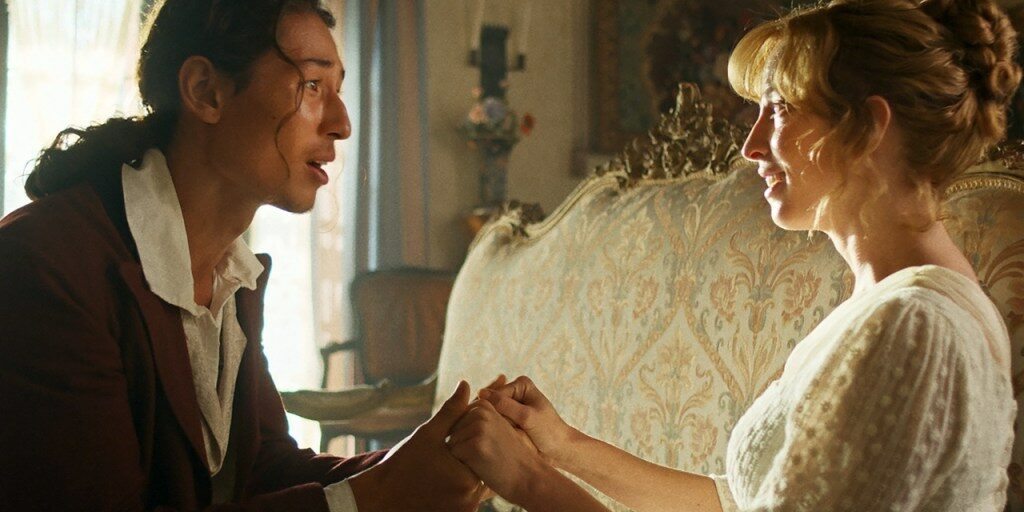
Julia Aks and Steve Pinder‘s Jane Austen’s Period Drama is a Jane Austen-inspired comedy that follows Estrogenia (Aks) as she gets her period in the middle of a long-awaited marriage proposal. Upon seeing the blood that accidentally seeps through her dress, her suitor, Mr. Dickley (Ta’imua) mistakes the natural bodily function as a grave wound, leading to a series of comical mishaps and pertinently meaningful conversations about destigmatizing menstruation.
The 13-minute short premiered at the Santa Barbara International Film Festival and played at the Tribeca Film Festival. It has also garnered awards across several festivals, including the Best of the Fest award at HollyShorts Comedy Film Festival, the Best Comedy Jury Award at Aspen Shortsfest, and the Audience Choice and Comedy Award at the Indy Shorts International Film Festival.
Watch on Deadline
Below, the co-writing and directing duo talk to Deadline about exploring women’s health awareness set against a backdrop of love in the time of corsets.
DEADLINE: When I think of the Regency era, I think of a lot of great female novelists. However, none of them have their characters talking about their periods. Where did this idea come from?
JULIA AKS: Well, it started with the title, Jane Austen’s Period Drama. This was during a time when Steve and I were doing a lot of sketch comedy. Originally, it was conceived as a three-minute sketch. Steven and I both like wordplay, and I grew up with a dad who does dad jokes and puns all the time. So, I just thought about what if there was a period drama about periods, and the idea was so silly and cheeky. Then I started digging a little deeper and posted in a Facebook group I was in for female opera singers, which also doubles as a support group for all of us women in that business.
And I asked them for funny period stories just to inspire ideas for the sketch. What I got was just this overwhelming number of comments that, yes, some were funny period stories, but a lot of them were also heartbreaking stories. And it felt like a lot of them wanted to get things off their chest. A lot of the experiences were also tied to the healthcare system, which is terrible, but can also be used for laughs in a sketch. Others involved experiences with their partners and learning about reproductive health.
But it felt like I unexpectedly opened the floodgates. I even reflected on my own experiences and thought that maybe there was a little more heart to this idea and the concept of exploring a period drama. So that inspired me, and we ended up co-writing it.
STEVE PINDER: For me, well, Julie and I were bouncing a lot of sketch ideas off each other. And when this one came up, it just felt right in our wheelhouse, especially since we love doing highbrow, lowbrow humor. And so, it played right into a style of comedy we love and that comes naturally to us. And then my mom is a hematologist, and she has worked in communities where there has been a lot of period stigma. So, people really do have problems with accessing period products and problems with accessing care. And so, I just felt like it was a subject matter that I really cared about.
DEADLINE: The short goes beyond the funny and has some really educational moments. It surprised me that the dialogue broke down the scientific parts of the menstrual cycle. Talk a bit more about balancing education and humor.
AKS: We did a bunch of iterations of this. Essentially, it came down to recognizing that we have an opportunity to genuinely educate people about the elements of menstruation that don’t get talked about. One of the wonderful things about working in a duo and working with Steve is that we really do complement each other in so many ways when it comes to storytelling. And sometimes I’m like, “We have to educate the people.” And Steve was like, “And it also should be very entertaining and funny.” So, we went through a lot of iterations of the script, trying to thread the needle: we don’t want to preach, we don’t want this to be an after-school special, but we don’t want it to just be a sketch.
PINDER: In the revision process, it really was about asking how to find the balance. How do we keep people alive and engaged in the story and moving forward while also subconsciously picking up all of this other educational stuff?
DEADLINE: The names of the characters are so funny: Mr. Dickley, Estrogenia and Vagianna, to name a few.
PINDER: We have a long list of many more names that didn’t make the cut.
AKS: We tried to find the right balance. But I mean the names that did make it – that’s just me and Steve being childish.
PINDER: My mom is British; I was over there not too long ago, driving around the countryside, and I was just looking at a map, and every other town name you could turn into a euphemism. So, I was just texting Julia about all these places. Also, Jane Austen was engaged for a day to a guy named Harris Bigg-Wither. I mean, come on.
AKS: Bigg-Wither. And we were like, “OK, well that’s just Harry Big Willy,” obviously. That didn’t make it into the short film, but that’s the kind of things we toss around over here.
DEADLINE: In terms of inspiration, were you pulling from all the Jane Austen novels and films or just a small sampling?
PINDER: We drew on the movies from the ’90s and early aughts, like Ang Lee’s Sense and Sensibility with Emma Thompson and Joe Wright’s Pride and Prejudice as our two biggest influences.
AKS: We looked at a bit of Emma [1996].
DEADLINE: Where was this filmed?
AKS: We shot the interiors in this house in La Cañada, Flintridge. It’s sort of this Tudor, hacienda-style architecture. And so, we kind of tried to shoot around the hacienda parts and focus more on the Tudor parts, which still isn’t totally historically accurate, but it served its purpose. Steve brought up a good point in pre-production when we were looking for locations. He said, “For this particular project, for a short film, we just need to make sure that we transport audiences enough. You don’t want to be looking at some very modern light switch on the side, and it’s going to take you out of the story.” So, this house, really, we got very lucky when we found it, and [the owners] were very cooperative and wonderful to work with.
Those exteriors, though, were the very first shot of the film. We tried to capture the rolling green hills of England, but we were shooting in the middle of summer in Los Angeles, and all the hills were dusty, crusty brown. So, we went to every edge of Southern California looking for places where lawns were watered all year-round. We asked ourselves if we should shoot this in a cemetery or at Pepperdine University. We were trying to steal shots, and our producer, Elli [Legerski], was like, “Absolutely not. This is very illegal.”
PINDER: We really do have location-scouting footage of us pretending to carry someone and running across Forest Lawn Cemetery.
AKS: So, we ended up FaceTiming with our cinematographer, Luca [Del Puppo], who lives in Connecticut, and asked him where we might know some beautiful, lush green places. And he was like, “Oh, this is just where my house is.” So, we were like, “OK, well, we should just go there, because it’s New England.”
DEADLINE: How did you end up starring in this?
PINDER: Julia tried very hard not to be in this, and I insisted. So, it’s my fault that she’s in it.
AKS: Most of my career has been performing-centric, whether that is in theater, film, TV, opera, and for this project, I really just wanted to focus on behind-the-camera stuff, and I thought it was going to be too much of a mindfuck to try and do both. And for the record, it is! But Steve and I have similar tones and such good rapport together that it just came down to him being like, “Julie, it should just be you. I mean, we’ve written the script, it’s your voice. The humor just fits you so well.” And alienated us that much more because it was one less thing to worry about.
PINDER: That was the big thing for me; it was just this character’s point of view had Julia’s point of view. I knew we would have trouble finding another actor who could inhabit it so authentically, and this just grounded the whole production and served as an anchor for the rest of the cast. It felt right.
Yeah. I mean, that was the big thing for me, just knowing that the character’s point of view is Julia’s point of view. And I just knew that we would have trouble finding another actor who could live in it so authentically, and sort of ground the whole production and be an anchor for the rest of the cast. I just knew that that felt so right.
DEADLINE: What would you like audiences to take away from this short film?
AKS: We hope that people see this film and walk away talking about menstruation with joy. And I think there is joy in the camaraderie and the community of why it’s so important to talk about periods, which is the point of this film. And one of the joys of this film that we really didn’t anticipate when we made it was how many different types of people would respond with great laughter – men and women of all ages and backgrounds. It does seem to have inspired people to talk to each other and to us about their situations, like, “This one time I had a terrible period and …” or “My wife had this wild pregnancy thing where…”
Pinder: As the gay best friend, I’ve heard these types of stories more times than I can count. I have a lot of great female friends, and I love it when people feel comfortable enough to talk to me about it after screenings. And I feel like that’s what the short is about. There should be comfort, especially with guys able to join these conversations.
And I feel like that’s also kind of what it’s about, right? It’s like there is this comfort, especially with guys. And I think us being able to join these conversations with joy, I think is what the movie, Dickley joining the conversation is what the movie’s about.
AKS: Also, one of the other things to mention is that after these screenings, people would come up to us and say, “Isn’t it so crazy how little they knew or talked about periods back then.” And we were basically like, a lot of these jokes in the film are based on tweets from 2019. They didn’t talk about periods back then at all. We tried to balance modern humor with the Regency era in England, but there’s very little record of what they did or who women talked to about their bodies.
[embedded content]
You can watch the trailer above, here.
[This interview has been edited for length and clarity]