This post was originally published on here
Some of the most successful movies of all time, that have changed the format or fully influenced a genre, largely followed the same template. Be it Star Wars, The Terminator, The Matrix, or Blade Runner, there’s not only a set expectation of the narrative format, but also some underlying rules that the movies have to follow. When introducing audiences to new worlds and concepts, you have to at least explain yourself a little bit. Even if you’re teaching an audience all about a new world, new tech, or even new words, you have to spoonfeed them.
Videos by ComicBook.com
44 years ago today, though, on February 12, 1982, the French fantasy-adventure movie Quest for Fire was released. Though it may not be the most recognizable movie in the genre, it’s a film that defied every convention for a feature film at the time, largely because of the story that it told. Directed by Jean-Jacques Annaud and based on the 1911 fantasy novel by J.-H. Rosny, Quest for Fire is notable for not only being the rare movie with no actual dialogue but time has proven that it’s a movie that can never be repeated thanks to all the rules it broke.
Quest for Fire Defied Every Expectation for Movies
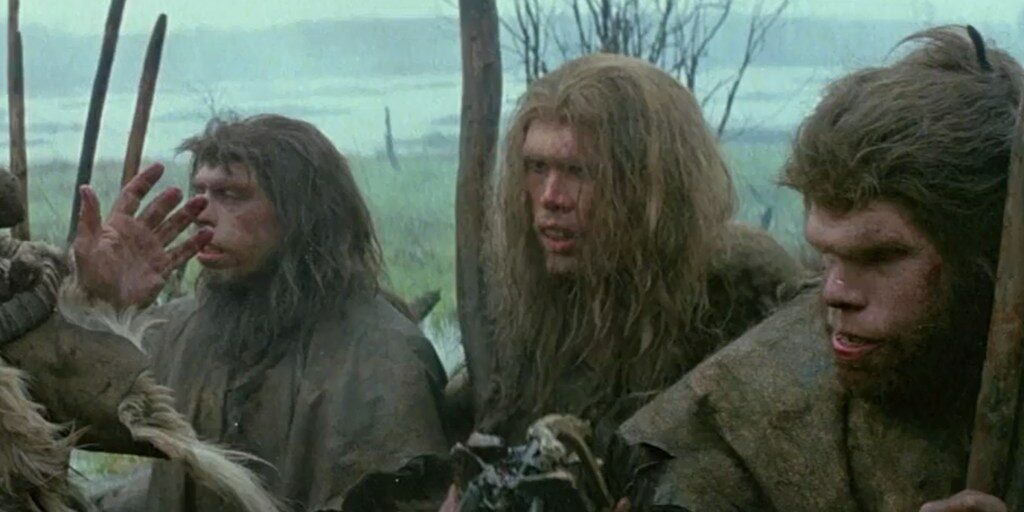
Quest for Fire literally puts it all in the name. Set 80,000 years ago against the backdrop of the Paleolithic era, the film follows early humans and their attempt to literally go find more fire and return it to their tribe. Along the way, they naturally encounter dangerous wildlife from the time but also other hominids that are equally as unpredictable. Sounds simple enough, right? One might even think of this premise as something that might get made today, but that’s when the movie begins to break every rule.
Quest for Fire took its setting and ideas seriously and features no actual discernable dialogue. The language spoken by the neanderthals seen in the film (which includes Twin Peaks star Everett McGill and Ron Perlman in his feature film debut) was created by A Clockwork Orange author Anthony Burgess, and though it’s largely clear to audiences paying attention what everything in the film translates to, there are no subtitles or direct translations offered. Even compared to other caveman movies, like Hammer’s One Million Years B.C., there’s not even a narrator to set the stage or offer further context.
Integral to the success of Quest for Fire and the fact that is has no dialogue is the universality of emotions on screen, which are the beating heart of the film. Even though there is no dialogue in a modern language, or even subtitles to translate the characters, their actions and the expressions of the actors are what make the story accessible to audiences from anywhere on the planet (and from any time). The characters in Quest for Fire express fear, doubt, joy, sadness, rage, and every other form of human feeling, all while speaking in a tongue that is totally foreign to every viewer.
It’s also worth noting that despite the “language barrier” at the heart of Quest for Fire, the film is still an immensely entertaining watch, and one that (despite the broken rules) follows a hero’s journey structure that adds to its universality. Quest for Fire has moments that are thrilling, scary, action-packed, and even, yes, funny. Even though it may not be for everyone, it’s a film that people willing to get on its level will find entertaining at every turn, and never dull.
Quest for Fire Is Timeless, And Cannot Be Repeated

The language decision for Quest for Fire may be the biggest rule that it broke, but it’s far from the only one. There are a slew of other elements at the heart of Quest for Fire that not only set it apart from the other movies being released at the same time forty years ago, but which make it a complete impossibility when compared to what’s being made now. One of the most obvious ones is that there are no recognizbale faces in the film at all. Though Everett McGill and Ron Perlman are notable character actors now, they weren’t the reason people were buying tickets back in 1982.
Another major taboo broken by Quest for Fire that would make it nearly impossible by today’s standards is the costumes, as many of the prehistoric humans in the film have known. Actress Rae Dawn Chong, who plays Ika, a woman the trio of cavemen met on their titular quest, is naked for almost the entirety of the movie, and she’s far from the only one.
Furthermore, Quest for Fire breaks the big Hollywood rule of “never work with animals.” The film features multiple scenes with live animals on screen including not only an actual bear (and a cub), but live African lions made to look like sabretooth tigers, and even circus elephants that have been made to appear as wooly mammoths. On top of the real animals on screen, Quest for Fire has no optical special effects that were added in post, capturing everything on screen in the camera (which included filming on location in remote parts of Canada, Iceland, and Kenya.
Despite being so distinct in how it tells its story, Quest for Fire was a major success upon its release. The film not only grossed more than $55 million at the global box office, but went on to earn critical acclaim, such as Roger Ebert who awarded it 3.5 stars out of 4. Quest for Fire would go on to win the Academy Award for Best Makeup and even Best Film at France’s César Awards. What Quest for Fire proved is that not only are rules made to be broken, but that audiences will show up when artists deliberately make those choices. A good story is a good story, no matter what language is being spoken and no matter if it’s in the modern day or the stone age; and a Quest for Fire is a good story, even if no one would dare make it now.