This post was originally published on here
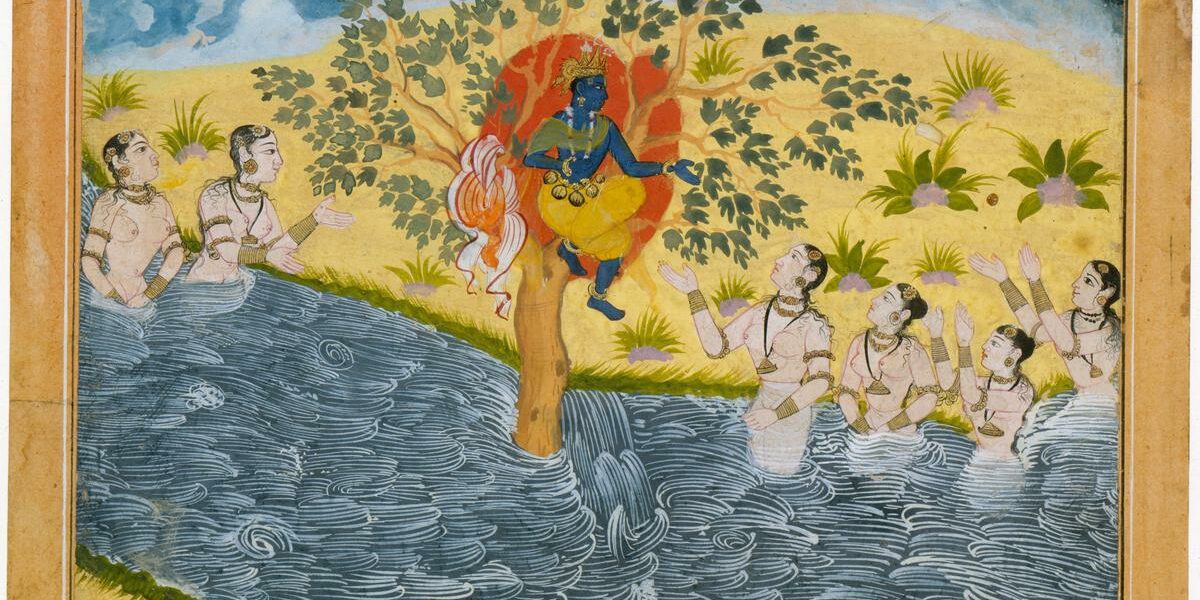
The gopis plead with Krishna to return their clothing.
|
Page from a Bhagavata Purana/Public Domain
Krishna, the young cowherd of Vraja, was a blessing to all who came into his presence. Listening to the music of his flute – not without its metaphoric connotations – bewitched and melted the hearts of all creatures, especially those of the women of Vraja who “continuously embraced him in their minds”. As Krishna played his flute, “even celestial damsels moving in their vehicles became infatuated with him, the chaplets of flowers dropping from braids of hair, and the folds of their garments slipping”. But the girls of Vraja thought of Krishna constantly. Whenever they were taking a bath in the waters of the river Yamuna at daybreak, they would make an image of the River Goddess in the sand, worship it with sandal-paste and fragrant flowers and repeat the same prayer: “O Goddess! O Great Maya of the Universe! Please grant the son of Nanda to me as my husband!”
Once in the course of this vow, the maidens left their garments on the bank and entered the waters of the Yamuna, nude, playing merrily. All the time, however, in mind, word and deed, they were with Krishna. Seeing them from a distance, Krishna collected their garments and climbed up the kadamba tree, laughing to himself and hanging the garments on the branches. Perceiving this to be a trick of Krishna, the maidens were overcome with love and embarrassment. Krishna promised to return their garments if they would come to him of their own accord. None of them came out of the water but pleaded with him: “Dear Krishna! Son of Nanda, whom we all adore, return our clothes, for we shiver with cold.” Krishna refused until there was total surrender.
The girls came out of the water to Krishna, shivering and bashfully covering their bodies with their bare hands. He teased them further by telling them that they would only receive their clothes if they bowed with their hands raised above their heads. The maidens in their helplessness realised that Krishna was asking for complete surrender – “the baring of themselves, as of their souls: to him”. They did as he commanded, thus being washed of all sins, flaws and transgressions. Pleased with their actions, Krishna gave them back their clothes, saying, “Your wish is already known and approved of by me and shall be granted. Return now to Vraja for your object is accomplished. You will spend the autumnal nights in enjoyment with me.”
Insights
I would like to pause here and point out the psychological process that is gradually beginning. The maidens of Vraja represent the instinctive forces of nature, still in a preconscious stage. They have “fallen” into the archetype of love without their conscious will, while Krishna represents the archetype of the Self in human form. He embodies the qualities of abandon, balanced with reason and will-power, making transformation possible. The myth points out that we have no choice when struck by such a force, thus ushering in the process of individuation.
In Jung’s understanding, we have two faces: one is the outward face of the psyche – the acquired personality – how one appears to oneself and the outside world, but not what one truly is. This he termed the “persona” – that which acts as a compromise between the individual and the society. In dreams, which reveal the deeper layers of the psyche, the persona is often symbolised by clothes or lack thereof.
The myth describes the process where Krishna steals the gopis’ clothes, the false wrappings that cover who they truly are, and he does not give them back to the gopis until they have totally surrendered to him. Krishna has only given them a glimpse of their divine nature; they are still caught in lila or illusion, and attracted to Krishna, who symbolises the divine outside of them. However the whole objective of individuation is to bring us to the realisation that the divine lies within “us”. In our myth, Krishna is acting as the force which encourages the gopis to start their journey, as the rest of the myth will show.
The myth
The enchanting season of autumn arrived, when the lotuses were in full bloom. The small safari fish sparkled in the water; the peacocks, no longer animated by passion, fell silent in the woods. The lakes started drying up, the skies were “free of clouds like the hearts of ascetics are of desire”, and the nights were bright. Krishna kept his promise to the women of Vraja and with his presence blessed each one of them with his loveplay, revealing the many dimensions of love. He played on his celestial flute, melting their hearts.
Hearing the music of his flute made “even the rivers exhibit their passion” and the girls could not resist its call. They left their houses, regardless of what they were doing. Some left the pots of food to burn on the fire, some left their infants half-fed on their breasts, others did so while they were busy smearing their bodies with sandalpaste, “their ear ornaments trembling with excitement as they hastened to the forest”. The few who were unable to get away began to meditate on him, seeing themselves in his company. They were all joined with him in unfettered love and felt free of all bonds.
Krishna then entered the waters of the Yamuna with the maidens, playing with them, embracing them, touching their hands, locks, thighs, waists and bosoms, accompanied by playful glances and hidden smiles. Receiving such attention and love from a god, they were filled with pride and felt superior to all other women of the earth. But Krishna was quick to see their conceit and pride and disappeared from their midst. Deeply distressed at being suddenly left alone, their hearts totally absorbed in Krishna, the women started wandering from grove to grove, looking for him in their mad longing. Finally they found his footprints. But following the tracks, they suddenly discovered the footprints of a woman alongside Krishna’s. Seeing this they were torn by jealousy, not knowing who this fortunate woman could be.
Excerpted with permission from Eros vs Kama, The Psychology of Love: The Wisdom of Indian Mythology, Rashna Imhalsy-Gandhy, Speaking Tiger Books.