This post was originally published on here
By: Francis Rienzo
Under a unifying theme of “against the current,” the DC Environmental Film Festival is hosting their 34th annual festival from March 19th to the 28th. This past week at the Georgetown University McCourt School of Public Policy previewed the coming attractions and gave guests a taste of what to expect.
In 2025, the DCEFF drew a total of over 10,000 people to venues across the city. The events will take place at over 20 to 25 different venues, including but not limited to the U.S. Navy Memorial, Martin Luther King Jr. Memorial Library and the National Museum of Women in the Arts. The annual event began in 1993, and has provided viewers with opportunities to see top-tier journalists, researchers, scholars and activists speak and showcase their art through film.
This year’s theme is “Against the Current,” which is meant to amplify the voices of those who continue to work towards defending our planet. In light of new tensions in D.C. with the current administration, the festival urges viewers to reject cynicism and find hope in art and coalitions.
“People feel right now that there are forces beyond our control,” said Monica Schorn, executive director of DCEFF, in an interview with The Georgetowner. Schorn spoke about the activists, artists and scientists that come together for this event. “What’s so critical is that we do not exist in a vacuum. People are trying to right the course,” she continued.
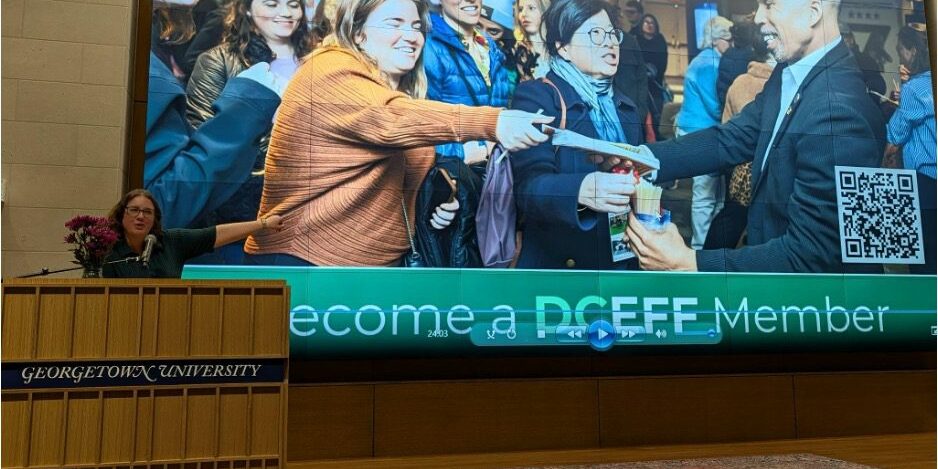
Photo by Bruce Guthrie. Monica Schorn, executive director, speaking at the McCourt School of Public Policy at Georgetown University about the DC Environmental Film Festival.
Jacob Crawford, director of marketing and operations, said that there have been “efforts made to alter the DNA of D.C.,” in reference to the recent actions by the Trump administration. Working against these changes, the festival offers partnerships with various organizations, including the Smithsonian National Museum of Asian Art. The museum sponsored a film that will play at the festival.
The offerings range from fun animated films to dramatic scientific explorations. There are about 60 programs, with one half of the festival being short films and another feature films. There will even be a Sundance Film Festival winner, Nuisance Bear, which won in the documentary category. There are some films that will be making their world premiere at the festival, such as The (Conserv)atives, directed by Dominic Gill and Nadia Gill, which will explore climate activists across party lines.
Brad Forder, director of programming, spoke about his goals for the festival. “We wanna showcase the people in these films,” he said, labeling them as character driven. The festival will feature panel discussions and Q&A sessions after the programs, allowing viewers to explore the filmmakers intent and process.
The majority of the programming offered at the festival is free. They do take donations, urging viewers to donate and allow these stories to be seen on a more global scale. They announced at the preview event that a board member is doing a match gift, so every donation will be matched dollar by dollar.
DCEFF also has four award winners, three for feature length and one short. Each one is slightly different in format, with some documentaries and some more narrative. As of February 16th, friends of the festival and donors can start reserving tickets, with openings for the general public happening the day after. Schorn, about the festival’s success, said “as long as we are making people feel connected to the work that’s happening right now, it’s a successful festival.”