This post was originally published on here
Provaris Energy Ltd (ASX:PV1, OTC:GBBLF, FRA:WS90) has hit a concept selection milestone for its proprietary liquefied CO₂ tank design, expanding the technology’s potential use across the carbon capture and storage (CCS) supply chain.
The milestone forms part of Provaris’ joint development agreement with Yinson Production and moves the YP-Provaris LCO₂ tank beyond its original reference role in Yinson’s Floating Storage and Injection Unit (FSIU) development program. The technology is now being evaluated for LCO₂ carriers and floating storage terminal solutions.
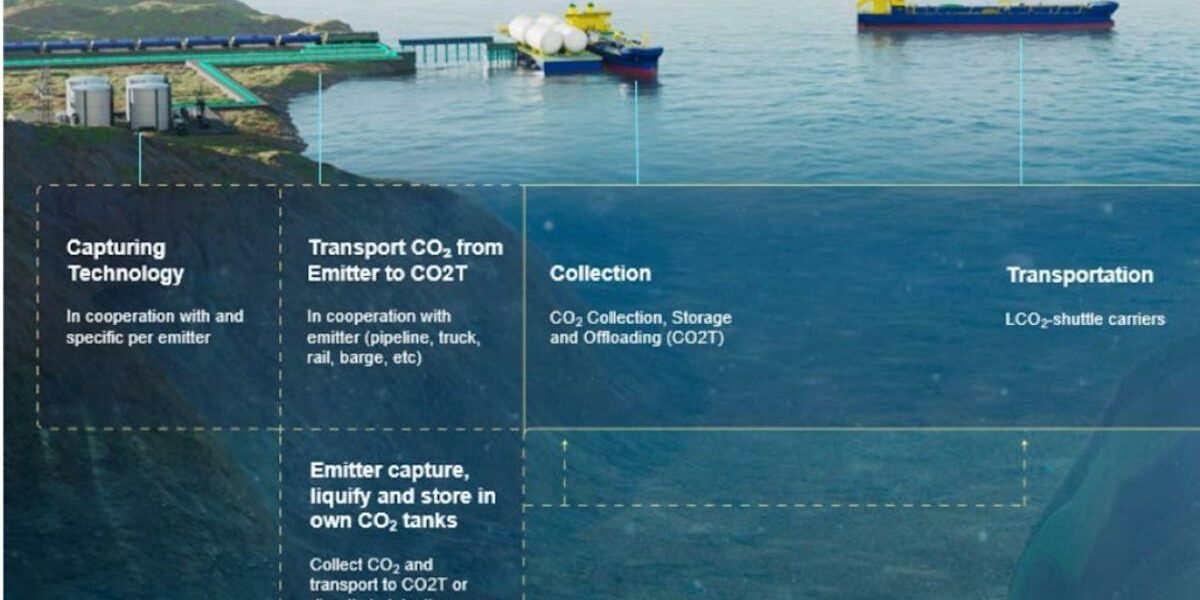
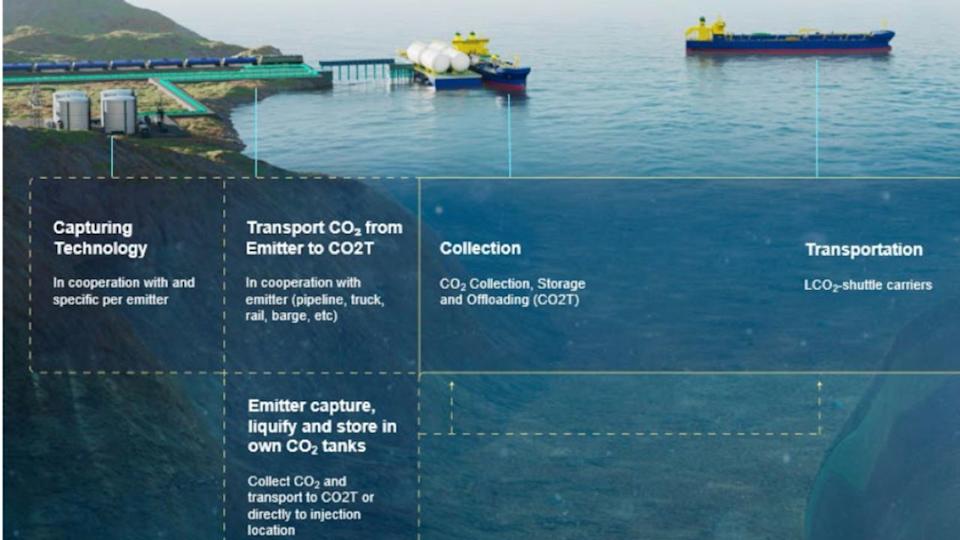
Illustration of Yinson’s large scale CCS Supply Chain infrastructure suitable for <10 Mtpa of CO2>
Hitting this milestone materially increases the commercial scope of Provaris’ LCO₂ tank technology by opening potential applications across marine transport, floating storage and offshore injection infrastructure.
The design enables significantly larger tanks to be fabricated and installed in carriers and barges, with the aim of improving transport and storage economics compared with conventional solutions.
The company sees this as a key point of difference as CCS projects move from planning into execution, where infrastructure scale, cost per tonne and storage efficiency are expected to become increasingly important.
“We are pleased with the progress of our joint development of the LCO2 tank FEED stage. From a project economics perspective, large-scale CO₂ storage solutions have the potential to materially improve efficiency and reduce cost per tonne relative to existing market offerings,” Yinson Production AS chief technology officer (CTO) Lars Gunnar Vogt said.
“The LCO₂ tank design provides a scalable containment solution well suited to the requirements of large CCS developments. Subject to successful completion of the tank’s FEED stage and receipt of a General Approval for Ship Applications (GASA) approval by DNV for maritime classification, the LCO₂ tank design can be a preferred solution for future projects.”
Relevance to CCS infrastructure
Large-scale CCS developments are expected to require expanded marine transport and offshore storage capacity over the coming decade, particularly in regions such as Norway and the broader North Sea.
Provaris and Yinson are targeting a solution that could support large CCS supply chains by improving efficiency per tonne of LCO₂ transported and stored, reducing unit costs through scale and improving overall project economics for storage, shipping and offshore injection projects.
The concept selection milestone also represents a technical and commercial de-risking step, providing a pathway into FEED-level studies and future execution phases.
“The selected concept reinforces our differentiated positioning in delivering key technical and economic benefits to CO₂ supply chains. The design and engineering of the Type C Equivalent tanks to date have verified that we can produce and operate the 25,000 LCO₂ tank with an extremely low probability for structural failures and leakages in accordance with the requirements for a Type C tank in the IGC Code,” Provaris Energy CTO Per Roed said.
“Moreover, we have advanced the design of the automated production facility which will allow for a high level of quality assurance and cost reduction during fabrication compared to conventional fabrication processes.”
Development pathway
Stage 2 FEED activities are underway for a 25,000-cubic-metre LCO₂ tank and are targeted for completion by mid-2026.
The current work program includes structural modelling, final design documentation and staged fabrication and testing of tank components at Provaris’ robotic laser-welding facility at Fiskå in Norway.
DNV has been engaged to progress General Approval for Ship Application (GASA) class approval, which is intended to validate the tank design, robotic manufacturing process and material performance against maritime requirements for Type C equivalent tanks.
Next steps
In the June quarter, Provaris expects to continue FEED work, component testing, GASA class approval activities and integration with Yinson’s FSIU FEED program.
The company is also continuing design work on a full-scale tank production facility, including estimates of unit costs and delivery schedules, as part of its memorandum of understanding with Himile.
Provaris said the development pathway provides a framework for a proposed joint venture company with Yinson and for potential future licence fee monetisation linked to CCS project milestones, final investment decisions and execution timelines.