
This post was originally published on here
Static Media
We may receive a commission on purchases made from links.
Every once in a while, science fiction has a tendency to skirt too close to reality for comfort. Some sci-fi movies actually got the future right and predicted real-life technology well in advance. Still, it’s one thing to make educated guesses about things to come. It’s completely another to put in the work and actually deliver a realistic portrayal of what it would be like to have an adventure in space.
This is not to say that realistic space movies are completely impossible to find, though it can be difficult. Even though films tend to take a certain amount of creative storytelling liberties when it comes to realism in films, some space-themed movies can still get an impressive amount of things right when they set their mind to it. As such, there are quite a few films that take place in space (or on notable celestial objects) that do actually manage to be very accurate. Here are five of the most realistic space films ever made.
Gravity
Warner Bros.
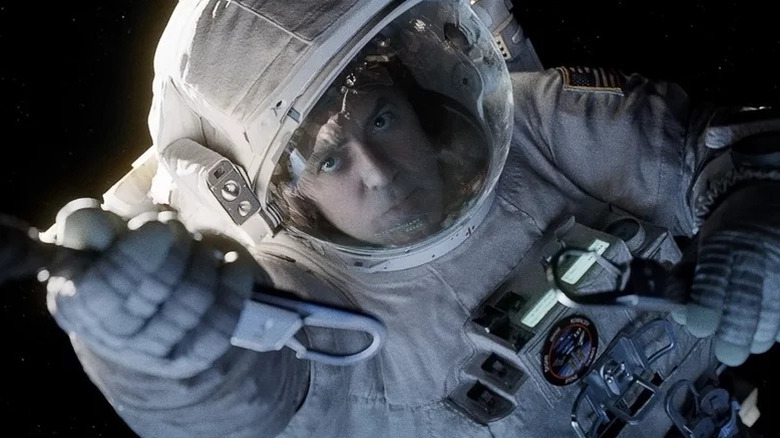
Alfonso Cuarón’s “Gravity” has one of the most harrowing non-alien-related premises when it comes to terrible space situations. Here, astronauts Ryan Stone (Sandra Bullock) and Matt Kowalski (George Clooney) find themselves in deep trouble when debris from a destroyed Russian spy satellite wrecks their shuttle and kills the rest of the crew. With nothing but their space suits and a Manned Maneuvering Unit at their disposal, they soon find out that their nearest port in the storm, the International Space Station, has been evacuated — and that they might not actually make it to the station at all.
This chilling and visually impressive survival thriller is both an example of human tenacity in the face of crisis and a thoroughly uncomfortable watch in the best of ways. As it happens, many aspects of the film are also pretty scientifically accurate. The film manages to capture the look and “feel” of space itself and the two major space stations it depicts. It also makes sure to get its time frames and speed units right, and the depiction of the dangers of space debris is extreme but plausible.
Yes, there are also things “Gravity” gets wrong. The debris from the Russian satellite would likely be in a far higher orbit from Earth than both the ISS and the protagonists’ spacecraft, and there are some debatable choices regarding things like Kowalski’s fate and the fire extinguisher trick near the film’s climax. At the end of the day, however, “Gravity” definitely knows ball when it comes to science — even if it occasionally chooses to ignore it in service of the story. That’s cinema.
Interstellar
Paramount Pictures
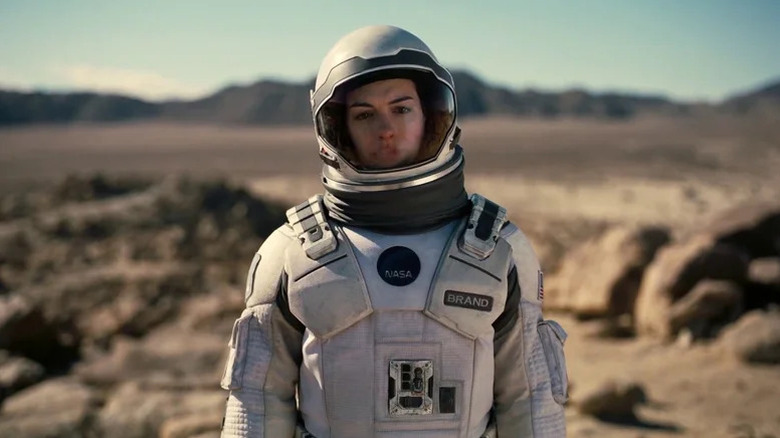
Christopher Nolan is the kind of filmmaker who likes to put in the work, so it’s not exactly a shock to find out that “Interstellar” is surprisingly accurate when it comes to science — even though the movie deals with some pretty uncanny subject matter. Yes, there are times “Interstellar” got science all wrong, since it relies heavily on unverified theories and tech that’s a fair bit more developed than what we have today. It’s still science fiction, after all. Even so, there are several space-themed parts of it that are actually fairly sound, as far as science goes. For instance, the gravity well of a black hole will indeed affect the way time passes for those who venture too near.
As Looper’s sister site /Film has noted, Christopher Nolan’s “Interstellar” is fairly scientifically accurate in many parts, thanks to Nolan working with the Nobel Prize-winning theoretical physicist Kip Thorne to create the film’s awe-inspiring visions. From the tsunami-infested, time-dilating water world of Miller’s Planet to the way the movie’s painstakingly-created black hole looks and behaves, the film straddles the line between “scientifically sort of plausible” and “scientifically accurate,” exaggerating and tweaking as needed but nevertheless building the story’s platform on a base of accuracy.
“The story is now essentially all Chris and [Jonathan Nolan’s],” Thorne told Wired. “But the spirit of it, the goal of having a movie in which science is embedded in the fabric from the beginning — and it’s great science — that was preserved.”
Moon
Sony Pictures Classics
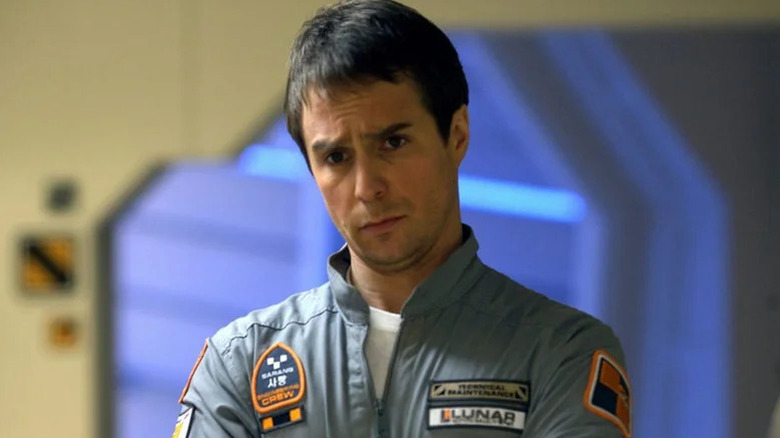
In Duncan Jones’ 2009 sci-fi movie “Moon,” Sam Bell (Sam Rockwell) works a three-year contract as the sole human staffer on a solitary moon base mining Helium-3, a valuable fuel. While he’s performing an important job, his value as a human being seems questionable. He’s dealing with severe isolation and a variety of tech hiccups prevent contact with the outside world. When another Sam appears after a close-call accident, it turns out that there’s a reason behind all the oddities: The station is staffed by short-lived clones of the original Sam, with new ones activated as the old ones perish. With two Sam clones now active, they team up to expose the shady practices of the company.
In an interview with The Guardian, Jones described the meticulous process that went into making the film look as real as possible. “We built the moon base as a full 360-degree set and we would seal the cast and crew in at the start of the day. That set gave us confidence, though it cost close to a third of our $5m budget,” he said. “We wanted to make stuff seem as real as possible.”
As it turns out, there actually are Helium-3 reserves on the moon, and it legitimately is a potentially important future source of energy. The movie’s evil company finding inventive ways to exploit workers is also not too difficult to imagine, considering the sweatshop practices of many real-world companies. Apart from themes of capitalism and worker’s rights, the film’s key technology is also chillingly on point, or at least on its way there. Human cloning is still making moves behind the scenes, and in early 2026, a startup called R3 Bio discussed its intentions to grow “brainless” cloned lab animals — and eventually humans.
Apollo 13
Universal Pictures
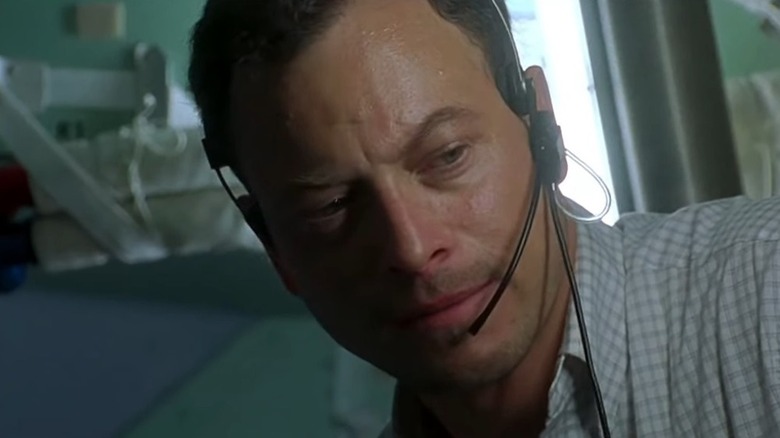
Ron Howard’s 1995 space disaster film “Apollo 13” is largely accurate to the true story of the infamous 1970 space mission that almost claimed the lives of Jim Lovell, Fred Haise, and Jack Swigert (played in the movie by Tom Hanks, Bill Paxton, and Kevin Bacon). Since it depicts the play-by-play events of a well-known real life incident, a lot of attention went to getting things right, and the end result is one of the most historically accurate space movies out there.
Given all those laurels, It may not be exactly surprising to find out that Apollo 13 is also on point when it comes to the science behind the film’s events. Naturally, there are some creative liberties taken, but when it comes to the way “Apollo 13” portrays the weightlessness of space, the film truly went all out. Howard used NASA’s KC-135 plane — colloquially known as the Vomit Comet — which could create 25-second periods of weightlessness by flying up to 36,000 feet and then performing a controlled dive.
To film the gravity-free scenes for the movie, the makers of the movie went through over 600 of these dives, painstakingly shooting the scenes in short, tight segments. The process was tricky for everyone involved. If you think it’s hard to act in such circumstances, imagine how challenging it is to actually hold a camera and capture the action.
The Martian

20th Century Fox
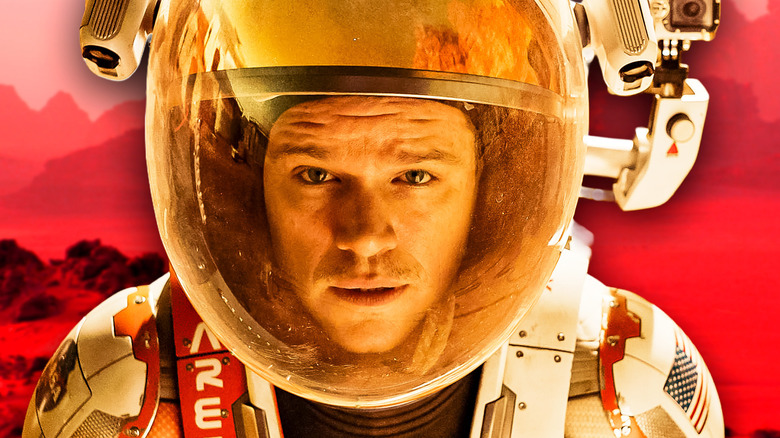
Ridley Scott’s “The Martian” is a bit ahead on the “Mission to Mars” curve compared to real life, but this doesn’t mean that its science is fabricated. Mark Watney’s (Matt Damon) lonely struggle for survival after being accidentally stranded on Mars offers a fair share of accuracy, as does his team’s risky mission to rescue him.
Based on Andy Weir’s novel of the same name, “The Martian” does admittedly indulge in some scientific nonsense — for instance, the massive storm that strands Watney and establishes the movie’s stakes wouldn’t have even a fraction of the depicted impact in real life, thanks to Mars’ vastly thinner atmosphere compared to Earth. In addition, the lower gravity of the red planet doesn’t always come across from the way Watney moves.
However, many of the hard science aspects of the film are surprisingly accurate. Scientists think that you really could grow food in Martian soil. And while Watney might be wiser to look into extracting his water from the planet’s soil, you can use rocket fuel to make water the way he does in the film. NASA’s Perseverance rover has also confirmed that extracting oxygen from the planet’s carbon dioxide-heavy atmosphere is possible, and even the gravity slingshot maneuver the Hermes uses to return to Mars is a very real thing that NASA has used, notably in its Voyager program.