This post was originally published on here
David Fincher is cinema’s great control freak. You know this before you know a single credit. Every frame is measured. Every take is one of fifty. So every ranking of his films is really a ranking of what he does with all that control. Does he polish a surface, or does he point the precision at something that fights back?
The numbers give the obsession a scale. Fincher has directed a dozen released features, and per Wikipedia’s filmography they have grossed over $2.1 billion worldwide. Per his Wikipedia profile, that work has earned him three Best Director nominations. This is one critic’s ranking. Mine. I expect you to argue, and I want you to.
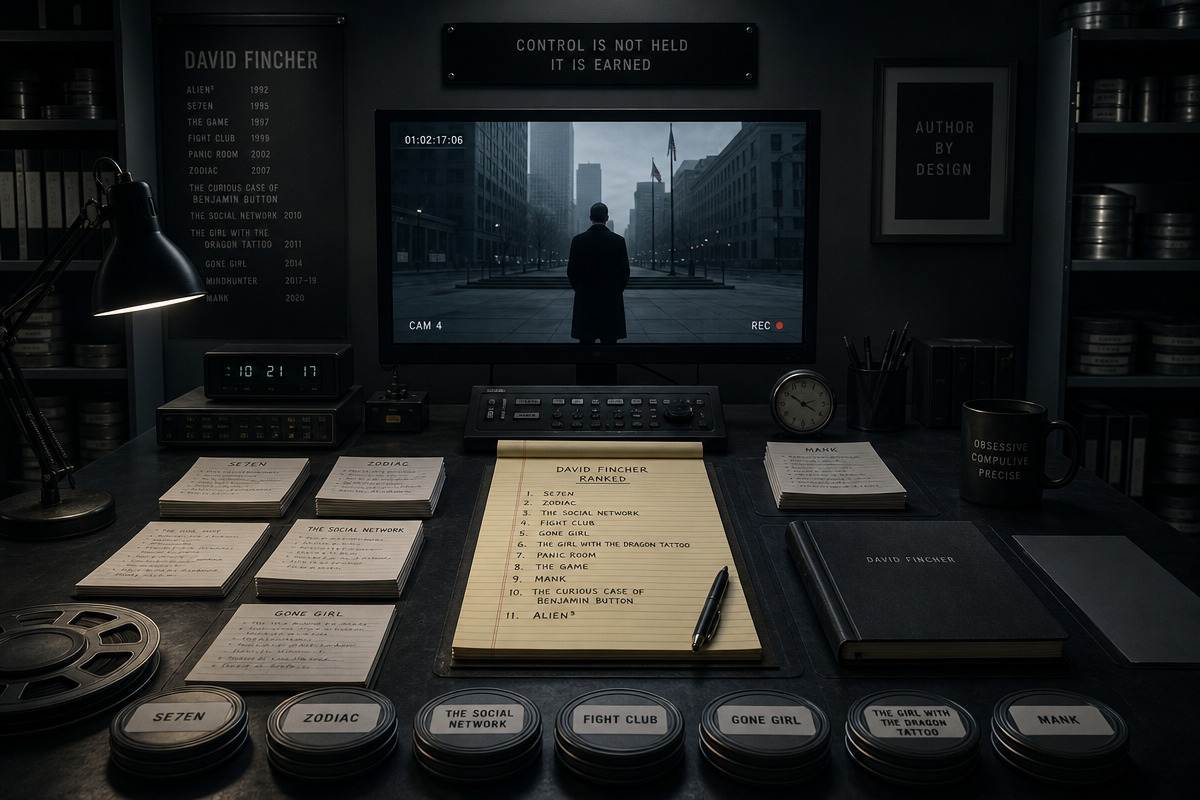
Here is the through-line, so you can hold me to it. The films rise on this list as control stops being a style and starts becoming the subject. At the bottom, precision is a finish. At the top, it is the whole point.
The Director for Hire
Start at the bottom, where the control is just a job. These are the assignments Fincher took and shaped, without ever fully owning them.
His debut sits dead last at #12. Alien 3 (1992) arrived after studio meddling gutted the production, and Fincher has largely disowned it ever since. You can hear the fight in every compromised reel. It is the one film here where his control was taken away from him.
The rest of this tier is where he keeps control and finds too little to do with it. The Game (1997) builds a beautiful puzzle box and springs a shrug. Panic Room (2002) locks Jodie Foster inside a house and locks you outside her. The camera threads through keyholes with more feeling than the plot has for anyone in it.
The pattern holds as the budgets climb. The Girl with the Dragon Tattoo (2011) is a cold, exact adaptation of a book that already worked. Fincher renders it with a craft that never answers the question of why he bothered. The Curious Case of Benjamin Button (2008) earned Fincher his first Best Director nomination. It still plays embalmed, a life story told from behind glass.
I do not dispute the craft. These five films are technically immaculate. They are also sealed off, engineered so tightly that no air gets in. The control here buffs the surface and stops there. Fincher can do this in his sleep, and sometimes it looks like he did.
Control as a Weapon
Move up a tier and the precision finds a target. Now Fincher aims his discipline at a theme, and the films get teeth because of it.
Fight Club (1999) is Fincher pointing all that control at a culture that cannot stop buying things. It flopped in theaters and then became a defining cult film on home video. A generation played it back until the twist curdled into a lifestyle. I have argued elsewhere about the authenticity of Fight Club, and the film still cuts sharper than its fans do.
Gone Girl (2014) turns the same scalpel on marriage as performance. It is Fincher’s highest-grossing film at roughly $370 million worldwide, a wild fact for a movie this poisonous. The whole thing lives or dies on Amy Dunne as a monster, and Rosamund Pike makes the control feel like a weapon Amy wields herself, wrested clean out of the director’s hands. The film knows control is a story you tell about yourself. It lets Amy out-direct every other person in the frame.

Mank (2020) aims the camera back at Old Hollywood and the making of Citizen Kane. It led its year with 10 Oscar nominations and won two, for cinematography and production design. Fincher shoots Mank in glorious black and white, and the fetish for period detail nearly swallows the screenwriter at its center.
The Killer (2023) makes the theme literal. A hitman narrates his own routine, reciting rules to himself while the plan quietly falls apart. It is Fincher watching a control freak fail in real time, which is funnier and sadder than the deadpan lets on. The joke lands because you recognize the director inside the man. Both trust process to hold chaos at bay. Both watch it slip anyway. These four films matter because the precision is finally about something. That is what lifts them over the hired work below.
The Perfect Machines
At the top, the theme and the technique become the same thing. Control stops being the method and turns into the subject the film is actually about.
At #3 sits The Social Network (2010). It is Fincher’s best-reviewed film at 96% on Rotten Tomatoes, and many critics compared it to Citizen Kane. Its Trent Reznor and Atticus Ross score won the Academy Award for Best Original Score. That nervous pulse runs under every rapid-fire scene. The comparison to Kane earns itself. Both films watch a man buy his way toward a connection he has already broken. I have written about the reflective edge of The Social Network. It is a film about a boy who builds a machine to control the very intimacy he cannot manage.
At #2 is Se7en (1995), the serial-killer film with Brad Pitt and Morgan Freeman. It made Fincher’s name after the ordeal of his debut. Every gray frame drips with a designed dread. You can trace how the movie thinks through Se7en and the dangers of apathy. A killer’s rigid design overrides two good men who cannot match it. The ending is one of the cruelest exercises of authorial control in mainstream cinema. John Doe scripts the last act, and Fincher lets him keep the pen. You leave shaken because the killer’s design beat the good men flat.
And at #1, Zodiac (2007). Fincher shot it almost entirely on the digital Thomson Viper, per Wikipedia. He chased a clean, patient exactness across years of dead ends. The film takes the procedural and turns it into a study of obsession that never gets its answer. It belongs to a lineage I have traced through Fincher’s serial-killer obsession, yet it stands apart from all of it.
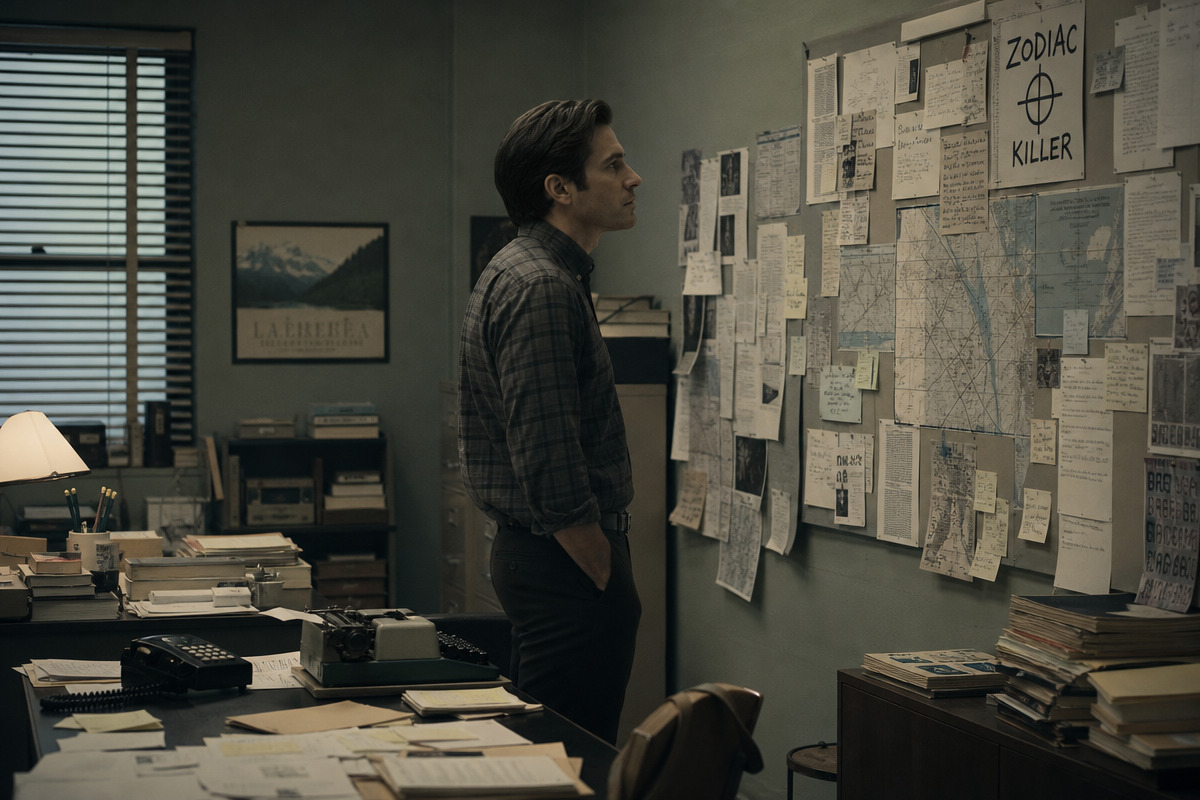
Here is why it tops the list. Zodiac is the one film where Fincher’s control collides with a truth it cannot solve. Robert Graysmith gathers every fact and still ends up staring at a face he can only suspect. That failure is the point. Every other Fincher film hands you a solution, however bleak. Zodiac hands you a wall of evidence and a shrug from history. The most controlled director alive made a masterpiece about the limit of control. Nothing else in his filmography risks that.
The Verdict
Zodiac is the peak because it is where the control freak meets the unknowable and refuses to fake an ending. The films below it prove Fincher can master anything he points a camera at. This one proves he knows the camera cannot solve a murder. Come back to the thesis I gave you up top. Every Fincher ranking measures what he does with control. His greatest film is the one that admits control runs out. That is my case. Now go make yours, and I will happily read why you think I am wrong about Se7en.