This post was originally published on here
Relative to the United States, Canada is often portrayed as polite and benevolent. In reality, Canada’s past and present are entrenched in colonial and imperialist conquest. Many understand Canada’s settler-colonial roots and its genocide of Indigenous Peoples, but its development as an imperialist power is sometimes less clear. It is crucial to understand the development of Canada’s state power through the lens of imperialism, not only because it explains Canada’s role in the world, but also because these are the conditions within which we must organize for a better future. Without understanding Canada’s imperialist role beyond its colonial borders – in Palestine, Somalia, or Haiti, for example – making a material change within these borders is impossible.
Here are five books to help you understand Canada’s imperialist past and present.
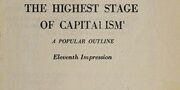
Imperialism, the Highest Stage of Capitalism by V.I. Lenin (1917)
Imperialism, the Highest Stage of Capitalism is not about Canada, but Vladimir Lenin’s analysis of imperialism and finance transcends borders. Published in 1917 as a pamphlet, it lays the foundation for understanding the current stage of capitalism, how we got here, and where we might go. Though Lenin focuses on the Russian Empire, this book – and Lenin’s body of work – forms the basis of revolutionary struggle and history across the world. Contextualizing the role of banks in the age of imperialism, Lenin illustrates geopolitical dynamics between the world’s capitalist powers by tracing the flow of capital. He introduces imperialism as a “special stage of capitalism,” wherein a monopoly of banks, industries, and the world itself (its raw materials and labour power) is concentrated within the hands of fewer and fewer capitalist powers. Importantly, this can only happen through violence: the exploitation of labour power in colonized and previously colonized nations, the parasitic extraction and theft of resources, and wars of aggression and encroachment. Lenin historicizes imperialism internationally, and calls into question the role of the working class within those capitalist superpowers.
Canada in the World: Settler Capitalism and the Colonial Imagination by Tyler A. Shipley (2020)

Tyler A. Shipley reminds us that the process of development, generating superprofits, and the consolidation of state power in Canada through imperialist extraction and aggression cannot be delinked from the formation of the Canadian state through settler colonialism. Canada in the World thoroughly scrutinizes Canada’s foreign policy, beginning with its relationship with the Indigenous Peoples it colonized. Rather than accept the notion of “peacekeeping” at face value, this book proves Canada’s foreign engagement begins and ends with its interest in capitalist accumulation. Shipley explores Canada’s role in expanding imperialist hegemony throughout the Cold War and afterwards, the violence of its “peacekeeping” missions (particularly in the case of the military’s conduct in Somalia), and its fervent participation in the “War on Terror.” Shipley ends by examining the rise of fascism in contemporary Canada as an outcome of capitalist accumulation and imperialist expansionism. With the acceleration of state violence to repress protest against the genocide in Gaza, alongside Canada’s commitment to arming Israeli forces (however indirectly), state repression and sabotage of strikes, and the rising cost of living in tandem with stagnating wages, this book forces us to reckon with the inextricability of the accumulation of superprofits in the hands of the few as workers and the poor struggle through Canada’s imperialist past and present.
Blood of Extraction: Canadian Imperialism in Latin America by Todd Gordon and Jeffery R. Webber (2016)

In the wake of Canada’s support for the U.S. coup d’état in Venezuela and its intensifying blockade against Cuba, it’s essential to understand how imperialist aggression and exploitation operates in Latin America. Through thousands of government files and interviews with unionists, peasant militants, activists, and lawyers, Todd Gordon and Jeffery R. Webber investigate and clarify the state-sanctioned role of Canadian mining megacorporations in driving regime changes, ecocide, land theft, and human rights violations in Latin America. One key example is Canada’s support for Honduras’ reactionary, corporation-backed military coup in 2009 despite touting democratic values. In reality, Canada’s interest in accumulating and consolidating profits for its mining companies at the expense of people’s land, resources, and sovereignty is the driving force behind its political operations in Honduras and elsewhere. Canada’s role in Latin America, this book asserts, cannot be divorced from the global machinery of Western imperialism. Historicizing Canada’s intervention and engagement within the broader framework of imperialist expansionism and hegemony reveals the framework through which Canada systemically generates profits to the tune of billions of dollars by dispossessing, displacing, and exploiting Latin American citizens.
Bombardier Abroad: Patterns of Dispossession by David P. Thomas (2018)

Many of us who have attended Canadian universities have seen recruiters for Montreal-area aircraft and high-speed rail manufacturer Bombardier Inc. at career fairs. Bombardier builds infrastructure for Montreal’s metro, but it also provides machinery for the occupation of Palestine. In this book, David P. Thomas examines three case studies, one of which is Bombardier’s A1 railway project that runs from Jerusalem into the 1948 occupied territories known as “Israel.” To build this railway, Israeli forces displaced and dispossessed Palestinians living in Beit Surik and Beit Iksa. This book lays out the mechanism through which Canadian megacorporations like Bombardier reap the benefits of accumulating superprofits domestically by participating in imperialist and colonial aggression abroad. Bombardier Abroad shows how Canada’s supposed adherence to international law conventions falls apart through its engagement in the West Bank, eastern Jerusalem as occupied by Israel, and elsewhere, while supporting corporate capital accumulation.
Paved with Good Intentions: Canada’s development NGOs from idealism to imperialism by Nikolas Barry-Shaw and Dru Oja Jay (2012)

An often overlooked mechanism of imperialist aggression is how state actors use social and cultural institutions to produce favourable political and economic outcomes. Nikolas Barry-Shaw and Dru Oja Jay explore how this manifests through the boom in non-governmental organization (NGO) funding in the neoliberal age, how Canadian NGOs support reactionary and repressive regimes, and by questioning to what end “good intentions” benefit popular, progressive movements in the Global South. This book reveals Canada’s backing of a reactionary, repressive regime in Haiti through the Canadian International Development Agency, going as far as installing its own “experts” in Haiti’s government. Millions have been poured into development packages for Haiti, yet Haiti’s people remain impoverished and oppressed as Canada’s NGO sector thrives. Paved with Good Intentions is a compelling look into Canada’s more covert, insidious imperialist endeavours, which parallel its overt, violent exertion of economic and military power.