This post was originally published on here
 16 min read
As we hit the home stretch of 2026, there have been several shining examples of truly provocative movies that center sex: Emerald Fennell’s immediately notorious re-rub of Wuthering Heights, Harry Lighton’s so-called dom-com Pillion, Elliot Tuttle’s taboo-flouting Blue Film, and Jane Schoenbrun’s psychosexual (and often goofy) evisceration of the slasher genre, Teenage Sex and Death at Camp Miasma, From pegging to consensual nonmonogamy to the joys of sex work to tentacles to dinosaurs doing it, this year is full of novel depictions and true breakthroughs in representation.
Teenage Sex and Death at Camp Miasma
Jane Schoenbrun’s latest popcorn polemic combines an interrogation of the slasher (Friday the 13th and Sleepaway Camp are the most explicitly referenced) with the elliptical sapphic tension of Mulholland Drive, and the results are way more goofy and fun than you may have been led to believe. At its heart, Camp Miasma is an exploration of what it means to annihilate the binary—not just on a gender level, but on every one, as the line between horror fan and participant collapses during the movie’s runtime. Hannah Einbinder, demonstrating a stunning range, plays Kris Williams, a filmmaker who has been tasked with rebooting a vintage slasher franchise, Camp Miasma—that is, as they once said on Twitter and BuzzFeed, “problematic.” She taps Billy Presley (Gillian Anderson), the series’ original final girl, to aid in the reboot, though the pull of the original shooting location and Billy herself end up blowing her off course.
They eventually attempt to consummate their growing attraction. What would be a sex scene on the floor next to a roaring fire is interrupted by Kris’s inability to give in to the moment. What ensues is a rare conversation in film about what gets the character off—this is too often taken for granted in a standard twenty-second sex scene in which a hetero couple has practically immediate orgasms through PIV. Instead, Billy urges Kris to tell her what she’s into and when Kris says she’s bad at sex, Billy counters: “There’s no ‘bad at sex.’” Kris admits that she can’t get off unless she dissociates during sex, and that her most reliable fantasy involves her as a victim in one of the Camp Miasma movies. “It’s stupid, it’s so misogynistic,” she admits, embarrassed. “If you wanna become that with me, you can ‘cause it’s all just play,” says Billy.
The veteran actor eventually reveals that her sex scene in the first Camp Miasma movie marked the loss of her actual virginity, via sexual assault, and that sex was “exactly as bad as I had always imagined it would be.” Billy pulled through and orgasmed by a dissociation similar to that which Kris employs during sex: She imagined she was not merely the victim but also the killer, thus smashing the binary. Later, she guides Kris through the same process to similar results. Talk about finding someone to match your freak! Camp Miasma is singular in the space it allows its characters to find themselves and then each other, sexually. It takes a “they don’t make ‘em like this anymore” vibe and applies it to a movie the likes of which had never been made before. Astounding.
The End of Oak Street
A foreboding moan sounds in the middle of The End of Oak Street, David Robert Mitchell’s slick creature feature that out-Spielberged Steven Spielberg’s actual movie from this year, Disclosure Day. At this point in the film, the Platt family, led by Denise (Anne Hathaway) and Greg (Ewan McGregor), has gotten used to their new normal and the movie’s premise: They are at constant risk of being eaten by the dinosaurs that now live among them in their suburban neighborhood. The guttural rumble just happens to be in the path they’re taking to get home, so they walk toward it and are not prepared for what they see: a pair of sauropods mating.
Leaning on a house’s roof for stability, the giant creatures are slow, they are sensual, they are loving. The top wraps his neck around the bottom. If only all cinematic sex were this gentle. Denise, who snorts when she realizes what’s going down, implores Greg to stand in front of them so she can take a picture of him with the DTF dinos. “I wanna remember this insane, stupid moment,” she reasons. That’s meta-commentary on the movie’s scene, which is both of those things and also brilliant. This will go down as one of the most memorable sex scenes of the year.
Gail Daughtry and the Celebrity Sex Pass
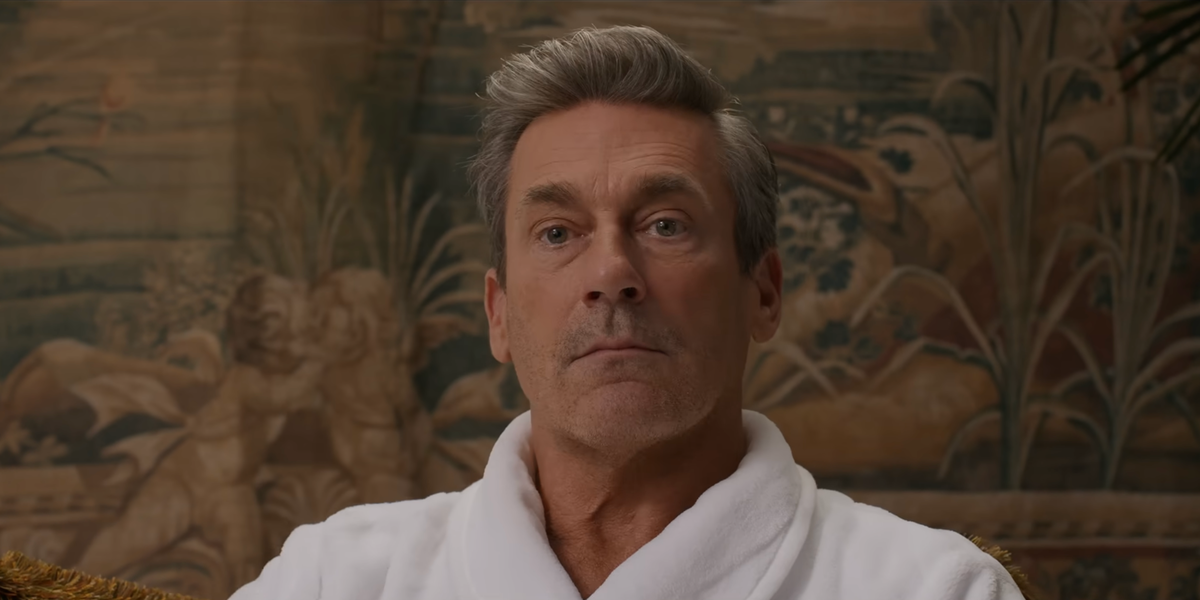
From director David Wain, who brought us Wet Hot American Summer and They Came Together, comes a satire about modern monogamish arrangements tucked into a loose remake of . . . The Wizard of Oz? Celebrity Sex Pass guns for Wild at Heart’s status as the wackiest Oz retread on film. Gail Daughtry (played by Zoey Deutch—see how her character’s name is a flipped riff on Dorothy Gale?) sets out to find her celebrity sex pass (that is, the celebrity she’s allowed to sleep with without jeopardizing her relationship), Jon Hamm, after her fiancé, Tom (Michael Cassidy), falls practically dick-first into his, an extremely receptive Jennifer Aniston.
Aniston plays herself and she’s admirably game. Tom and Jen meet at a signing for her cookbook, Straightforward Suppers. They get busy in the back room of a bookstore—we see her from behind on a couch, her legs up pointing to ten and two o’clock, as they discuss Friends. When Gail interrupts them, Jennifer apologizes, saying it was her understanding that this didn’t violate their agreement. Besides, it would be a great story for them to tell at their wedding and a “fun half hour for me.” Gail eventually gets hers, and Hamm shows off a sense of humor about himself very much in line with Aniston’s in an over-the-top syrupy love scene: light flares, slow motion, multiple suggestions that he’s getting pegged. Beautiful.
Body Blow
Body Blow, written and directed by Australia’s Dean Francis, finds the middle ground between noir and gay culture via mutual investment in archetypes. His erotic thriller of sorts is populated by a twink (the femme fatale, if you will), a daddy, a butch top, and drag queens, to name a few. Upon patrolling Sydney’s gay district, cop Aiden (Tim Pocock) comes across bartender/sex worker/ardent drug user Cody (Tom Rodgers), whose “daddy” is a drag-queen drug lord, Fat Frankie (Paul Capsis). Bad Lieutenant-style hijinks ensue. Taking a page from Paul Verhoeven, Francis directs his actors straight, even when they’re saying ridiculous lines like, “You know what happens to twinks like you in jail? Prolapse.”
Body Blow is a dumb action movie, yes, but it’s a clever one. The entire production is sexually charged, and scenes of explicit sexuality penetrate the tension. This includes a back-alley, neon-lit, and clothed encounter between Aiden and Cody, and a much more loving and comfortable one later in the movie in which the roles reverse and archetypes are flayed: the twink tops the cop. Aiden struggles with his sexual impulses in general, guided by a NoFap podcast, and even goes as far as to cage his penis. He throws the key in his chicken coop and when horny Cody finds this out, his furious tearing at the ground to dig it up is one of the movie’s great visual gags.
I Want Your Sex (2026)
Gregg Araki’s sex comedy I Want Your Sex owes debt to sexploitation satirist Russ Meyer, animator Tex Avery, and pornography. It even winks at Araki’s own back catalog, particularly in its consciously over-the-top performances that are so stilted as to conflate the very concepts of good and bad acting.
I Want Your Sex is an endlessly amusing romp anchored by career-best performances from Olivia Wilde (as Erika Tracy, a fine artist who weaves her sex life into her provocative and more-than-a-little-ridiculous work) and Cooper Hoffman (as Elliot, Erika’s underling). The age gap (she’s 40; he’s 23) and dom/sub nature of their sexual relationship, which Erika effectively wills into existence, make I Want Your Sex something of a hetero-ish Pillion, though the sex here is way more explicit and voluminous. “You’re my sub,” Erika assigns Elliot. She dresses him in a leash and collar and a latex maid’s uniform and pegs him—the only enjoyable penetration that Elliot experiences in the movie is that which he’s on the receiving end of. He makes it through a rather mundane session with his actual girlfriend, Minerva (played by an especially droll Charli XCX), by fantasizing about Erika. Minerva ends up faking an orgasm.
Further adventures include Erika loaning out Elliot to a friend as a birthday present (“I’m your boy whore for the evening,” he explains) and a threesome with Elliot’s best friend, Apple (Chase Sui Wonders), that begins with Erika telling him, “Oh I’m fucking you tonight, but you have to find someone who will hold your ass open,” and ends in tears.
Modern Whore (2025)
Nicole Bazuin’s adaptation of writer/performer/sex worker Andrea Werhun’s memoir of the same name is technically a documentary driven by Werhun’s own reflections on her career as an escort and stripper, as well as her conversations with people close to her (including her mother, partner, and fellow sex workers). But there’s a wealth of re-creations to go along with Werhun’s anecdotes and meditations, and many depict her in various sex acts. These re-creations range from straightforward (a tight, chest-up shot of her enjoying receiving oral sex on her back) to illustrative (a montage of her simulating riding guys while topless in front of various backgrounds to show the repetitive nature of her work) to absolutely outlandish (after a john asks for a rimjob, we get an anus-eye view of her puckering up and going in).
The tone is generally lighthearted (even when she’s discussing bacterial STIs she contracted during her career travels), but there are serious turns. There’s a discussion of her being raped while giving a lap dance and a recurring bit where, in male drag, Werhun plays a dude-ish manifestation of her own shame. She is reliably clear and well-spoken about her work. (She is, after all, a writer.) “Commuting in rush hour? To a job I hate? I would rather fuck a stranger,” she says, explaining her career choices. Sex-worker reviews on message boards constitute “a genre of erotica written by men for men,” and she compares herself to a comet when reflecting on her relationship to the bulk of her patrons: “You get to the core of a person and then you’re gone.”
Throughout Modern Whore, there is a motif of men attempting to tease out the trauma that they assume led her to her career path. That, in turn, imbues the film with an urgency. She explicitly underlines why it’s important for members of marginalized groups to tell their stories: so that these very misconceptions are avoided. Modern Whore is a great argument for showing and telling.
Touch Me (2026)
“Shall we have cross-species intercourse?” If that invitation sounds remotely appealing, well, Addison Heimann has written and directed the hentai-adjacent body-horror comedy for you. It concerns roommates Joey (Olivia Taylor Dudley) and Craig (Jordan Gavaris), who, thanks to scatological reasons, need to move out of their shared home and stay in the country house of Joey’s former lover Brian (Lou Taylor Pucci), who is a literal alien. There is no ambiguity, no big reveal. The guy is an alien who is so into “cross-species intercourse” that the movie is practically begging you to take a shot every time he drops the phrase. (You’d be hammered maybe halfway through.)
Heimann stretches his low budget to preposterous lengths, as sex with Brian involves being wrapped in tentacles (or maybe one big one). It snakes around Joey’s body, framing a breast, and at one point lifts her arched body in the air. (“I forgot how good it feels to have his tentacles on my skin,” she tells Craig later.) It probes Craig’s mouth (after he yells something in Japanese, an overt acknowledgement of the hentai at hand). At one point it appears that Brian and Laura (Marlene Forte) are sucking on a double-sided tentacle.
The sex scenes are staged in vivid hues: bisexual lighting for a bisexual alien antihero. The tentacle sex is unsurprisingly dangerous, as a Grindr hookup reveals (in a charmingly anachronistic flair, the text exchanges are displayed onscreen like silent-movie dialogue cards, with brief messages taking up the entire screen, bordered and in black and white). “I give people the best cross-species intercourse of their lifetime. It’s a gift,” claims Brian. It’s certainly something!
Blue Film (2026)
Elliot Tuttle’s Blue Film is, by most measures, a small movie. Its budget was something like $50,000, it concerns only two characters in a single location, and it follows one long conversation between them. But it packs a huge punch with an incendiary premise: A teacher named Hank (Reed Birney) hires his former student turned camboy Alex (Kieron Moore) to spend the night. Very early, it’s revealed that Frank served prison time for attempting to rape another of his former students, and he had a crush on the underage Alex. Hank notably identifies as not a pedophile but a pederast, but that’s a distinction that amounts to splitting hairs in the current cultural climate. Together, they mull both Alex’s fin-dom work and Hank’s attraction. Does it make him inherently evil? Is his perversion just a complicated manifestation of loneliness?
The centerpiece of Blue Film is a role-play scene that could test the will of even the most open-minded audience members. (Unsurprisingly, people reportedly walked out of screenings.) Hank shaves Alex’s body and then enacts a scene in which he molests Alex (“You can’t tell anybody I did this ’cause we could both get in a lot of trouble”), presumably living out the fantasy he had all those years ago when he was Alex’s teacher. After some oral on Hank that’s reciprocated, Alex snaps out of the illusion when Hank tells him, “I love you, Alex. So much.”
Though it takes place among consenting adults, what the scene represents is so reprehensible that it feels like Tuttle is pulling off the impossible. This is cutting-edge filmmaking, a way of manifesting a taboo, of realizing that which previously seemed to be impossible to make ethically. Blue Film is predicated on a conversation about attraction that is so reviled in our culture, simply speaking it is enough to leave a person wholly ostracized. That, naturally, prevents those who don’t want to abuse from seeking help—not that there’s a ton of help out there in the first place. The ability to discuss this sort of thing in public in terms beyond big, bold letters that spell “BAD” is a feat in and of itself. To be clear, titillation has nothing to do with why this scene is being included in this column. (It’s not something that most people will find hot, and Alex’s reaction is testament to that.) But it represents a clear headed and curious way of discussing something that often feels impossible to discuss in public and as such is something of a public service.
Paying for It
Debuting at Toronto International Film Festival in 2024 and then in Canadian theaters the following year, Sook-Yin Lee’s Paying for It finally landed in U.S. theaters in early 2026—and not a moment too soon. Here’s the film’s fascinating backstory: Cartoonist Chester Brown published a graphic memoir titled Paying for It in 2011 that tells the story of how opening his relationship with his girlfriend led to him frequenting sex workers. The girlfriend in question was none other than the director herself, who is renamed Sonny and portrayed in the film by Emily Lê. Though the film remains Brown’s story, we get to see it through the lens (literally!) of the actual woman with whom he was involved.
Paying for It is a wonderfully curious and compassionate portrayal of a relationship at a crossroads—a ’90s indie vibe (soft Araki/hard Wilt Stillman, perhaps) applied to ’20s problems. Sonny is put off by Chester’s foray into paid sex, as the movie openly ponders whether his involving money is fair within their agreement. Nonetheless, Chester (Dan Beirne) takes a tour of his local sex-worker offerings. The results are hilarious (“Oh great!” says his first after he prematurely ejaculates) and awkward (one complains about him stopping too much and wills herself to dissociate). Chester is … not particularly skilled by contemporary standards (very slow stroke, finishes rapidly, lacks passion), which may be a matter of fact or a jab from Lee. Possibly it’s both.
The sex workers he encounters are often descriptive in what they like and dislike about their jobs, both to Chester and to each other. He meets one, Denise, who deigns to kiss him on the mouth and receive oral from him. Their connection is real despite its transactional nature. Denise is played by Andrea Werhun, who wrote the 2018 memoir Modern Whore about her own time doing sex work. “I fuck for money and I enjoy it,” her character says without shame. Werhun plays the role impeccably.
Wuthering Heights
Love it or hate it, Emerald Fennell’s visually hearty take on Wuthering Heights is all her own. (The poster refers to it as “Wuthering Heights,” scare quotes and all, to convey that this is a conscious take on Emily Brontë’s classic—not a canonical retelling.) One of Fennell’s most notable insertions is sex, particularly that between Cathy (Margot Robbie) and Heathcliff (Jacob Elordi). We see Cathy’s sexual awakening—she watches people have sex through floorboards and masturbates soon after. And then, in the throes of her secret romance with Heathcliff, there’s a montage set to Charli XCX’s “Funny Mouth.”
Cathy and Heathcliff make out in the rain, then in a carriage, and she eventually rides him (in both contexts). He performs oral on her during a sun shower, and she sits on his lap outside among the wily, windy moors. They are almost entirely (and sumptuously!) clothed during these encounters. Later, they have more clothed sex on a table as they discuss Cathy’s husband, Edgar, whom she is cheating on with Heathcliff. “This is how you love him?” asks Heathcliff as he thrusts into her. Though brief—and, again, covered up—these scenes were enough to prompt The Economist to blare in a headline: “Sex, sex and more sex.” For the stodgy and easily scandalized, Fennell clearly hit a nerve.
The Secret Lives of Men
How Ass Worship Saved My Sex Life
A “Muff Dive” Request Changed My Life
I Got Pegged, Then Dumped. It Left Me Wanting More.
The Bride!
Maggie Gyllenhaal’s misbegotten reboot of The Bride of Frankenstein is likely to go down as one of 2026’s biggest flops. At the time of publication, The Bride! has grossed less than $25 million against a reported $80 million budget (with some reports suggesting that extensive reshoots brought the budget above $100 million). Visually distinctive (if steampunk adjacent) and narratively adrift, the film has all the hallmarks of a high-concept auteur project hampered by studio interference. Its vision is both palpable and blurry. Perhaps that’s why the sex scenes are so mixed: crucial but vague.
Jessie Buckley’s The Bride! character is reanimated from a dead woman by a (slightly) mad scientist played by Annette Bening at the request of Frank (Christian Bale), the monster created by Dr. Frankenstein. (In The Bride!’s reality, he’s a fact of life and a bit of a celebrity.) She exists explicitly to keep Frank company and to be his sex toy. Despite Gyllenhaal’s interviews about the film, the Bride’s lack of contending with the fact that her existence is defined through her relationship to a man makes a missed opportunity of a retelling that carries itself like a feminist inquiry into a classic story.
Still, when the film takes a Bonnie and Clyde–like turn and the Bride and Frank are hiding out in an abandoned pool near New York’s Washington Square Park, he refuses a blowjob. (“No … no thank you,” he says, which is very polite for a monster.) But when their relationship intensifies, actual sex does take place. It’s mostly him on top, which is framed tightly with a shaky, handheld camera. Her licking his scar is about as freaky as it gets. She climaxes breathily. A bolder movie would have shown the frankendick, but no such luck here. Whether that’s the studio’s fault or Gyllenhaal’s is anybody’s guess at this point.
Dreams
Dreams, from Mexican filmmaker Michel Franco, is a timely story of a romance between socialite Jennifer (Jessica Chastain) and undocumented ballet dancer Fernando (Isaac Hernández). Though it received middling reviews and little mainstream attention upon its U.S. release earlier this year, it contains a knockout sex scene about halfway in.
The scene is an unbroken medium shot of U-shaped staircases from the entryway of Jennifer’s tony San Francisco pad. Reunited, the two make out passionately, pulling each other’s clothes off as they go. She gasps with verisimilitude. They move to the middle of the frame, where each stair set’s railings meet, and she gives him head. Then they fall to the ground. He moves her legs back and returns the favor—with the camera positioned through the spaces between the steps, giving the whole thing an even more voyeuristic bent. He picks her up on his lap and crawls to the stairs, where she rides him. The scene is a furious 90 or so seconds total, but it’s an indelible centerpiece to the film.
Pillion
BDSM can mean more than just sex. In Pillion, it’s a lifestyle. The film follows timid barbershop-quartet singer Colin (Harry Melling) as he becomes the full-time sub to biker Ray’s (Alexander Skarsgård) dom. That means cooking Ray’s meals and sleeping on the floor near his bed, all for the sake of upholding a power structure that places Colin on the bottom with full consent. But then there’s the actual sex, which writer-director Harry Lighton (adapting Adam Mars-Jones’s novel Box Hill) presents straightforwardly with sexy results given the lead actors’ chemistry and the unadulterated heat Skarsgård emits.
Their first contact is a back-alley blowjob, during which Colin flounders. His choking causes Ray to direct Colin to lick his boot only for him to return to his dick (which is later revealed to be pierced, via prosthesis) and have Ray finish in his mouth. Later, a living-room wrestling match leads to anal with Colin flat on his stomach. “I didn’t think it was going to hurt so much,” says Colin before offering to finish Ray off. Ray declines. But the most audacious depiction of sex happens out in nature, among Ray’s biker gang. In what looks like the start of an orgy, Ray selects another of his buddy’s partners, Kevin (Jake Shears) to get him started and to make Colin jealous. Ray switches over to Colin, who is no longer struggling and choking during oral. They have missionary sex and Ray says “Happy birthday, Colin” at the end. He’s a real prize.
The depiction of Colin’s growing comfort with his sexuality (and the sharpening of his skills) is one of Pillion’s great strengths. The character is clearly out of his depth in this dynamic and seems unsophisticated in general, but he learns through experience what his desires and boundaries are. It’s an extremely lifelike and compassionate depiction of sexuality’s evolution.