This post was originally published on here
Hawker Hunter jets bomb the presidential palace in the Chilean capital, Santiago, setting it ablaze. It is 11 September 1973, and General Augusto Pinochet’s bloody coup against Salvador Allende’s socialist government is under way.
These are the dramatic opening images of the documentary film trilogy La Batalla de Chile (The Battle of Chile), directed by Patricio Guzmán. The three films detail the struggles of the Allende government to stay in power and promote what it termed “the peaceful road to socialism”. Filmed at the time with interviews, direct footage of demonstrations, debates about how to take the Allende government forward and opposition attacks that eventually led to Pinochet’s brutal seizure of power, it had a hard-hitting immediacy that brought Guzmán a huge audience and reputation outside Chile – although the three films remained banned for many years in his own country.
While he was filming during the September 1973 coup, Guzmán, who has died aged 85, was arrested and became one of the thousands of people taken to the Estadio Nacional football stadium in Santiago, where many were arbitrarily imprisoned and tortured. He was released after a fortnight and left the country in November, first going to Spain and then Cuba, before settling in Paris, where he lived for most of the rest of his life.
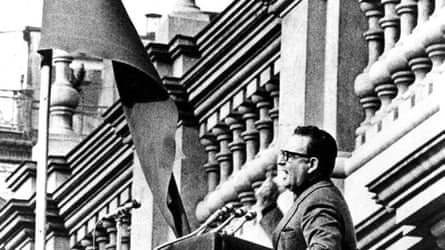
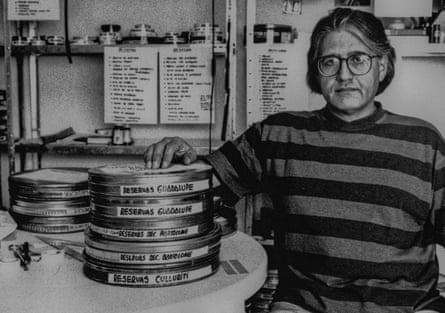
The many reels of film shot by Guzmán and his team during the years of the Allende government and then at the point of the Pinochet coup were rescued from Chile by Harald Edelstam, the Swedish ambassador, who sent them in a diplomatic bag to Europe. They ended up at the film institute in Cuba, where they were edited by Guzmán over the following years to become La Insurreción de la Burguesía (The Insurrection of the Bourgeoisie, 1975), El Golpe de Estado (The Coup, 1976) and El Poder Popular (Popular Power, 1979).
Patricio was born in Santiago, the only child of an architect, Luis Guzmán, and his wife, María Lozanes, who was born in Chile of Bolivian parents. His first job was in a local advertising agency, which he left to study film at the Universidad Católica, before spending a year at the Escuela Oficial de Cinematografía in Madrid, graduating with a diploma in film direction in 1970.
After his return to Chile in 1971, he directed his first feature-length documentary, El Primer Año (The First Year), which dealt with the initial 12 months of Allende’s government and set him on the path to chronicling the momentous political events happening around him. As a film-maker he was acutely aware that if he did not record these events, the memory of them could be lost for ever.
After being exiled, Guzmán returned briefly to Chile in 1987, while Pinochet was still in power, to make a film for Spanish television, En Nombre de Dios (In the Name of God), based on the work of Vicaría de Solidaridad, a Catholic human rights organisation that was one of the few institutions willing to help victims of the dictatorship.
He never returned to live permanently in the country of his birth, but in 1997 he went back again to interview some of the people featured in his trilogy. The result was Chile: La Memoria Obstinada (Obstinate Memory), a first-person narration exploring the effects of the coup and the years of dictatorship on individual and collective memory.
When Pinochet was detained in London in 1998, Guzmán was quick to take the opportunity to film subsequent events. The result, in 2001, was El Caso Pinochet (The Pinochet Case), based around the testimonies of women who suffered during his dictatorship. This was followed in 2004 by Salvador Allende, a clear-eyed appraisal of the president’s qualities and failings.
Guzmán’s later career included another trilogy, in which the exploration of Chilean history and the vital importance of preserving memory replaced direct political engagement.
The first of the three, Nostalgia de la Luz (Nostalgia for the Light, 2010), was shot in one of the worlds’ driest regions, the Atacama desert in the north of Chile, where telescopes seeking the origins of the universe are contrasted with women who are searching nearby for remains of the victims of a concentration camp from the 1970s. Guzmán concludes: “Those who have memory can live in the fragile present moment. Those who have none don’t live anywhere.”
In the second, El Botón de Nácar (The Pearl Button, 2015), the long coastline of Chile is depicted as witnessing two genocides – that of the Indigenous people of Tierra del Fuego in the early 20th century, and the bodies of torture victims dropped into the ocean.
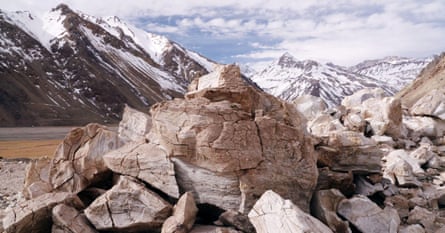
The third is La Cordillera de los Sueños (The Cordillera of Dreams, 2019), a cordillera being a chain of mountain ranges. It focuses on another element, the earth, as represented by the Andes mountains running the length of Chile, and is more autobiographical, as Guzmán revisits scenes from his childhood.
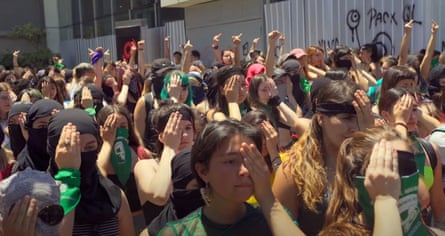
His last completed full-length film, Mi País Imaginario (My Imaginary Country, 2022) returned to more contemporary themes. In it he portrayed the mass anti-government protests of 2019-20 in Chile through the eyes of female activists, his aim being to show “how a whole people had woken up 47 years after Pinochet’s coup in a so-called social outburst”.
Over a career spanning five decades and 30 films, his work won numerous international honours, including a Silver Bear award in 2015 for best screenplay at the Berlin International film festival for The Pearl Button. In August 2023, on the 50th anniversary of the coup, Chile’s ministry of culture awarded him the National Prize for Performing and Audiovisual Arts, the country’s highest artistic honour.
Guzmán is survived by his wife, Renata Sachse, and two daughters, Andrea and Camila, from his first marriage, to Pamela Urzúa, which ended in divorce.