This post was originally published on here
“It Ends with Us” author Colleen Hoover isn’t typically in the business of making women look bad (male writers have all but cornered that particular market since before the invention of the printing press), which is why it’s so curious that the latest movie adapted from her books seems determined to convince us that its title character — a grieving mother who’s been rendered catatonic by a recent car crash, and now requires full-time care from the stern Ukrainian nurse who tube-feeds her in between diaper changes — is actually a demon bitch from hell. Anne Hathaway would never! … or would she?
Faithfully adapted from Hoover’s 2018 bestseller of the same name, Michael Showalter’s “Verity” is a ludicrous psycho-thriller as cold and tart as the wine cocktail that should come free with every ticket. It’s also a film whose enjoyably contrived pleasures, like those of its source material, hinge upon the fact that people are eager for any excuse to look down on a successful woman. And while men are eternally GOATed in that regard, women are just as capable of falling into that trap — especially when they feel that another woman’s success came at the expense of their own. Human nature! Gotta love it.
Related Stories

Indeed, it’s “local author” Lowen Asleigh (Dakota Johnson) who scoffs at the idea of ghostwriting the next installment in Verity Crawford’s ultra-popular book series. It’s Lowen who rolls her eyes at the kind of airport paperbacks that have since made Hoover into a millionaire several times over, and Lowen who grows addicted to the unfinished autobiography that she finds on a USB stick inside a locked drawer of Verity’s writing desk — a self-excoriating but utterly remorseless memoir in which Verity outs herself as one of the book world’s biggest “monsters” since the days of Cathy Ames.
But… we get it. I mean, of course we feel bad that Verity’s young daughter was killed in a canoe accident, even though Nick Antosca’s script reduces the scale of the tragedy as it’s presented in the novel, but the part of our brains that’s been corrupted by true-crime (in addition to centuries of misogynistic suspicion) can’t help but look sideways at the mom for surviving the same event.
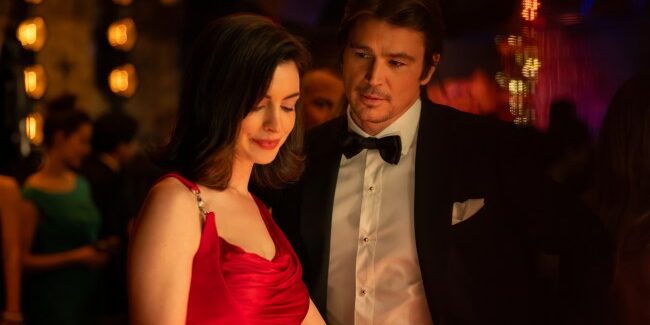
Verity built an empire on trash, fell victim to the plot of a bad melodrama, and then drove headfirst into a tree shortly thereafter, abandoning her dreamboat ultra-DILF of a husband (Josh Hartnett as Jeremy Crawford) to solo parent their son in the cavernous glass Jens Quistgaard mansion that her “violent miracle of a career” bought for the family somewhere in upstate New York.
And then there’s the Anne Hathaway of it all. The equally beautiful Lowen might resent Verity for leveraging her looks wherever she could (even in her audio books, which the lit phenom recorded in a cartoonishly pornified voice), but we sense that she also resents Verity for wasting them. For leaving such a picture-perfect life behind. If she didn’t to begin with, she certainly does after reading the part of Verity’s memoir where she writes about her attempts to murder her children in their cribs when they were babies — not because of any diagnosable postpartum condition, but simply because they kept pissing her off when they cried. Why shouldn’t Lowen, who’s sweet toward Verity’s son, horny for her husband, and likely no less talented of a writer, take hold of this half-abandoned fairy tale for herself?
We certainly want her to, and half — or maybe even most — of the fun in “Verity” comes from sharing Lowen’s perspective as she’s seduced towards drastic measures while staying with the Crawfords for research. Showalter isn’t particularly convincing as a horror craftsman (despite being set in a house straight from Ari Aster’s dreams, the movie often confuses sterility for ominousness, which is less than ideal in a story that should be bubbling with repressed desire just under the frozen lake of its surface), and “Verity” is more silly than scary whenever its dark strings give way to the sudden jolt of seeing Hathaway standing up or whatever (surely, Lowen must be seeing things), but the director does a patient job of watching the ice thaw between the ghostwriter and her broad-shouldered host.
Simultaneously playing into and off of his sociopathic comeback performance in “Trap,” Hartnett is tremendous as the kind-eyed trophy husband who’s paid a heavy price for his wife’s success. Convention says not to trust him, just as you should always be suspicious of anyone who somehow has both a dad-bod and an eight-pack at the same time, but there’s an innocence to Jeremy — a credit to Hoover’s writing — that Hartnett adamantly refuses to relinquish. And fans of the book’s character detail have no need to worry: As in the source material, everyone Jeremy has sex with is overcome with ecstasy that they compulsively start biting the headboard of his bed.
Johnson is even better in a role that might have seemed thankless in the hands of a less elusive and/or convincing actress. Lowen is more than a little thin on the page (it would be an understatement to say that the movie breezes past her mother’s recent death), but Johnson has an inimitable talent for palpably thinking through the truth of a moment, so that we can almost see Lowen’s empathy at war with her desires. Verity’s pain is her pain, until everything else that belongs to Verity starts to become hers as well. Also, Johnson’s hilariously gruesome first scene — which demands to be immortalized with a plaque or at least a pop-up photo-op on 41st and Park Ave. — triggered welcome memories of Luca Guadagnino’s sorely underappreciated “Suspiria” remake, which I’m reminded was also funded by Jeff Bezos. Running the Washington Post into the ground is just a hobby, his real passion is paying for people to cover Dakota Johnson in blood.
I fear that I’m making this lurid — if not quite lurid enough — airplane movie sound a bit more nuanced and high-minded than it is, but last year’s “The Housemaid” was a clear reminder that a good actress can elevate this kind of material high enough to enjoy at ground-level. “Verity” has two of them, and Hathaway seems to be having the time of her life going full succubus in the story’s melodramatic flashbacks. Slack-jawed but seething from Verity’s wheelchair, she invites us to project any number of raw emotions onto her vacant body, and though we know a series of ridiculous third act twists will shake up any of the assumptions we’re coerced into making along the way, it’s hard not to feel bad for Verity as Jeremy gently “Vertigo”s Lowen into a better version of his wife.
Ridiculous as those twists might be, however (and some of them strain belief even by the standards of a paperback thriller), the ultimate effect of the movie’s conclusions lies in how eagerly we’ve jumped to different ones along the way. Our brains are narrative engines that can’t help but fit the people we meet — and the stories we tell about them — into the molds and tropes that allow us to make some broken sense of the world. There’s a very real power in fiction, even the kind that “real writers” might tend to look down on, but most of it can be demystified by taking a beat and making room for ambiguity.
“Verity” would fall apart if it gave us that chance, but this well-furnished popcorn thriller crucially denies it from its characters as well, or at least encourages them to deny it from themselves. Does Lowen distrust Verity for good reason, or has she just been conditioned to resent her? The truth can be hard to swallow, which is all the more reason to chew on it first.
Grade: B-
Amazon MGM Studios will release “Verity” in theaters on Friday, October 2.