This post was originally published on here
When was the last time you saw a major studio release about a living movie star? In the last year, folk, rock and pop fans might have seen A Complete Unknown, with Timothée Chalamet as the young Bob Dylan, or Springsteen: Deliver Me from Nowhere, about the making of The Boss’s “difficult” 1982 album Nebraska. Or maybe you went deeper and saw Better Man, in which British singer Robbie Williams is played by an animated chimpanzee. It seems that movie stars, however, must wait — even Judy Garland, whose first and only big-screen biopic, Judy, arrived in 2019, 50 years after her death.
In the absence of a real flesh-and-blood A-lister, we have Jay Kelly, played by George Clooney in Noah Baumbach’s Netflix drama of the same name. Clooney himself has acknowledged that it was a tough role to cast (“Tom Cruise was busy”), but then, playing a fictional Hollywood movie star has always been a hard act to pull off. Here are 10 of the more noteworthy attempts — and, before you mention it, no, All About Eve doesn’t count. Fictional Broadway stars would be a whole other Top Ten…
Norma Desmond
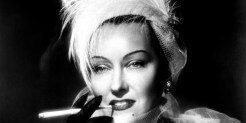
Gloria Swanson in Sunset Boulevard, 1950
Watch on Deadline
Gloria Swanson was just 50 years old when she appeared as Norma Desmond, the crazy washed-up relic of silent-era Hollywood in this famous film noir directed by Billy Wilder, in which she embarks on a deadly affair with Joe Gillis (William Holden), a younger, down-on-his-luck screenwriter, who she thinks will help her make a sensational comeback. Wilder’s film still packs a punch, now with an added and more timely subtext about the way Hollywood throws older actresses on the scrapheap, and Swanson plays a part that should have been way beyond her years. By this time, however, she had already been in the movie game for more than 30 years, making it perfectly acceptable for postwar viewers to believe the film’s most famous line of dialogue, one that resonates today: running by chance into her driveway, aspiring screenwriter, recognizes her and says, “You used to be big.” “I am big,” she replies. “It’s the pictures that got small.”
Alan Swann
Peter O’Toole in My Favorite Year, 1982
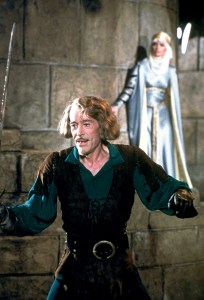
Strictly speaking, this is a movie about the golden age of television, but at the center of it is Alan Swann, a movie star on the way down who is booked to appear on a comedy show and entrusted to the care of a junior writer to keep him sober. Though the story was entirely fictional, the character of Swann was loosely based on Australian American actor Errol Flynn, the swashbuckling star of the ’30s and ’40s whose hellraising antics gave rise to the phrase “in like Flynn” and who wrote an autobiography appropriately called My Wicked, Wicked Ways. Much like Jay Kelly, the casting pool was limited, if the audience was going to buy into the character. Luckily, Peter O’Toole was available, the (hard) drinking buddy of such hedonistic legends as Richard Burton and Richard Harris. An early casualty of O’Toole’s lifestyle was Michael Caine, who went for dinner with the actor in 1959 and woke up two days later to find they had been banned from the restaurant. “Never ask what you did,” O’Toole told Caine. “It’s better not to know.”
Elsa Brinkmann
Kim Novak in The Legend of Lylah Clare, 1968
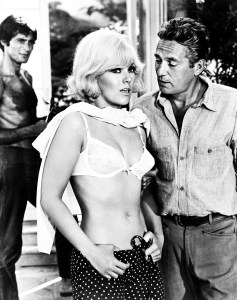
Just as she did in Vertigo, Kim Novak does double-duty in this almost hallucinogenic behind-the-scenes exposé of high-testosterone studio filmmaking (“A story of Hollywood as you always knew it would be,” warns the trailer). Only Rainer Werner Fassbinder could have made such a bizarre story into art, and director Robert Aldrich succeeded mainly in making a cult camp classic, but Novak’s performance is dazzling as a young actress who is plucked from obscurity to play the lead in a biopic of a major star who died in mysterious circumstances some 20 years before. In echoes of Vertigo, Novak’s character becomes consumed with the role she has been given, driven to drink and drugs by the men who try to control her. “What am I supposed to feel?” she asks the director of the movie-within-a-movie, played by Peter Finch. “Feel, you stupid cow?” he explodes. “All you have to do is what I say, and your feelings will be up on the screen.”
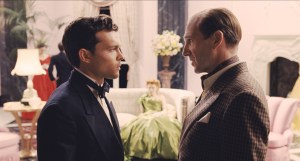
Hobart “Hobie” Doyle
Alden Ehrenreich in Hail Caesar!, 2016
The Coens first broached Hollywood in their macabre 1991 Cannes hit Barton Fink, in which a pretentious New York playwright suffers a breakdown while trying to write a commercial script, and their return to la-la land was just as perverse. To anchor Hail Caesar!, a tale set in the Golden Age of the early ’50s, the brothers devised a character based on Eddie Mannix, an MGM executive who worked behind the scenes as a firefighting “fixer”, keeping the indiscretions of his studio’s talent out of the gossip columns. Played with grim determination by Josh Brolin, Mannix has a lot of news to bury, including a kidnapping and an out-of-wedlock pregnancy, but perhaps his biggest challenge involves trying to persuade director Laurence Laurentz (Ralph Fiennes) to cast cowboy superstar, Hobart “Hobie” Doyle (Alden Ehrenreich) in lieu of Clark Gable. “This is a drama, Mannix, a real drama,” Laurentz protests. “It’s an adaptation of a Broadway smash. It requires the skills of a trained thespian, not a rodeo clown.” Hobie proves him right, and Ehrenreich has a great time mangling the line “Would that it were so simple!”
Blanche Hudson
Joan Crawford in Whatever Happened to Baby Jane?, 1962
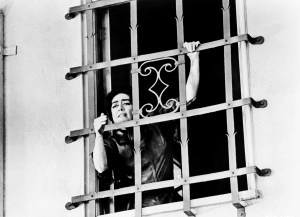
In Hollywood movies about Hollywood, filmmaking has a bizarre effect on women’s sanity that doesn’t seem to affect men, and it’s sobering to reflect that its warring stars Bette Davis and Joan Crawford were 54 and 58 respectively when Whatever Happened to Baby Jane? was first released, starting a trend now cruelly known as “hagsploitation”. Though Davis played the title role — on the skids like Norma Desmond, a precocious music-hall child prodigy who no one now remembers — the real star is her disabled sister Blanche (Crawford), an actress whose fame is being revived by reruns of her old movies on TV. In a reversal of Baby Jane’s fortunes, Davis got the limelight and an Oscar nom, which her co-star grudgingly accepted. “Sure, she stole some of my big scenes,” said Crawford, “but the funny thing is, when I see the movie again, she stole them because she looks like a parody of herself — and I still looked like something of a star.”
Gil Shepherd
Jeff Daniels in The Purple Rose of Cairo, 1985
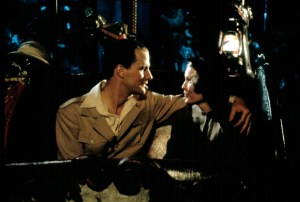
In happier times for Woody Allen and Mia Farrow they made The Purple Rose of Cairo, a return of sorts to the “early, funny” movies that he referenced himself in 1980’s Stardust Memories. The conceit is one of Allen’s best, and, unlike a lot of his later films, it holds up all the way through. In 1935, New Jersey waitress Cecilia (Farrow) escapes the harsh reality of her unhappily married life by going to the movies. Watching a hokey adventure movie, also called The Purple Rose of Cairo, she falls in love with the film’s hero, Tom Baxter. It’s all just fantasy until one day Baxter meets her eye and comes out from the screen, even inviting her back into the film for “a madcap Manhattan weekend” (cue a ’30s-style montage of dancing, neon signs and corks popping). This does not sit well with the studio, which sends Gil Shepherd (Jeff Daniels) — the actor who plays Tom Baxter — to sort it all out. Shepherd convinces Cecilia she is in love with him, not Tom Baxter, giving a bravura performance that proves as fake as the palm trees in his movie.
Daisy Clover
Natalie Wood in Inside Daisy Clover, 1968
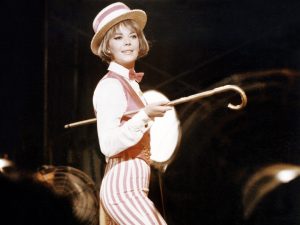
“Wish me luck — I’m gonna make some noise in the world!” Natalie Wood certainly turns up the volume in this seamy exposé of the tinseltown production line, playing a teenage girl plucked from the rundown beachside shack she shares with her elderly mother and propelled toward the big time. Despite being a sassy, violent tomboy, her hair cut short into a scruffy, dirty-blonde beatnik bob, Daisy falls for all the traps that come her way, from the manipulative producer-manager (Christopher Plummer) to the unfaithful, predatory lover (Robert Redford). Wood certainly knows how to go from rags to riches, scrubbing up well for the inevitable transformation, even if some the musical numbers — notably “The Circus is a Wacky World” — leave a lot to be desired.
Rick Dalton
Leonardo DiCaprio in Once Upon a Time… In Hollywood, 2019
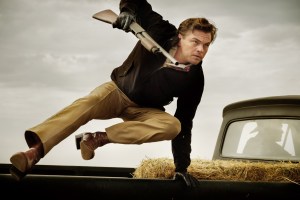
In 1969, in stark counterpoint to the likes of Norma Desmond and Baby Jane Hudson, TV western star Rick Dalton, played by a middle-aged Leonardo DiCaprio, manages to accept the unwelcome news of his waning fame without becoming a) delusional and b) homicidal. “It’s official, old buddy — I’m a has-been,” his character tells his friend and long-time stuntman Cliff Booth (Brad Pitt) at the start of Quentin Tarantino’s still most recent film. But like a lot of actors of his generation, Dalton learns that sometimes you have to go away to come back, which is why he parlays his skills into the burgeoning Italian exploitation market, following the trail blazed by Clint Eastwood, in films like the spaghetti western Nebraska Jim and the police thriller Operazione Dyno-O-Mite.
Eddie Murphy in Bowfinger, 1999
Kit Ramsey
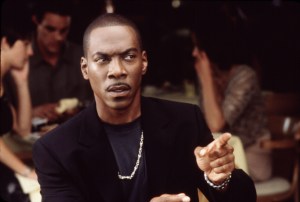
On the basis of Saturday Night Live alone, Eddie Murphy was a household name in the USA, celebrating his 21st birthday in 1982 with an all-star party at New York’s Studio 54. After the subsequent success of the Beverly Hills Cop movies he became an even bigger deal, something he was able to satirize even before he turned 40 in the Steve Martin-scripted comedy Bowfinger. The conceit is that director Bobby Bowfinger (Martin) has promised Universal Pictures a movie that will bring the legendary Kit Ramsey (Murphy) out of semi-retirement. But when Ramsey turns him down, Bowfinger hires a lookalike (also Murphy) and shoots his movie guerilla-style, without Ramsey’s knowledge, using a cast of extras — who all believe that Ramsey is deep in character — to spin a story about an alien invasion (“Did you know Tom Cruise had no idea he was in that vampire movie ’til two years later?” Bowfinger tells them). The result is one of Murphy’s most underrated and certainly most self-deprecating performances.
Doris Mann
Shirley MacLaine in Postcards From the Edge, 1990
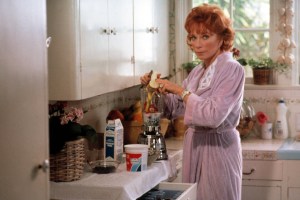
Carrie Fisher and her mother Debbie Reynolds were as close in death as they were in life, the latter passing away just one day after her daughter. It wasn’t always plain sailing, however, as Fisher suggested in her debut novel, Postcards From the Edge, the semi-autobiographical story of an actress in recovery after a drug overdose. Turning the book into a film was an inevitability, but who could fill those shoes? In retrospect, the answer now seems blindingly obvious: Meryl Streep as Fisher’s heroine Suzanne Vale and Shirley MacLaine as her overbearing actress mother Doris. Streep was on fire at the time, and the role brought with it her ninth Oscar nomination. But it’s MacLaine who steals the show as the wily and not-entirely-blameless Doris. “I know that she does these things because she loves me,” laments her daughter. “I just can’t believe it.”