This post was originally published on here
Welcome to Memory Holed, a new column from MovieWeb deputy editor and film critic Britt Hayes (that’s me). Each week, I’ll revisit the movies (and occasionally TV shows) that were culturally relevant for a brief time before collapsing into obscurity. Whether they were notable for having high-profile casts, generating awards-season buzz, using popular IP, stirring controversy, igniting discourse, or any combination of the above, these movies have been deliberately erased from the pop-culture consciousness. In other words: they’ve been memory-holed.
In 2013, Tomorrowland had all the potential in the world: George Clooney, a script by Lost vet Damon Lindelof, and a story connected to Disney’s retro-futuristic history. It also had an exciting filmmaker in Brad Bird, the director of The Iron Giant and The Incredibles, who had recently transitioned to live action with Mission: Impossible – Ghost Protocol. By the time it hit theaters in 2015, little of that initial excitement remained. Reports of extensive rewrites, which began in pre-production and continued through lengthy reshoots, undermined confidence in Bird’s second live-action feature, as did Disney’s reliance on Mystery Box marketing – which included a literal mystery box unpacked on stage at D23 – and the studio’s reputation for exhaustively mining its IP.
Tomorrowland underperformed at the box office, barely recouping its reported budget of $180-190 million (sans marketing costs) and almost instantly getting chucked down the memory hole.
Which is too bad, because 10 years after its release, Tomorrowland is a much better film than it was given credit for at the time. Despite its narrative flaws, Bird’s film is an entertaining throwback to kids’ sci-fi adventure movies of the ’80s and ’90s – the kinds of movies that didn’t condescend to their audiences and which emphasized a sense of wonder that has since been lost to time. Movies like Explorers, E.T., The Neverending Story, and even The Iron Giant. Its failures are the result of an ironic meta-narrative about self-fulfilling prophecies and cynicism, and a self-mythologizing studio resistant to ceding creative control to actual creatives (a problem that only intensified over the next decade).
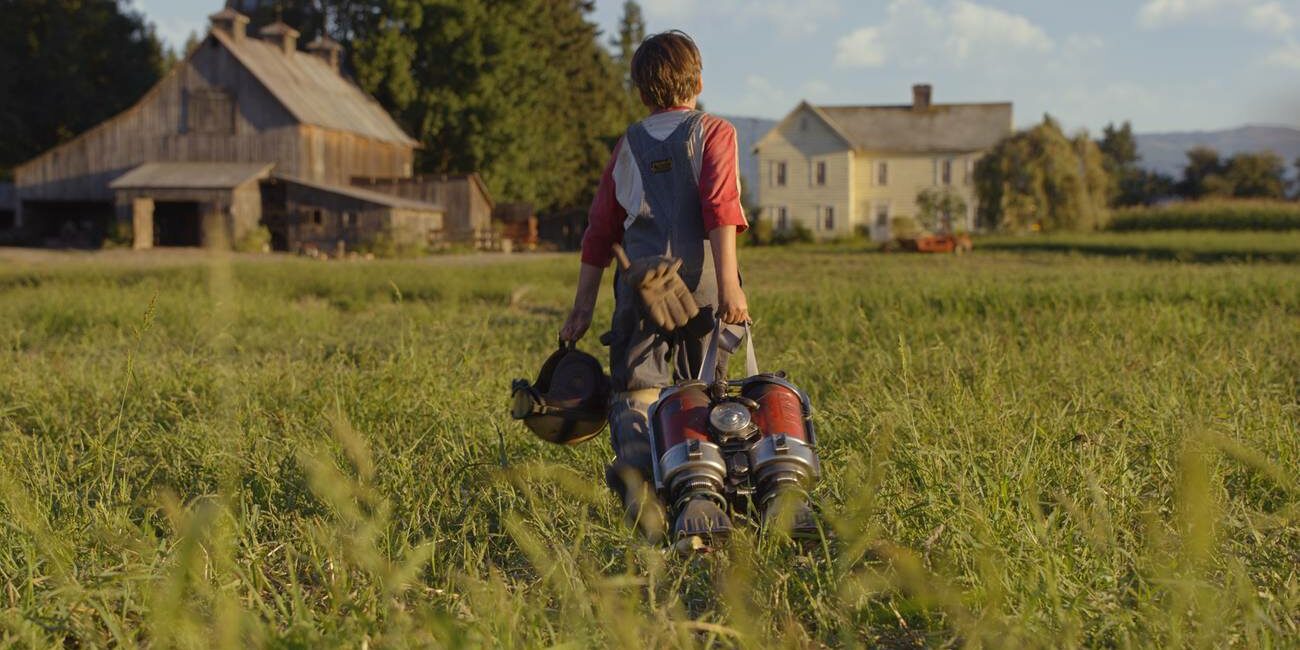
Tomorrowland begins in 1964 at the New York World’s Fair, where young Frank Walker’s ambitious jet-pack prototype is dismissed for being faulty. Frank is approached by a young girl named Athena (Raffey Cassidy), who offers him a special pin with a “T” on it that grants him access to a secret area underneath the “It’s a Small World” attraction, where he’s transported to Tomorrowland – an awe-inspiring retrofuturistic utopia where a giant robot fixes his jet pack.
In the present day, Casey Newton (Britt Robertson) is an idealistic teen whose stealthy attempts to prevent NASA from dismantling a launch site land her in jail. Collecting her belongings on the way out, Casey finds a mysterious pin emblazoned with the letter “T” that instantly transports her to Tomorrowland. At first, it seems like Tomorrowland is a parallel universe, and there’s a great extended sequence in which Casey tries to find her way to the center of the city, only to run face-first into a wall or tumble down the stairs as she moves through both worlds simultaneously.
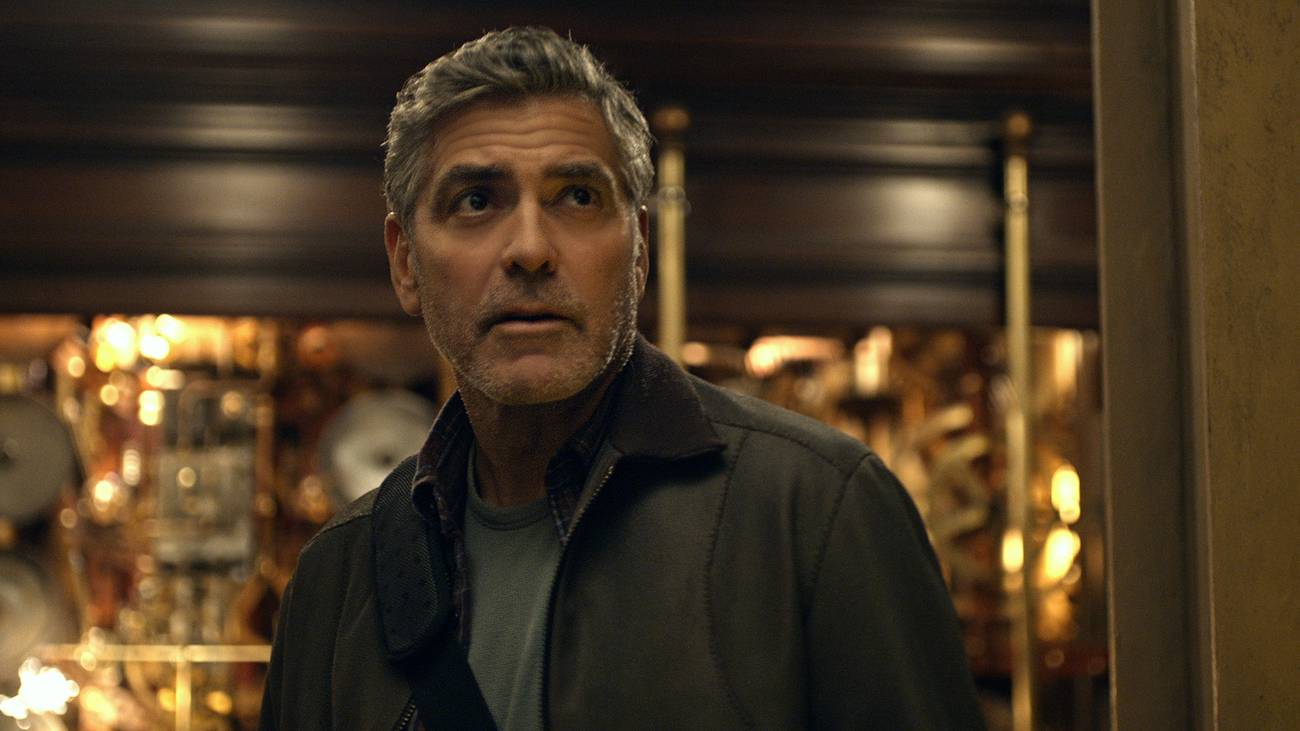
The past and present collide when a seemingly ageless Athena re-emerges, revealing herself to be an Audio-Animatronic programmed to recruit Dreamers who could help save Tomorrowland. She drops Casey off at the rural home of a now-adult Frank Walker (Clooney), and the pair evade a series of uncanny, militant animatronics on their way back to Tomorrowland – the real Tomorrowland: as Frank explains, the version Casey encountered when she touched the pin was actually just a virtual invitation to a “party that was canceled” and a world that has since fallen into dystopia.
Walt Disney Studios Motion Pictures
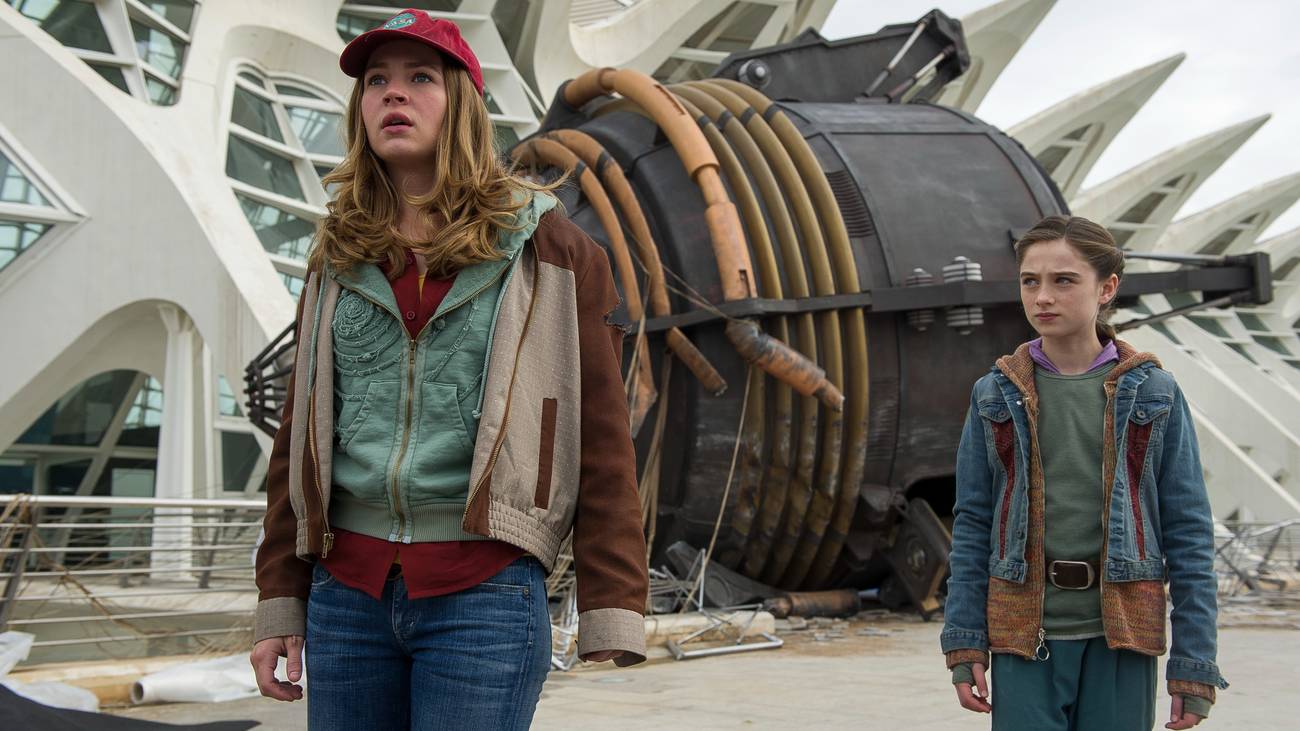
In one of the film’s best sequences, Casey, Frank, and Athena teleport to the Eiffel Tower, where Tomorrowland’s founders – Nikola Tesla, Thomas Edison, Jules Verne, and Gustave Eiffel – hid a rocket, The Spectacle, that could transport them to the futuristic utopia they created in another dimension. The Eiffel Tower’s structure pulls apart as the rocket emerges, sending the trio hurtling through space and time to a very different version of Tomorrowland, where the once-sleek and shiny metropolis is now scuffed and dingy, overrun by vegetation and largely abandoned.
Bird does excellent work contrasting the heightened artifice of Tomorrowland in its earlier scenes with its dystopian counterpart, where the flaws add a tangible quality to the architecture. But Bird’s direction really shines when he utilizes the skills that made him a great animator; his action scenes are kinetic and his use of perspective feels inventive, as if unhindered by the constraints of the live-action medium. A run-in with a pair of villainous animatronics (played cartoonishly by Kathryn Hahn and Keegan-Michael Key) ends with the explosion of a bomb that freezes time, trapping them in a temporal dome, their hair and limbs comically splayed.
You can just tell that an animator directed this film, and more than once I wondered why and how Disney hadn’t hired him for Star Wars (they tried with Episode VII). There are also several effective comedic moments throughout, though none as hilarious as Athena getting hit by a truck. Although played by a child actor, she’s still technically a robot, which allows Bird to get away with a little mischief.
Walt Disney Studios Motion Pictures
We ultimately learn that Frank invented a tachyon machine that predicted exactly when the world would end, and that Tomorrowland’s governor, David Nix (Hugh Laurie) projected the inciting catastrophes – climate disasters and war – to the outside world in an attempt to inspire people so that they might do what is necessary to avoid an apocalypse. But Nix’s plan had the opposite effect: people resigned themselves to the inevitable and gave up, and as the concept of the end of the world became hyper-normalized, few felt empowered to stop it.
It’s almost impossible to imagine Tomorrowland being made by a major studio today. There are fewer live-action films targeted at a young adult audience, and family-friendly movies have gone the way of comedies, which must now be action films starring muscular leading men. Even the comedic actors are required to be at least somewhat ripped. More than that, it’s hard to imagine an optimistic story with a simple message of hope being made in the post-Trump era. Tomorrowland arrived in May 2015, over a year before Trump’s first presidency began. There was a brief period in the intervening years, during the Biden administration, when we collectively felt a tentative swell of hope, a rebound to the isolation of the pandemic, which reinforced our country’s worst individualist tendencies (among many other things, the scope of which is impossible to thoroughly address here).
In his second term, Trump has swiftly decimated efforts to combat climate change, worsened our relationships with other countries, revoked international aid that helped address starvation and disease (resulting in hundreds of thousands of avoidable deaths), and doubled and tripled down on destructive environmental policies – opening protected wildlife reserves for oil drilling, restricting tax credits for green energy, issuing executive orders that outright reject or deny decades of scientific research (while eliminating or inhibiting further research in environmental and medical science), and so on.
And the elected officials who should be fighting these policies are instead seemingly resigned to our inevitable destruction, acting as if there’s no use in even trying to fix it at all.
Walt Disney Studios Motion Pictures
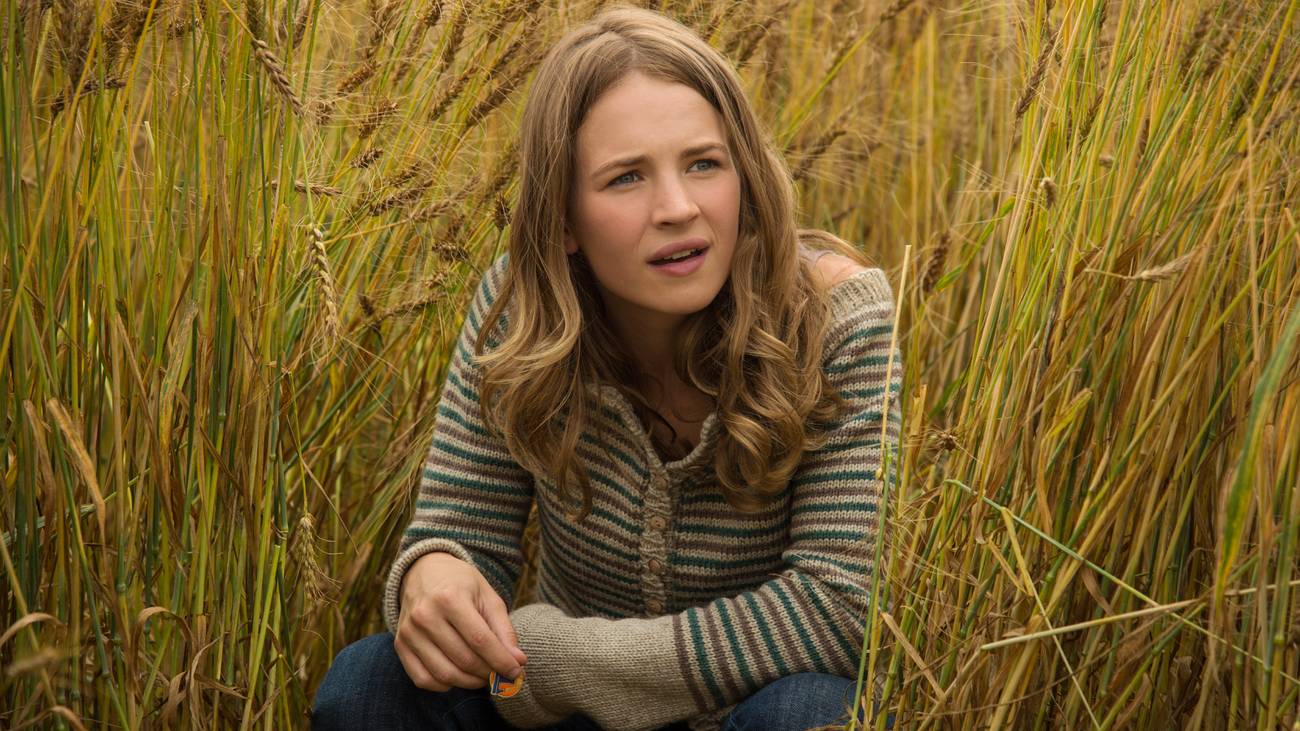
During an early montage in Tomorrowland, we see Casey sitting through a series of classroom lectures about all the ways in which our world is doomed: climate change, the ever-looming threat of war and the fallout from weapons of mass destruction, and all the lessons we’ve yet to learn from dystopian fiction. In each class, Casey’s eagerly raised hand is ignored by her teachers, until finally, one begrudgingly calls on her. “What are we doing to fix it?” Casey asks. The question feels so incredibly quaint, it’s almost naive. But it’s a fair question.
The answer, according to Tomorrowland, is to find the people who haven’t given up. Not the “visionary” technocrats, who are prone to hoarding the fruits of their (outsourced) labor, shutting the rest of the world and all its possibilities out so that they may one day die alone, entombed in sterile underground bunkers – uncanny, lifeless facsimiles of a world they could have saved. We need to find the people who, despite the crumbling world around them, maintain a sense of curiosity, optimism, hope, and a determination to show up for their communities, in ways big and small, every day.
Tomorrowland has some fairly significant flaws, chief among them a framing device that was obviously forced onto the narrative during reshoots. As has since been confirmed, several plot elements and entire characters were excised from the film, including additional sequences that would further illuminate the history of Tomorrowland, and Judy Greer, whose portrayal of Casey’s mom was reduced to a cameo. There’s a tension between the film’s overall story and its smaller character moments; it feels alternately disjointed and too expository. Damon Lindelof has always been more successful with serialized storytelling. The Leftovers and Watchmen perfectly blend his genre ambitions with character-driven stories, while Star Trek Into Darkness and The Hunt demonstrate his struggles with developing multiple characters under the time constraints of feature-length films.
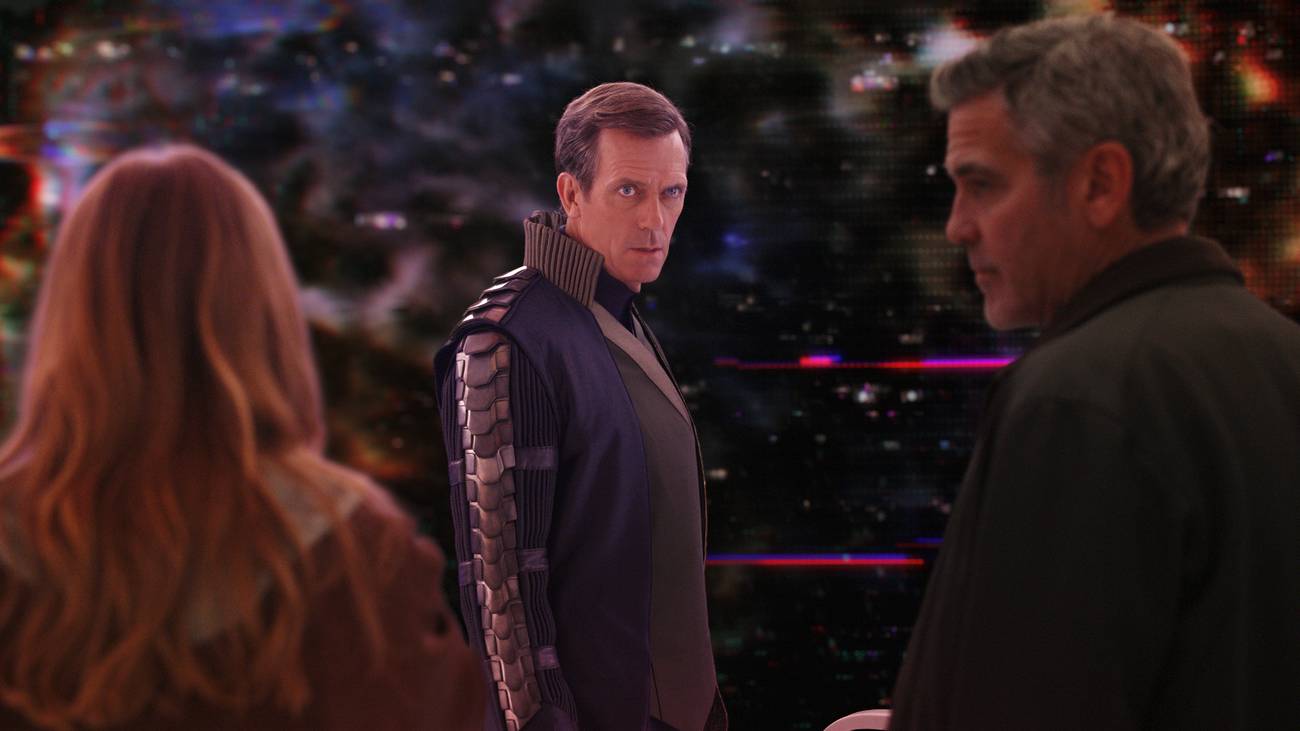
Walt Disney Studios Motion Pictures
And then there’s that pesky aforementioned meta-narrative: Audiences had grown tired of the Mystery Box marketing popularized by Lindelof cohort J.J. Abrams, so Disney’s use of an actual, physical Mystery Box to promote Tomorrowland backfired. Nothing inside that box could possibly be as exciting as participating in the fervent speculation about what might be in it. Potential viewers had also been trained to perceive rewrites and reshoots – common parts of the filmmaking process – as evidence of a bad movie. Audiences had resigned themselves to Tomorrowland‘s failure sight unseen. In its own way, Disney had too, by failing to market the film on its own terms and instead promoting the illusion of what it might be.
Even still, the best parts of Tomorrowland – its good-natured optimism, its awe-inspiring moments of possibility, and its creative direction – supersede its narrative shortcomings. I recently said that the hidden goal of this column might be to find a movie that’s been unjustly memory-holed. I can’t believe I already found one.