This post was originally published on here
Iceland Review publishes selected commentary from contributors writing under collective or anonymous bylines.
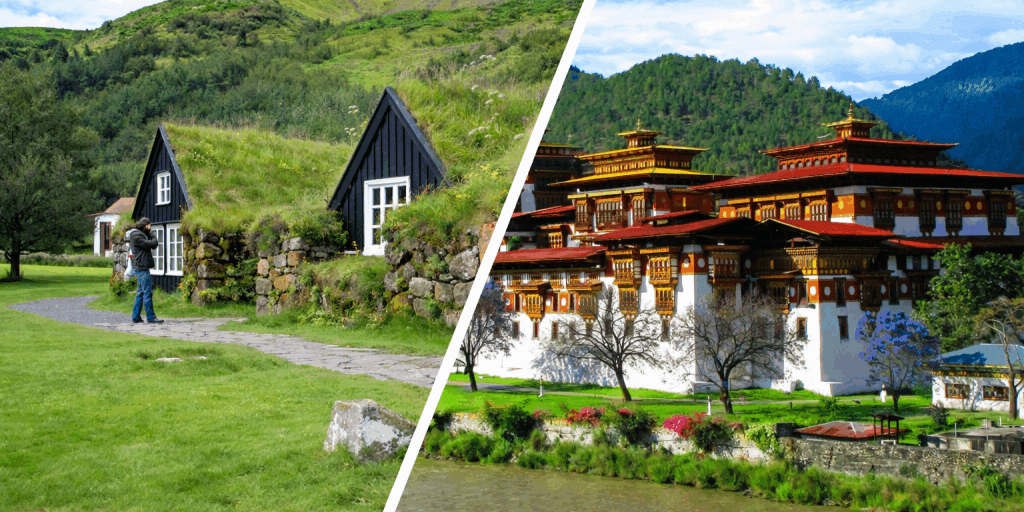
In a recent article in local media comparing so-called “mountain nations,” Iceland has been held up alongside Bhutan as a country that might benefit from a different approach to tourism and development.
Those making the comparison point to Bhutan’s location in the Himalayas and its deliberately restrictive tourism model, which emphasises “high value, low volume” travel.
Central to their argument is the concept of Gross National Happiness, as well as a daily Sustainable Development Fee of around $100, intended to limit visitor numbers while funding public services and environmental protection. At first glance, the idea is an appealing one. It suggests balance, restraint, and a clear set of national priorities. The reality in Iceland, however, is markedly different.
In Reykjavík, tourism has grown rapidly over the past decade, reshaping daily life and infrastructure in visible ways. Rental cars are now a familiar sight on city streets, and visitor numbers far exceed those seen in similarly sized countries. The question, then, is not whether Bhutan’s model is admirable, but whether it could ever be meaningfully transferred to Iceland’s economic, social, and geographic realities….
Here’s the short answer. No, it could not.
Two Very Different Tourism Experiments
Bhutan’s economic strategy is built around strict limits on visitor numbers.
By capping tourism, the country has prioritised environmental protection and cultural preservation, ensuring that infrastructure and public services are not overwhelmed. Tourism remains deliberately small in scale, tightly managed.
Iceland has taken a different path. Since 2010, annual visitor numbers have risen from around 500,000 to more than two million, transforming tourism into one of the country’s most important economic pillars.
This growth has brought a level of economic diversification that is difficult to ignore. Rather than remaining confined to a narrow sector, tourism has spread across the workforce, reshaping how many Icelanders earn a living. Fishing communities have added tourism services; rural areas have developed accommodation and transport businesses; individuals often combine multiple roles to sustain year-round income.
As a result, tourism now accounts for roughly 9% of Iceland’s GDP and around 30% of export revenue. Its influence extends well beyond hotels and tour operators, supporting innovation in food production, transport, design, and technology.
Iceland did not simply expand an existing industry. It built an interconnected economic system that reaches into nearly every corner of society, providing foreign currency, employment, and resilience in a country with few traditional export options.
A Question of What Pays for What
Bhutan places a strong emphasis on measuring wellbeing, using concepts such as Gross National Happiness to guide policy decisions.
In Iceland, by contrast, economic indicators tend to be more immediate and practical, reflecting the cost of living and the ability of residents to secure housing and long-term stability.
Bhutan’s tourism fees are used to fund public services, including healthcare and education, within a tightly controlled system. Iceland has taken a broader approach. The rapid growth of tourism over the past decade has generated substantial foreign currency inflows, which have helped support not only the tourism sector itself but a wider ecosystem of economic activity.
That revenue has played a role in the expansion of Iceland’s technology sector, creative industries, and emerging fields such as biotechnology. While visitors may arrive for natural attractions, their spending has contributed to diversification well beyond hotels and tour operators.
At its core, Bhutan’s tourism model relies on restriction, with high entry costs limiting access. Iceland’s approach has been comparatively open. Travel to the country is accessible to a wide range of visitors, and tourism operates within a market-driven framework rather than a quota-based system.
Rather than relying on a single wellbeing metric, Iceland’s model prioritises economic vitality as a means of sustaining life in a remote, environmentally challenging location.
For a small nation in the North Atlantic, maintaining a strong, adaptable economy has been central to that goal.
Preservation Versus Pressure
There is a risk in treating a country primarily as something to be preserved rather than allowed to evolve. When protection becomes an end in itself, change slows, and society can begin to resemble a static exhibit rather than a living system.
Iceland has taken a different approach. The country has absorbed rapid growth and tested the limits of its infrastructure, environmental management, and planning capacity. This process has not been smooth, and it has at times exposed weaknesses, but it has also driven adaptation and investment.
The result is not always orderly. Visitor pressure is uneven, and parts of the country experience congestion, particularly during peak seasons. Yet the system remains dynamic. Tourism has brought new residents, expanded the labour market, and accelerated the development of services and facilities that would not otherwise exist at this scale.
Rather than focusing primarily on cultural preservation through restriction, Iceland has prioritised participation and economic integration. International workers have become part of everyday life, large-scale developments have reshaped parts of the landscape, and tourism revenue has helped stabilise the króna and support broader economic resilience.
This approach carries risks, but it reflects a deliberate choice to remain flexible, responsive, and economically engaged with the wider world.
What This Means for Iceland
Bhutan will continue to prioritise limited access and tightly managed tourism, an approach that aligns with its own social and economic goals.
Iceland, however, has chosen a different path.
Welcoming around 2.5 million visitors a year, the country has built a substantial service sector and positioned itself as a major destination for travellers moving between continents.
For a small nation with few natural exports beyond energy and seafood, tourism has become a practical source of income, employment, and foreign currency. While concepts such as wellbeing and quality of life matter, they must be supported by an economy capable of sustaining them.
In Iceland’s case, openness and economic activity have been central to that balance.
Quick Economic Reality Check:
- Iceland GDP per capita: ~$82,000 (Top 10 globally).
- Bhutan GDP per capita: ~$3,800.
- Iceland’s Tourism: 8.8% of GDP, supporting 22,000+ jobs.
- Bhutan’s Tourism: ~5% of GDP, with significant “brain drain” as youth move abroad for better opportunities.
Unlike in previous decades, Iceland may now feel busy at times.
But the economic stability that tourism provides has allowed the country to remain resilient in a challenging global environment.