This post was originally published on here
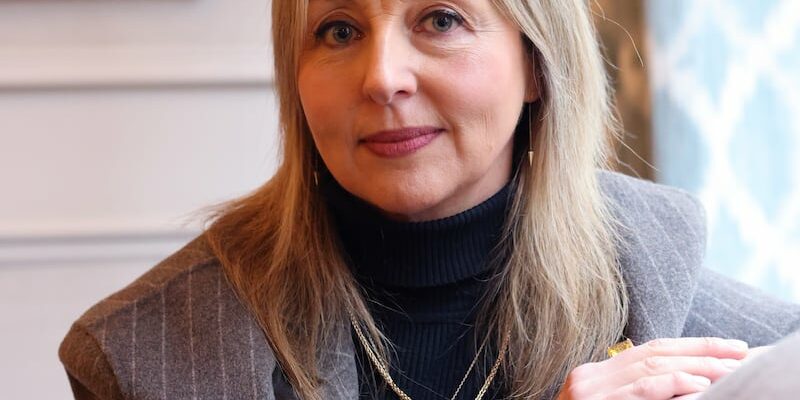
On a rainy day in a rainy month in Dublin, Edel Coffey sits in a quiet corner of a city-centre hotel, dressed all in black, but emanating sunshine. The author, until recently books editor of The Gloss magazine, and a regular contributor to these pages, is explaining the concept of a shadow artist.
“It’s where you know, deep down in your heart, that you’re a writer, a singer, or whatever the creative thing is that you love. But you kind of approach it, because you’re too afraid to go directly for it, or you don’t think it’s for you,” she says.
Coffey, whose third novel, In Glass Houses, is published this month, spent many years circling the thing she loved. A lifelong bookworm, she dreamed of studying English at Trinity College Dublin. But when the time came, she obeyed her head, choosing communications at DCU. She went on to build a successful career in journalism, working variously as a reporter, columnist, editor and radio presenter/researcher for several media outfits, always orbiting the world of books and arts, even doing a stint as a books’ publicist, but never the thing itself: writing novels.
“This is the hilarious thing. I had lots of opportunities,” she confesses.
About 2009, one of the “big-five” UK publishers (an industry term for the dominant publishers in the market: Penguin Random House, Hachette, HarperCollins, Simon & Schuster and Macmillan) approached her looking for a book.
“I went and had lunch with them in London,” she recalls. “They said: this is the editor you can work with, so just deal with her directly. And I went home. And I didn’t write it.”
Whether she was “rigid with fear” or “completely creatively dead”, she is not sure. Nevertheless, the offers kept coming. Some time later, another English editor got in touch, on the lookout for a young journalist to write autofiction.
“Again, they were like: we’d love to work with you. And again, I went off and was like: I can’t do this.”
Her creative energies were instead channelled elsewhere. For much of her 20s and early 30s, alongside her day job, she played in bands: singing, playing guitar, often finding herself on the same bill as Booker Prize-winner Paul Lynch, then in a Muse-like ensemble of his own.
“There’s such a crossover, actually, I’ve noticed, between certain people my age in Dublin who played in bands and are now writing novels,” she says, listing the likes of Patrick Freyne, Anna Carey and her one-time bandmate Rónán Hession, author of the recently adapted for TV Leonard and Hungry Paul, among others, but, to her, forever Mumblin’ Deaf Ro.
Aged 37, Coffey had her first child and moved from Dublin to her husband’s hometown of Galway. Within 18 months, she had two daughters, as well as two stepsons, and life moved through a key change.
“It was the first time in my adult life that I had not been working at a crazy pace,” she says. “I had a really tough time stopping. I completely identified myself as a journalist. I know it’s not very woke or progressive to identify completely as your job, but I do.”
She felt the simultaneous widening and narrowing of opportunity: work and social calendars emptying, but motherhood consuming all her attention.
“I thought, okay, it’s two-pronged. First, I was terrified that I would never write the book because I have no time here; the children had just taken over my life completely,” she says. “And second, I really missed that creative, intellectual engagement with writing I’d had through my job.”
I feel like [life] is a computer game in many ways – you get through this level and then you get on to a harder level; you level-up
— Edel Coffey
In this strange conundrum, a tentative beginning took place.
“It didn’t happen overnight. I didn’t start writing the book until my youngest daughter was in Montessori, so she was nearly three. I just remember being very frustrated that I hadn’t done this yet, and this awareness that if you don’t do it now, you’re probably not going to.”
Letting go of ideals of perfection, brilliance and optimal conditions, she wrote in short stints – as she waited for school pick-up, for example, or instead of looking at social media.
“Every time I opened a social media app, I used that as a kind of a trigger,” she says. “[I’d say], okay, instead of doing this, you’re going to write. […] That’s how I did the first book. It was a process of sheer frustration with myself.”
Breaking Point, an emotional yet pacy thriller about an overburdened mother’s tragic mistake, secured Coffey a six-figure, two-book deal. It was acquired in 2020, just months after the death of Coffey’s mother, and published in early 2022. The experience was a surreal one, Coffey says.
“I remember the book deal coming and it being so big, to my mind, and feeling completely terrified and numb. It’s that thing of being scared when good things happen. I think it’s very common. I didn’t touch the money for a full year, because I was afraid that they’d made a mistake and I’d have to give it back.”
In Her Place, an ingenious take on the “other woman” trope, followed in 2024, and In Glass Houses, the first in another two-book deal, is published this month.
Three books in, does she feel she is getting into a groove?
“Do you know what, life is just so much flux and change, and every time you get the hang of something, it changes again,” she says. “I feel like it is a computer game in many ways – you get through this level and then you get on to a harder level; you level-up.”
In Glass Houses is set in the privileged world of the Manhattan elite, and with its twisty plotline wouldn’t be out of place among the slate of glossy book-to-screen crime dramas dominating streaming platforms. Opening with the image of a dead body floating in a sky-high transparent swimming pool, the book is a darkly glamorous tale of how the privileged exert power to protect their own. At its centre is a luxury skyrise, home to rich lawyers, developers, old money, and a proportion of “cost-rental lottery winners” who are forbidden from using the building’s premium facilities.
“We’ve got this almost apartheid system within the building. And I didn’t know this, but this actually happened in Dublin,” Coffey says, referring to a 2025 article on the website, dublinlive.ie, where social housing residents of a Grand Canal Harbour development claimed they had been denied access to amenities available to private tenants.
Class and its various stratifications were a central preoccupation of Coffey’s from the start.
“I wasn’t completely conscious of this, but now, three books in, I think I’m actually always talking about class, simply because of my background and my life,” she says.
Originally from the Dublin suburb of Ballybrack, a working-class neighbourhood right beside the salubrious Killiney, Coffey grew up very aware of how the other half live.
“We’d walk to the train station, and pass these huge mansions. Some of the houses had peacocks. And beautiful blue roofs. Amazing, phenomenal houses. I always remember being like: wow. From your little semi-D in your council estate, to that, you’re very aware of the different ways that people live.”
Education, work, marriage – each nudged Coffey into the milieu of the middle classes as life went on.
“The shift in class is interesting to me,” she says. “When I first started as a journalist, I wouldn’t ask questions that I should have asked because I felt I would expose myself if I [did]. So, if I was told to go somewhere on a job, I might be thinking: how am I going to get to the middle of Monaghan? I don’t have a car, the bus doesn’t go to Monaghan. But I wouldn’t [ask]. I was 22. Of course I wasn’t going to have a car. But in my head, I felt quite inferior.”
“I don’t want to overstate it,” she adds. “It’s not a trauma. These are small things, but they’re interesting things, because where do they come from? Where does that feeling of shame come from?”
One day, Coffey began to think about the notion of a person who killed someone but had never been caught. This coalesced with her thoughts and preoccupations on class, and so emerged the story of Juliet Fox, daughter of a rich property developer, whose murder was never solved. Twenty years on, Eddie, a journalist whose career was practically destroyed when she tried to solve the case the first time, finds herself drawn back in to its mystery.
“I think this book is actually about morality, and how morality changes [depending on] your position in the class system,” Coffey says. “Does your morality change if you know that you’re likely not going to be punished for what you do, or not punished severely, or going to be able to find a way out? And then also, there’s a difference when morality is applied to people who don’t have privilege.”
Beyond themes, Coffey has one major aim when she writes. She quotes a line from the digital newsletter Air Mail: “We choose our stories wisely to relieve your worldly woes.”
“That’s exactly why I read books. I read books so I don’t have to think about my own life for an hour, two hours. And that’s what I want to give to my readers: that sense of, I’m here to relieve your worldly woes. Life is horrific. You can get back to that in an hour. But right now, I’m here to entertain you.”
In Glass Houses by Edel Coffey is published by Sphere