This post was originally published on here
There is a preference to capitalize Northern when referring to the northern part of Southern Ontario. We want it to be a proper noun.
What will my editor, Carol, think?
And it is difficult to write about Northern Ontario in its entirety. Mainly because it is a vast and magnificent land.
That noun phrase of the subordinate clause is often used in Back Roads Bill stories.
Where does that inspiration come from?
We will find out.
It is also a complex challenge to identify a must-read book list about this vast and magnificent land.
Northern Ontario
It makes up almost 87 per cent of Ontario’s land area but holds only about 6 per cent of its population.
It is larger than countries like France, Japan, and Germany, and comparable to nations like Turkey or Argentina, and fitting all of Atlantic Canada within its expanse.
We kind of know where Northern Ontario exists. We only have two area codes, 705 and 807, when it comes to our cell numbers.
Northern Ontario is most often described north of an imaginary line of latitude linked with where the French River watershed enters Georgian Bay in the west, and then loosely follows a meandering line to the east, following Lake Nipissing and the Mattawa River watershed, where it meets with the Ottawa River in the east.
According to AI, “Northern Ontario is the vast, sparsely populated region of Ontario, Canada, lying north of Lake Huron, Georgian Bay, the French River, Lake Nipissing, and the Mattawa River, encompassing most of the Canadian Shield with its rugged terrain, extensive forests, and numerous lakes, and is geographically divided into Northwestern and Northeastern regions.” Close enough.
Everything north of this unseen border suffices to define Northern Ontario.
It is not a province, but there was an effort and a political movement to make it so.
The Northern Ontario Heritage Party was a provincial political party, formed in 1977 to campaign for provincial status for Northern Ontario.
The party’s founder, Ed Deibel of North Bay, and also a council member, travelled Northern Ontario in the late 1960s and early 1970s to promote the idea of creating a separate province, and to sign up supporters for the party. The concept may not have been so wrong.
There is also the idea of Northwestern Ontario joining Manitoba, sometimes proposed as a new province called “Mantario.” It stems from residents feeling neglected by the Ontario government, seeking better political representation, economic benefits, and proximity to a closer capital (Winnipeg).
Historically, at the time of Confederation, the Ontario provincial boundary was believed to end somewhere near Port Arthur (Thunder Bay). There is a lot more to this story. Eventually, on August 11, 1884, the Privy Council awarded a vast parcel of land to Ontario, agreeing that Ontario’s boundary ran in a northwesterly direction along the Mississippi River.
And Northern Ontario is comprised of enormous districts, not counties. The key difference is governance: counties are governments, districts aren’t. Here’s a February 2021 story that explains all of this.
All of which makes us different.
So then, what about the books we should read about Northern Ontario? Those books that point to the uniqueness of this part of the province.
Recommended reads
Many regional and community books contribute integral story parts to the whole story of Northern Ontario.
Too many.
You can find them online, at your libraries, used bookstores and at garage sales. Most have small press runs when published with limited copies. These books revolve around communities and specific historic events – all critical to the makeup of Northern Ontario. There are many categories within the fiction and non-fiction genres.
But if you Google Goodreads or AbeBooks within the online book marketplace and put Northern Ontario in the search function, you’ll end up somewhere between 280 and 682 fiction and non-fiction offerings. The titles are diverse, including: ‘Cuda: (Royal Harlots MC: Northern, Ontario Chapter),’ ‘Nothing Ordinary: The Story of the Northern Ontario School of Medicine,” ‘The Temagami Experience: Recreation, Resources, and Aboriginal Rights in the Northern Ontario Wilderness,’ ‘Mud, Muskeg & Mosquitoes: The Life and Legacy of a Northern Ontario Pioneer,’ and so on.
But here are some recommendations based on some themes that are closer to the whole than in part.
Indigenous
To better understand two themes, residential schools and Indigenous culture the following.
Indian Horse is set primarily in Northern Ontario, from the late 1950s through the 1960s and beyond, depicting Saul Indian Horse’s journey from his Ojibwe community and the wilderness to Catholic residential schools and the world of hockey, exploring themes of cultural loss and trauma against the landscape backdrop of northwestern Ontario. There also the 2017 movie Canadian drama film adaptation of the 2012 novel. The author is Richard Wagamese, an Ojibwe Canadian writer from the Wabaseemoong First Nation, northwest of Kenora.
From a non-fiction perspective there is Sudbury’s Bill McLeod’s ‘ St. John’s Residential School, Chapleau 1907-1948,’ a book about the two residential schools that operated in the community (he has passed). There’s the compelling ‘Up Ghost River: A Chief’s Journey Through the Turbulent Waters of Native History’ by Order of Canada recipient Edmund (Ed) Metatawabin.
From a cultural perspective Waubgeshig Rice (Waub) penned two post-apocalyptic novels based on a Northern Ontario setting. Moon of the Crusted Snow and its sequel Moon of the Turning Leaves. With the author, there is a film adaptation being developed.
To understand the cultural significance of pictographs – Selwyn Dewdney and Kenneth E. Kidd, University of Toronto Press ‘Indian Rock Paintings of the Great Lakes,’ (1962). Or, ‘Discovering Rock Art-A Personal Journey with Tribal Elders’ by Thor Conway (2016).
Nature
We have pristine wilderness at our doorsteps.
One novel that highlights this natural value is the novel ‘Loon’ by Nipissing University Professor, A.W. (Bill) Plumstead. It was published by the famed (closed in 2011 after 50 years) Highway Book Shop in 1992.
From the novel evolved the 2006 movie ‘That Beautiful Somewhere’ a Canadian feature film. The film stars Roy Dupuis and Jane McGregor. The screenplay was based on the novel Loon. It can be found on streaming services. The hardcover is difficult to find.
From the trailer’s description: “a world-weary detective, Conk Adams, and a troubled archaeologist, Catherine Nyland, who team up to investigate a mummified body found in a Northern Ontario bog, uncovering spiritual themes, First Nations healing rituals, and their own personal struggles with loss and guilt, leading to a story about redemption and connection in desolate landscapes.”
Then there is the updated ‘The Complete Up North: A Guide to Ontario’s Wilderness from Black Flies to the Northern Lights’ a paperback – published in the spring of 2010. This book is a compilation of the best from the first two books, Up North and Up North Again,
It is kind of an easier to read, lighthearted field guide written by journalists not scientists.
Its cover says: “Filled with amusing trivia, easy-to-understand natural history, and little-known folklore, The Complete Up North is the perfect introduction and companion to Ontario’s great outdoors. Naturalists Doug Bennet and Tim Tiner answer those questions we have always wanted to ask — and many others we wish we’d thought to ask — about plants, mammals, birds, fish, insects, reptiles, clouds, the night sky, the weather, and the ground we walk on. Their infectious curiosity makes Up North as fun and interesting to read as it is useful to pack for a hike into the woods.”
Practically you need to know about foliage. Trees of Ontario: Including Tall Shrubs by Linda Kershaw will get you started along with Woody Plants of the Northern Forest: A Photographic Guide Paperback by Jerry Jenkins (2018).
This leads me to some others.
Honourable Mentions
The Northlander passenger train is slated to be back on the rails this year.
Locate Robert J. Surtees’ book entitled ‘The Northern Connection – Ontario Northland since 1902. It covers a great deal of community history of northeastern Ontario and the coming of the railway.
Michael Barnes wrote many about many Northern Ontario themes from pioneering to mining, specific communities and all the great fires that ravaged the land. Just Google Michael Barnes books for a list.
But find ‘Northern Ontario: Introducing the Unknown Country’ was published in 2012. It was written for armchair travellers and tourists, really anyone curious about Northern Ontario’s unique character, making it different from Southern Ontario. He explores the economy, population, geography, and the unique identity forged by its remoteness, resources, and hardy people of the north in general terms.
If you want to know about the lifestyle of the Voyageurs who criss-crossed Northern Ontario, search out Grace Lee Nute’s The Voyageur or the Voyageur’s Highway.
Any book on the Dionne Quintuplets, because that momentous event initiated tourism in the north. A more recent offering is Sarah Miller’s The Miracle and Tragedy of the Dionne Quintuplets.
Any books by Hap Wilson or the Happy Camper Kevin Callahan (social media links) will lead you to paddling destinations. And the ultimate challenge presented by the landscape, by Adam Shoalts – Alone Against the North – An Expedition Into the Unknown.
Hiking – Ontario Provincial Parks Trail Guide by Allen MacPherson, which highlights favourite trails within provincial parks. It highlights the ones you may wish to tackle.
And rocks, Roadside Geology of the North Shore of Lake Superior in Ontario, Canada: From Wawa to the Ontario-Minnesota Border by Steven Donald John Baumann. And Manitoulin Rocks -Rocks, Fossils and Landforms of Manitoulin Island. Both of these books have GPS locations. A real gem is the series of books by Ann P. Sabina a notable Canadian geologist, particularly known for her extensive work with the Geological Survey of Canada, authoring popular guides for rock and mineral collectors in Northern Ontario.
Charlie Angus has now retired after serving as a federal MP for 20 years in Northern Ontario. He has authored many well-researched books with diverse topics – mining being one. Also, one on the Adams Mine-landfill controversy – Unlikely Radicals (2013).
There are beautifully illustrated and written books on Lake Superior and beyond by the McGuffins. Listen to them on the Back Roads Bill podcast.
Stay tuned for Wawa’s Johanna Rowe’s book in 2026 on Group of Seven artist A.Y. Jackson, who summered there.
I can pretty much reach over my left shoulder and find any of these cited books. You can never have enough books.
There are almost countless more books that address the people and places of Northern Ontario over a long-time frame.
The inspiration
In my mind, there emerges one definitive non-fiction book that tells the Northern Ontario story. It is an old school type of primer.
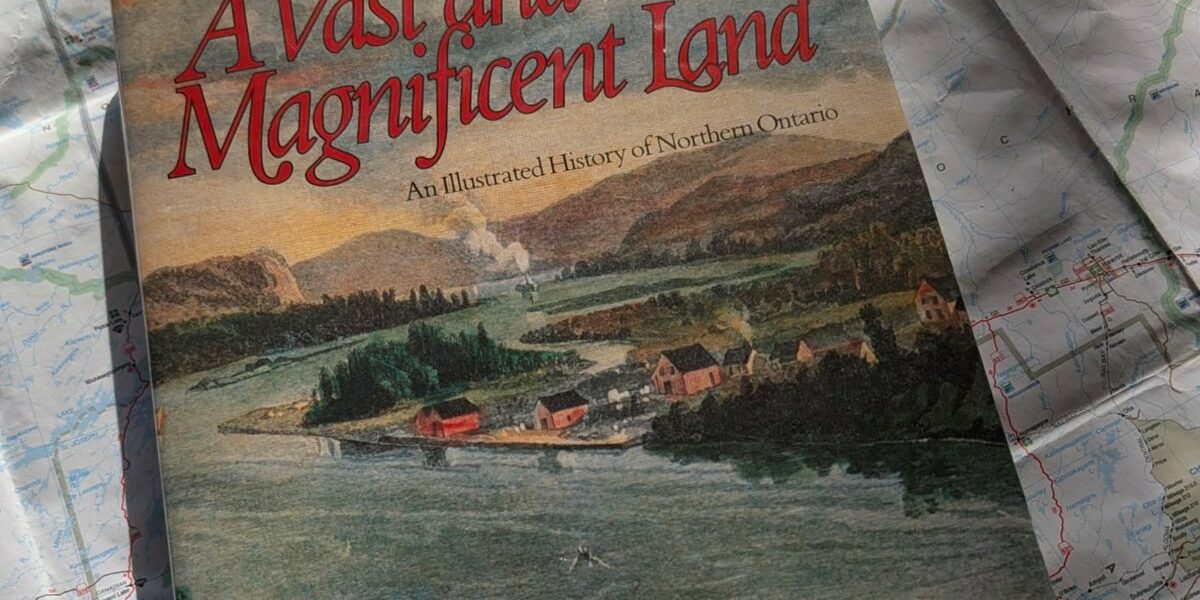
The poignant phrase refers to the 1984 book A Vast and Magnificent Land: An Illustrated History of Northern Ontario, edited by Matt Bray and Ernie Epp. It was a timely addition to Ontario’s Bicentennial celebration as initiated by Minister Leo Bernier, Ministry of Northern Affairs.
Matt Bray passed in 2023; co-editor Ernie Epp, now 85, provides the not-so-subtle nuances of how this mammoth project came together. He is Lakehead University historian (1978) and former NDP MP.
The book’s jacket says “twelve authors co-operated in writing a volume that deals with ten interconnected themes in the history of Northern Ontario.” The contents are augmented with more than 400 photos, maps and paintings illustrating the people, places, institutions and activities that have made this a vital place it is today.
He said, “I first heard of the project as linked to the Bicentennial of the end of the American Revolution and the flight to the Colony of Quebec of United Empire Loyalists. Their coming led to the creation of the two Canadas in 1791. Dr. Arthur (his senior colleague at the university) saw no connection to Northern Ontario in those events and was consequently not interested in the project. So, it fell to me to join in the effort!”
Minister Leo Bernier had represented the riding of Kenora since 1966. He could speak with pride of the fact that “what was seen by a handful of European adventurers as a vast and sparsely populated wilderness has become what we know Northern Ontario to be today—a resource-rich land supporting modern urban centres linked through a network of rails, roads, air routes and electronic wizardry. This book is about the people and events that brought about this remarkable transition.”
So the project began. “As it happened, the two historians who accepted the challenge—or the opportunity! Matt Bray, in the History Department at Laurentian University, and I at Lakehead University were Manitoba farm boys. I thought that the fact that two farm boys from Manitoba were prepared to celebrate the Northern Ontario achievements provided a nice example of the bridging from east to west on which the Dominion of Canada is built!”
Minister Bernier’s eventual Foreword asserted that, “To prepare this work, twelve authors were asked to write short summaries of major themes in the history of Northern Ontario” and that the photographs that graced the ten chapters “were gathered by three teams of researchers who collected more than 3,000 photographs from sources throughout the north and in major southern cities, [with] many northern residents suppl[ying] photos from their private collections.”
To Ernie, the Minister’s reference to “twelve authors” is a bit of a mystery. “There are ten chapters in the book, and two of the ten were written by the editors, Matt Bray and me. If the Minister understood that the editors were in addition to ten authors, one could add them up to be twelve. However, Matt and I were happy to play a part; Matt decided to write the first chapter on ‘The Place and the People,’ and I chose the chapter on ‘Transportation and Communications.’ I may say that this chapter was a joy for me to write since I could draw on personal experience of travels.”
He recalls two observations. “When I headed east (from Thunder Bay) in 1963, the Trans-Canada Highway had been finally opened to traffic, (Wawa grand opening) although there were still men at work on the shoulders of the highway. And I had my first viewing of slag being dumped at night in Sudbury!”
He found the other authors for the book’s chapters. “Each of us undertook to write 5,000 words on our large subject. We had presumably all achieved what we had been asked to do when we were informed that the masters of the process had concluded that chapters would need to be cut to 3,000 words. I remember calling Matt Bray to consider our response. I was sufficiently taken aback that I remember asking Matt, “What should we do? Give up on the project? Let others do the cutting and editing?” Well, we carried on!”
The printing of A Vast and Magnificent Land opened the next stage of publication. “The Ministry had been clear that the copies would be given to Lakehead and Laurentian Universities to be sold to interested people at the price of $14.95, to raise a fund in each university to support historical research. When they learned that Laurentian had offered its allotment to The Highway Bookshop in Cobalt, the Ministry was truly offended and demanded that Laurentian University take on sale of its allotment. Lakehead had accepted the challenge and continued selling its allotment.”
And what of a French version?
“My memory is that there was a second printing, and a Laurentian colleague supervised a French version. Copies of the French version were shared between the two universities. My daybook states that the first run—English–had sold out at Lakehead by February 1985 and that the French version was being offered as well. As a result, the Ministry of Northern Affairs authorized a second printing.
The book’s popularity continues. “I had the joy this year – of being called about a couple of boxes of the French version sitting in a History Department office. What should we do after forty years of storage? The fifty copies were accepted with great appreciation by the Centre de Francophonie in Thunder Bay!”
There is an interesting aftermath Ernie shares. “I was in the House of Commons from the fall of 1984 until the Free Trade election of November 21, 1988. One of the joys of my service as a Member of Parliament was the autographing of copies of A Vast and Magnificent Land, which constituents left at my office that first year of service! After my defeat, I returned to teaching and research at Lakehead University. I was chairing the History Department in October 1989 when I was called to a meeting with the Chief Librarian and the Director of Research and Graduate Studies to distribute research funds resulting from Lakehead’s sales of A Vast and Magnificent Land. The fund generated $2,500 annually, which we awarded each year to worthy applicants. I believe that support for historical research continues forty years later!”
Then there is this odd notation. “When the book was published the following year, under the name of the Minister of Northern Affairs, the Hon. Leo Bernier, he asserted that “This year Ontario celebrates its Bicentennial, marking 200 years of progress and growth.”
He conceded that “The boundaries of Northern Ontario as we know it are less that 100 years old, but . . . Ontario’s claim to the land as far west as the Lake of the Woods, north to the Albany River, and east to Quebec was upheld in a Privy Council decision on 1884 and proclaimed in the 1889 Canada (Ontario Boundary) Act. However, not until 1912 was that part of the District of Keewatin, which defines our northernmost provincial land, added to Ontario.” I am glad Ernie explained the “what if” of Northern Ontario boundaries.
Afterthoughts
If you have, or are looking for a copy of this comprehensive book, above, know that these are difficult to locate. It’s a keeper.
Currently, it looks like there are a few publishing companies in Northern Ontario – Latitude 46 Publishing (Sudbury) and White Mountain Publications (Cobalt) and three in Thunder Bay, Wording Well, Split Tree Publishing and River Rocks Publishing.
And of course, the Internet search engines lead you to websites with more specific themes of the natural and cultural heritage of Northern Ontario. I went down the wormhole and put Northern Ontario books into Google – about 17,400,000 results in 0.27s-seconds (that’s under the drop-down Tools tab on the far right). Then fiction…1,4440,000, non-fiction – 3,410,000 results. There’s a need to refine the search. If you go to “northern Ontario nonfiction indigenous books”, there’s only 594,000. Add some more “…Dionne Quintuplets” – 9,400.
And if you care to: “northern Ontario back roads bill steer stories” – 133,000.
I have authored a few. Maybe it’s time to write a Northern Ontario book about the back roads?