This post was originally published on here
You’ve been sleeping on these classic sci-fi books, but it’s never too late to check them out. If you’ve been turned on to author Andy Weir’s work by adaptations of his novels like The Martian, or the upcoming Project Hail Mary, these book series, by some of his most lauded contemporaries, should be on your radar next.
Science fiction literature has its own equivalent of the Pulitzer Prize, called the Hugo Award. Most of the books listed here either won, or were nominated for, the Hugo for Best Novel in the year following their release.
Meaning, each of these authors is a rock star in the genre. If you’re looking to expand your literary horizons, start with these books.
5
The Neanderthal Parallax
Written By Robert J. Sawyer; Hominids (2002); Humans (2003); Hybrids (2003)
Robert J. Sawyer’s “Neanderthal Parallax” trilogy is a striking blend of classic sci-fi concepts. It is a “first contact” novel, about a meeting between two civilizations that are utterly familiar to each other. Yet in this case, they share a surprising connection. It is also a parallel universe story, as two very different versions of Earth are introduced to one another.
Hominids won the 2003 Hugo Award. The second book in the trilogy, Humans, was nominated the following year.
That is, our recognizable world is contrasted with one in which Neanderthals evolved and developed civilization, rather than Homo sapiens. As much as`in any great sci-fi story about extraterrestrials, Sawyer creates an immersive, fully-realized culture for his Neanderthals. This also means the book fits into the alternate history category, though its divergence from real history starts way before history itself.
Hominids, the first book, is a slow burn at first, as the two worlds literally collide. Over the course of the trilogy, though, the two Earths, and two societies, become increasingly enmeshed, and readers will find themselves increasingly captivated by every new detail they learn about our Neanderthal counterparts, as envisioned by Robert J. Sawyer.
4
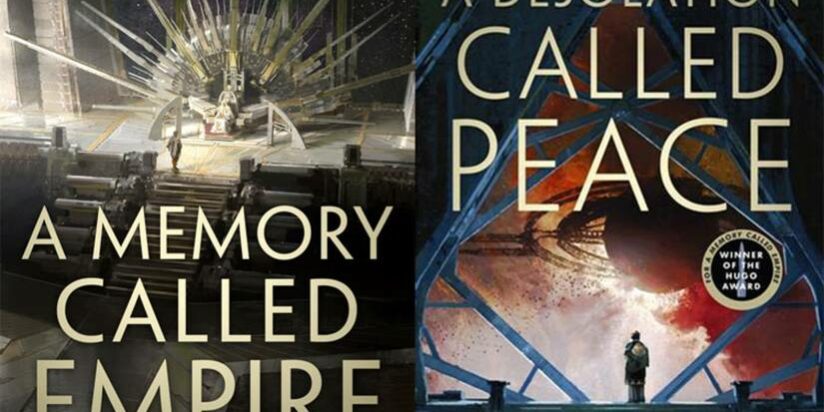
A Memory Called Empire/A Desolation Called Peace
Written By Arkaday Martine; Published In 2020 & 2022
Arkady Martine is one of the rising stars of science fiction right now. A Memory Called Empire was her 2019 debut novel, which earned her the Hugo Award. She won again for its sequel A Desolation Called Peace. Fans are still eagerly awaiting a third book in what many sci-fi readers are already calling the defining space opera of its generation.
It is the heir to classics like Isaac Asimov’s Foundation books, as well as George R. R. Martin’s A Song of Ice and Fire books. A Memory focuses on the new ambassador to the vast Teixcalaanli Empire, who seeks to uncover the truth of her predecessor’s death. At the same time, she must acclimate to the political intrigue of the Teixcalaanli court.
A Desolation Called Peace takes its title from one possible translation of an old quote about Rome: “they make a desolation and call it peace.” Author Arkady Martine is also a historian, and infuses her work with details and motifs drawn from real Roman and Byzantine history.
In other words, A Memory is a gripping murder mystery set against the backdrop of a galactic succession crisis. A Desolation continues the story, adding invading aliens to the mix for good measure, while expanding on the first book’s themes and pushing its big ideas to even more ambitious places.
3
The Oxford Time Travelers’ Saga
Written By Connie Willis; Doomsday Book (1992); To Say Nothing of the Dog (1998); Blackout/All Clear (2011)
Author Connie Willis deserves to be a household name; it’s a legitimate shame that her work isn’t more widely known. She is low-key the Michael Jordan, or Tom Brady, of modern sci-fi literature. That Hugo Award we keep talking about? She’s won eleven of them. In fact, all four of the novels here won for Best Novel.
Willis first introduced her concept of time traveling Oxford historians in the 1982 short story “Fire Watch,” and it subsequently served as the foundation for a quadrilogy of novels. Aside from a few crossover characters, the books each stand alone plot-wise; instead, they are connected by a common setting and recurring themes.
Doomsday Book, first Oxford Time Travel novel, shared the 1993 Hugo Award for Best Novel with Vernor Vinge’s A Fire Upon the Deep. That’s only the second time the Hugo has been co-awarded. The first was when Dune split the decision with Roger Zelazny’s This Immortal in 1966.
Connie Willis writes with a great sense of humor, while delivering plots that are intricately plotted and propulsively engaging. Even after four books, the possibilities of her time travel saga remain far from exhausted. That is to say, fans are still begging for a fifth entry in the series, fifteen years after the last one came out.
2
The Forge Of God/The Anvil Of Stars
Written By Greg Bear; Published In 1987 & 1992
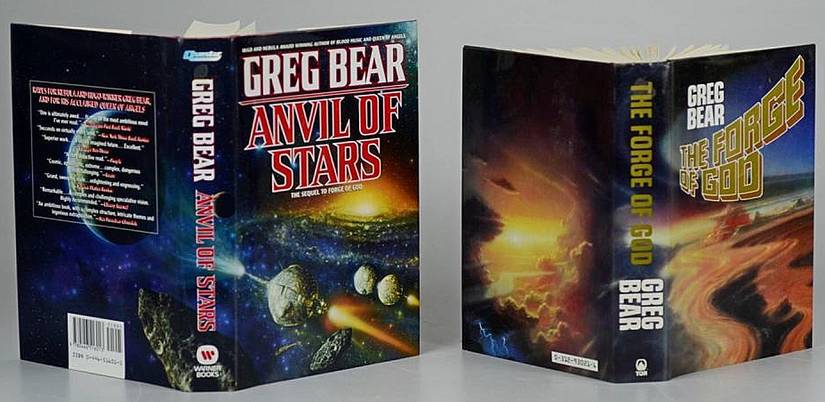
Greg Bear is another icon of modern sci-fi that wider pop culture hasn’t been exposed to yet. Bear’s work is complex, and packed full of ideas that mark him as an A-tier futurist alongside contemporaries like Neuromancer author William Gibson and Islands in the Net’s Bruce Sterling. The Forge of God is perhaps his most accessible novel for first-time readers.
Bear won Hugo awards for Novelette and Short Story, but the Best Novel award eluded him throughout his career. He was nominated five times, but never won.
It starts with mysterious things happening in the solar system, and the discovery of an alien with a dire warning for life on Earth. Where it goes from there is truly unpredictable, in the most satisfying way. Without spoiling much, Forge of God leaves readers on a stunning cliffhanger, begging to know what happens next.
Thankfully, Bear produced The Anvil of Stars several years later, which takes the story in even wilder directions. A third novel sadly never materialized before Bear’s death in 2022, and while there has been intermittent talk of adapting Forge and Anvil, they remain among the great unrealized sci-fi epics of all time for now.
1
The Zones Of Thought Trilogy
Written By Vernor Vinge; A Fire Upon The Deep (1992); A Deepness In The Sky (1999); The Children Of The Sky (2012)
Vernor Vinge’s “Zones of Thought” trilogy is space opera at its most sprawling, and its most operatic. A Fire Upon the Deep has everything. Malevolent AI? Check. Packs of alien dogs that share hive minds? Check. A Frankenstein-esque protagonist assembled from the body parts of space explorers? Check. Even militant, xenophobic aliens butterflies? Yep, even that.
A Fire Upon the Deep is the definition of dense, hard science fiction, but it moves with the spirit of Star Wars. Its follow-up, A Deepness Upon the Sky, is just as much of a tour de force. Set thousands of years earlier, it shares one character with the previous book: Pham Nuwen, the resurrected explorer, who founded a great civilization during his lifetime.
A Fire and A Deepness both earned Vernor Vinge the Hugo. He won again in 2007 for his standalone novel Rainbow’s End.
Children of the Sky is a direct sequel to the first book, but it unfortunately resolves few of the major plot threads left dangling by A Fire. Vinge passed away in 2024, leaving fans of his famous novel series to hope for an adaptation, or another author to pick up where he left off and complete the story.