This post was originally published on here

February 18, 2026 — 3:37pm
Warwick Thornton always loved westerns. The arrival of VHS in his hometown of Alice Springs, he remembers, meant that he and future screenwriter David Tranter could buck the programming at the two local cinemas and watch what they wanted.
“We just loved westerns, anything with Charles Bronson, How the West was Won, Soldier Blue. Then it dawned on us that we were the Indians. We always wanted to be the cowboy, but we were the dirty Indians! An evil epiphany to have as a teenager, but actually a great serving of ‘where do you stand?’”
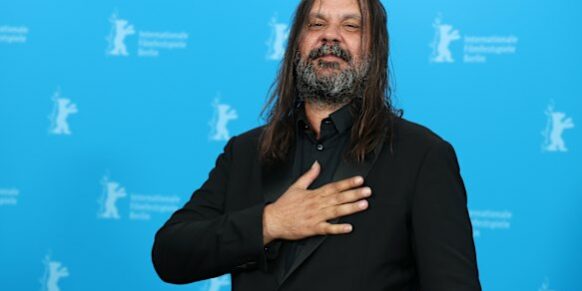
Thornton’s new film Wolfram, set in 1932 in a flyblown South Australian mining town, had its international premiere at the Berlin Film Festival, where it is competing for the top award, the Golden Bear.
It was well received by the audience; trade magazine Deadline’s review described it as “a modern Australian classic” with “a masterful merger of serious social comment and taut, thrilling action.”
Over the last week, the festival has crackled with a bitter argument over the place of politics in the cinema, first sparked by jury chairman Wim Wenders’ reply to a question about the festival’s position on Gaza on the first day. “We have to stay out of politics,” Wenders said. “We are the counterweight of politics, we are the opposite of politics. We have to do the work of people, not the work of politicians.”
Then, on Tuesday (Berlin time) Oscar-winning actors Javier Bardem and Tilda Swinton joined more than 80 film industry identifies to sign an open letter criticising the festival’s “silence” on Gaza.
Wolfram is a decidedly political film. It has a good deal to say about white oppression in Australia, opening with a shocking scene of black children carting buckets of rocks for white tungsten prospectors. Deborah Mailman anchors the film as a grieving mother who, having been forced into a relationship with an abusive white man, has lost her children; Errol Shand is the disruptor, a vile outcast who takes pride in mowing down any black people who have the bad luck to be in his field of vision.
Thornton says, however, that simply being at the festival as an Indigenous filmmaker is the statement he wants to make.
“I don’t think, I do,” he said at the film’s press conference on Tuesday (Berlin time). He pointed to the three other Indigenous Australians on the podium with him.
“What’s really clear is that we’re Aboriginal. Our families have lasted 200 years through colonisation, murder, rape, poisoning, genocide and stolen generations, trying to breed the black out of us. Us being here is a political statement … We don’t need anything more than that. We’re an embarrassment, but we’re the best embarrassment.”
He likes the idea that this film is an Indigenous western. “I don’t know how many Indigenous films you’ve seen,” he said to the German press, who responded with a round of applause. “But welcome to the Indigenous cinema! It’s a beautiful place!”
In most Westerns, he says, the country beyond the rancher’s porch is hostile territory, seething with savages and other dangers. “As an Indigenous filmmaker, my point of view is looking at that verandah thinking ‘that’s scary’.”
The classic western directors were also operating from a position of nostalgia for a Wild West that, if it ever existed, has disappeared. “All these directors were lamenting a past. But we were living in Alice Springs, where the west was still real. There were still people riding horses up and down the street, drunk.”
Tranter and Steven McGregor, the two scriptwriters, wrote Wolfram as a sequel to Thornton’s earlier film Sweet Country (2017). “It had a lot to say about our history and what was written about us by our colonising conquerors because they had the pen and we didn’t.”
That film was so tough to watch, said Thornton, that he was dubious about venturing into that terrible history again. He was persuaded when the writers promised him it had a happy ending.
What he could not have known was that they would have to face a fly plague. “I was counting about 15 flies a day I was breathing in,” he says. “At first you try to spit them out, but by about the fourth day it was just too hard. You swallowed them. It was easier on yourself. But you embrace this. It’s not like we’re making a commercial for butter. We’re making a hard-arsed film about survival and struggle. Bring on the flies!”
Wolfram is one of two Australian films launching in Berlin. Also screening on Tuesday was Saccharine, an entertaining body horror by Melbourne film-maker Natalie Erika James. At its bloody heart is a food-addicted student who tries to lose weight by eating the ashes of human body parts and is then haunted by the ghost of the woman she is eating. It has already screened to enthusiastic reviews in Sundance, but is picking up many more sales at the Berlin market.
The Berlinale runs until Saturday (Berlin time).
Must-see movies, interviews and all the latest from the world of film delivered to your inbox. Sign up for our Screening Room newsletter.
 Stephanie Bunbury is a film and culture writer for The Age and The Sydney Morning Herald.