This post was originally published on here
Kampala, Uganda | THE INDEPENDENT | Fincom Technologies, through its flagship product SchoolPay Uganda, a digital education payment and school management platform, partnered with the Uganda Catholic Education Department to host the first-ever nationwide Catholic Schools Science Fair. The exhibition took place at St. Kizito Secondary School in Bugoloobi, Kampala on December 5.
This pioneering initiative brought together young innovators from all 19 Catholic dioceses in Uganda. Each diocese nominated five top pupils, forming a national delegation of aspiring scientists who presented projects in technology, environmental science, engineering and creative problem-solving.
The fair marked an important step forward in promoting science, technology and innovation within Uganda’s basic education system. These are areas that have often faced challenges such as limited exposure, inadequate resources and unequal access to STEM opportunities, particularly in rural and underfunded schools. By creating a national platform for participation and recognition, the initiative offered learners a rare opportunity to explore, display and strengthen their scientific skills.
SchoolPay currently serves more than 15,000 institutions across the country and is a key driver of digital transformation in Uganda’s education sector. Through this partnership, the platform reinforced its commitment to creating a future where every learner has access to the tools, skills and environment needed to succeed in a fast-changing digital world.
Fincom Technologies Chief Executive Officer, Charity Atukwatsa Mutagamba, emphasized that the partnership reflects the core mission of SchoolPay, which is to use technology to unlock opportunity for learners.
She explained that the goal is to build technology that does more than simply process payments, and instead enhance administrative efficiency while also acting as a catalyst for student innovation, scientific exploration and national development.
“The Science Fair will help schools strengthen their digital culture, improve ICT readiness and prepare students for a future where scientific literacy is essential,” she said.
As a long-standing pillar of Uganda’s education sector, the Catholic Church described the partnership as an investment in both the intellectual and spiritual growth of students. With hundreds of Catholic-founded schools across the country, the Church highlighted the importance of nurturing curiosity, discipline and scientific thinking from an early age.
Rev. Fr. Ronald Rigan Okello, the National Executive Secretary for Education at the Uganda Episcopal Conference, said the aim is to inspire young minds, close existing gaps in STEM exposure and develop a generation that is ready to lead Uganda’s technological future.
He noted that the ideas showcased at the fair have the potential to grow through to university level and eventually be adopted locally and internationally. He also expressed support for the government’s competence-based curriculum, saying it encourages innovation and the development of practical skills. According to him, no country can progress without innovation and the learners present had chosen the right path.
Officials from the Ministry of Education welcomed the Science Fair, noting that it strongly complements Uganda’s Competence-Based Curriculum. They observed that the fair provided pupils with a valuable opportunity to deepen their understanding of scientific concepts while building critical thinking, creativity and problem-solving skills.
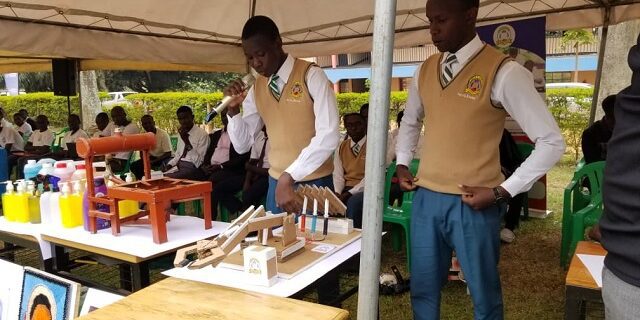
The projects presented at the exhibition focused on renewable energy and environmental solutions, ICT and digital innovation, engineering and simple robotics, agriculture and food security, as well as water, hygiene and health-related challenges.
Students from St.Kizito showcased what they called a ‘hydraulic robotic arm’ which can be used in industries and construction sites to lift heavy materials among others.
Showcasing students said they were ready to improve on their projects once supported by different stakeholders – private, government, religious, civil society and individuals.