This post was originally published on here
NEED TO KNOW
-
Several new studies on a near-Earth asteroid may reveal new information about our early solar system
-
The asteroid, named Bennu, contains sugars necessary for the development of life as well as a “gum-like” substance never before found on any space rock
-
Samples of Bennu were first delivered to earth in 2023 by NASA’s OSIRIS-REx spacecraft
Several new studies on a near-Earth asteroid are offering fresh clues about the early solar system.
Samples from the asteroid, named Bennu, were delivered to Earth by NASA’S OSIRIS-REx spacecraft in September 2023, per NASA. Scientists have since made “remarkable” discoveries while studying the sample.
The scientists published their findings in three recent papers, according to an article on the NASA website. Specifically, the asteroid contains “sugars that are essential for [living organisms], a gum-like substance not seen before in astromaterials and an unexpectedly high abundance of dust produced by supernova explosions,” per NASA.
Advertisement
Advertisement
And why are these findings significant?
NASA/Goddard/University of Arizona
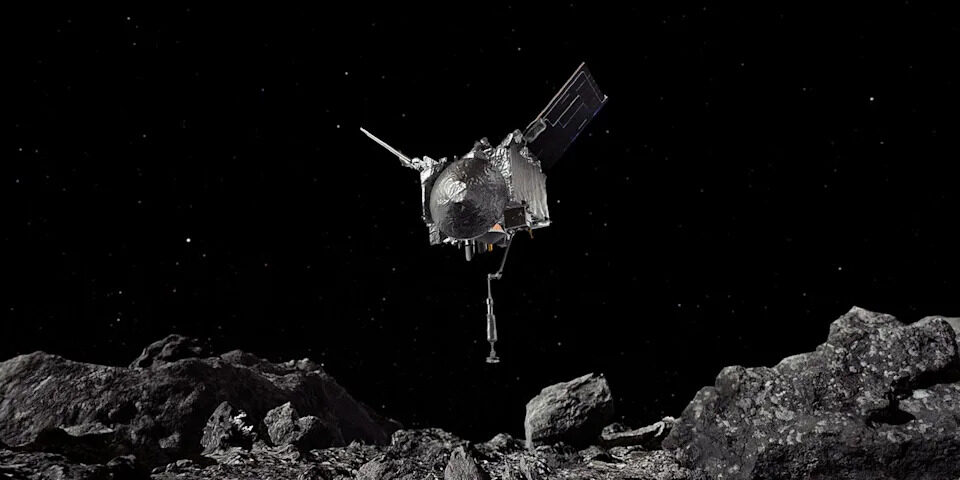
Artistic visualization of the OSIRIS-REx spacecraft descending toward asteroid Bennu to collect a sample
In one of the studies, published in the journal Nature Geoscience, Professor Yoshihiro Furukawa of Tohoku University explained that while the sugars are not evidence of life in the universe, their detection — along with several other previously detected materials in Bennu samples — prove that building blocks of biological molecules were present throughout the solar system, per the study.
The PEOPLE Puzzler crossword is here! How quickly can you solve it? Play now!
The study’s findings also indicate that the sugar ribose, which is one of the building blocks for RNA, may have been more widespread in the early solar system than deoxyribose, a building block of DNA. This goes to support what is called the “RNA world” hypothesis, which posits that the first forms of life relied on RNA for survival.
NASA/Goddard/University of Arizona
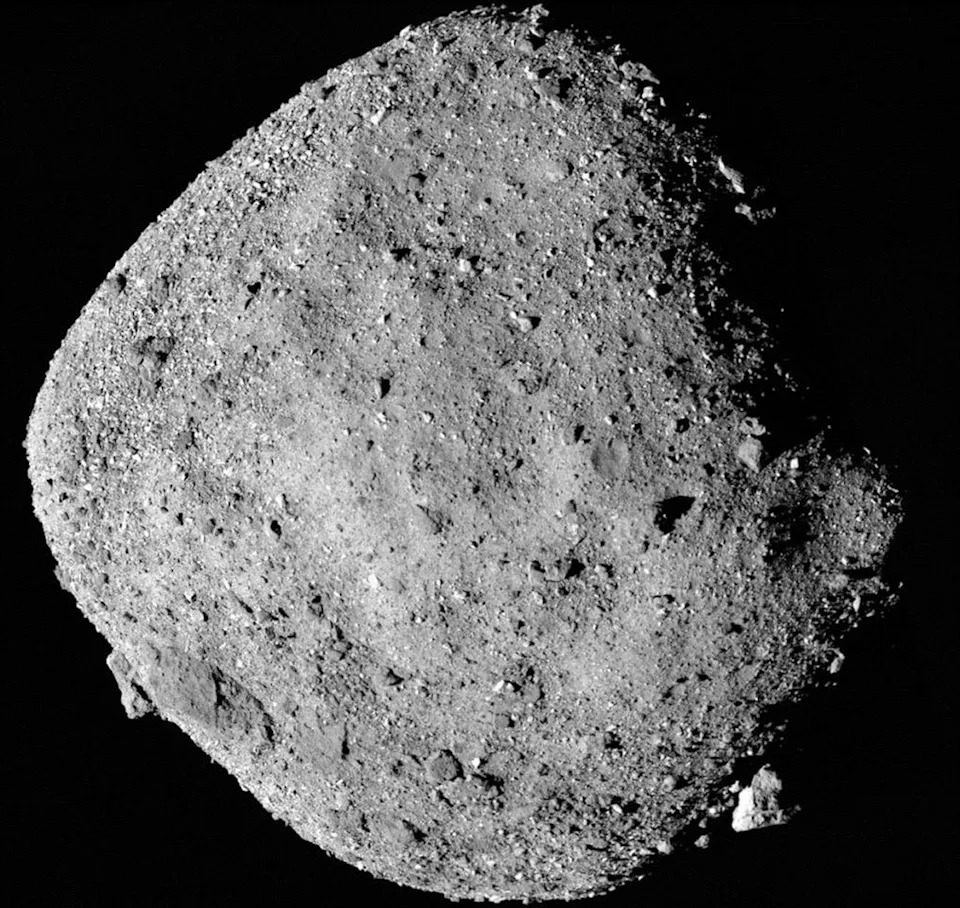
Asteroid Bennu
A second study published in the journal Nature Astronomy — led by researchers at NASA’s Ames Research Center and the University of California, Berkeley — found that Bennu additionally contains an ancient “gum-like” material that has never been previously found on any space rock, per NASA.
Advertisement
Advertisement
The material is rich in nitrogen and oxygen, and researchers say the gum could have potentially helped trigger life on Earth — as well as may help scientists study whether life exists beyond our planet.
Never miss a story — sign up for PEOPLE’s free daily newsletter to stay up-to-date on the best of what PEOPLE has to offer, from celebrity news to compelling human interest stories.
A third study also published in Nature Astronomy — led by Ann Nguyen of NASA’s Johnson Space Center in Houston — found that the Bennu sample contained more stardust particles than expected. This helps provide clues about the environment in which the asteroid was originally formed.
Read the original article on People