This post was originally published on here
Hot water defines the landscape at Lassen Volcanic National Park, where hydrothermal areas feature steam and volcanic gas vents, mud pots and boiling pools. Living within the hot water, scientists recently learned, is a single-celled organism that thrives in temperatures previously considered impossible for a creature of its kind to endure, according to new research published last week.
Beryl Rappaport, a microbiologist completing her Ph.D. at Syracuse University, and a team of researchers identified a new eukaryote, a type of amoeba whose cells have a membrane-bound nucleus, that can live in heat once thought to be fatal. “Eukaryotes can grow at higher temperatures than we thought was possible for them,” Rappaport said.
Advertisement
Advertisement
She named the new geothermal amoeba Incendiamoeba cascadensis – or fire amoeba of the Cascade Range, a nod to both the heat-loving nature of the organism and the mountain range in Lassen Volcanic National Park.
“Lassen is seemingly one of the overlooked national parks in the western U.S.,” Rappaport said. “People think of Yellowstone for the hot springs, but Lassen has the largest geothermal lake in North America.”
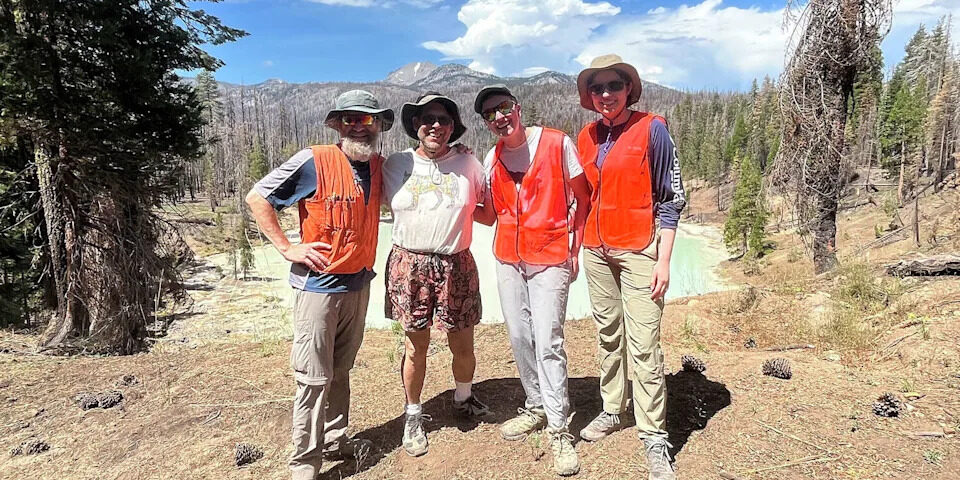
From left, researchers Ken Stedman, Gordon Wolfe, Angela Oliverio and Beryl Rappaport, lead author, stand in front of Boiling Springs Lake in Lassen Volcanic National Park. (Helena Stedman)
Rappaport’s work was published as a preprint, meaning it hasn’t been peer-reviewed yet. But the work raises important questions about where the boundaries of survival truly lie. “I like being impressed by what life is capable of,” she said.
Advertisement
Advertisement
Finding organisms that push perceived limits helps researchers better understand life on Earth – and perhaps on other planets. “Understanding the boundaries of life on Earth helps guide us for where to look for life elsewhere, and what kinds of life might be elsewhere,” Rappaport told SFGATE.
The newly discovered “fire amoeba” can replicate itself at about 145 degrees Fahrenheit. The upper limit was previously thought to be about 140 degrees Fahrenheit for such organisms, along with some red algae and fungi. “This opens the doors to what eukaryotes might continue to be capable of,” Rappaport said.
Other microbial life, including bacteria, have been recorded at even higher temperatures. Tardigrades, an invertebrate, have been found in water hotter than 235 degrees Fahrenheit.
Left, algal biofilm in the tributary of Hot Springs Creek where the “fire amoeba” was sampled. Right, Beryl Rappaport sampling from the tributary of Hot Springs Creek, collecting liquid and biofilm with long tongs. (Beryl Rappaport/Kristen Skruber)
Rappaport identified the fire amoeba in a tributary of Hot Springs Creek, a small trickle of water that sends little puffs of steam into the air next to a hiking trail. Researchers took water samples from the creek back to a lab, where they activated the amoebas with a culturing process and put samples of varying temperatures in incubators. The hottest one was about 135 degrees Fahrenheit, the previous record-high temperature for an amoeba to sustain. As it thrived, they continued to turn the temperature up – and up, and up.
Advertisement
Advertisement
Now, the scientists are seeking to answer questions about why the organism can tolerate such hot conditions. They’ll do so by sequencing its genome to understand potential adaptations or mechanisms it uses to persist in the heat. Organisms die when their proteins unfold and melt; perhaps this amoeba has a protein structure that helps it regulate stress in high temperatures.
The search for heat-loving life will continue. Similar organisms have been found in hot springs around the world, including New Zealand. Rappaport would like to expand her studies to a global scale, learning more about the microscopic organisms living in our hottest waters.
“There’s no reason we couldn’t find something else growing at an even higher temperature somewhere else,” she said.
More National Parks
– Trump’s face on new national park passes outrages conservationists
– Yellowstone visitors stunned as man seemingly provokes wolf pack
– Reconsider travel to Glacier National Park, travel experts say
– New wolf pack found in California as numbers continue to rise
Advertisement
Advertisement
We love national parks just as much as you do, so we have a newsletter that covers them from top to bottom. Sign up here.
This article originally published at Scientists find a startling discovery in a national park’s hot waters.