This post was originally published on here
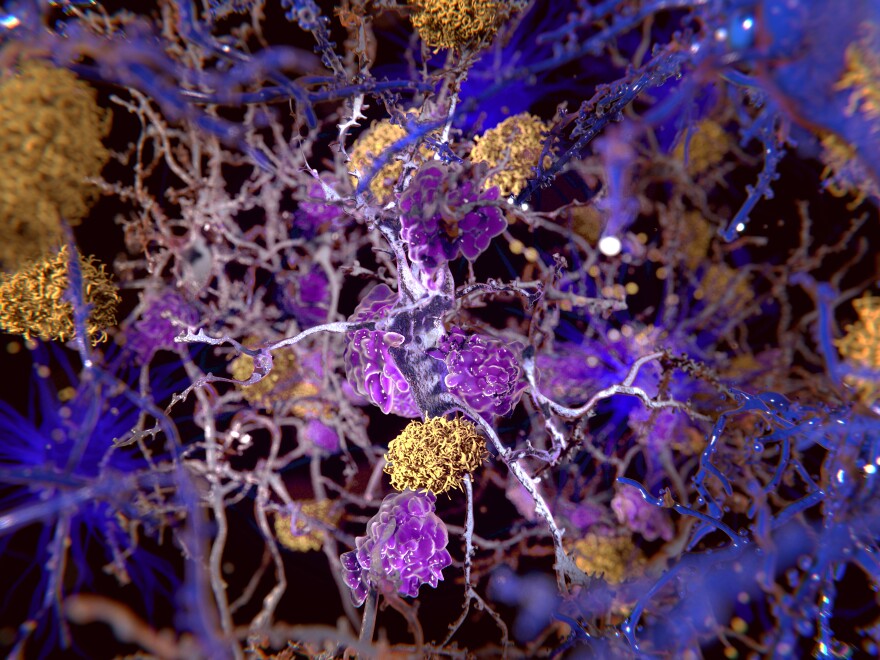
When a person has Alzheimer’s disease, a protein called amyloid accumulates to form sticky globs called plaques outside of brain cells. Abnormal tau proteins create twisted fibers inside neurons. Alzheimer’s researchers have spent a lot of time learning about how these proteins clump and tangle. “But they are largely ignoring the lipids,” said UT Health San Antonio neuroscientist Juan Pablo Palavicini, “Which, in my view, is a big mistake, because they make up more than half of the dry weight of the brain.”
Palavicini is an assistant professor in the Department of Cellular and Integrative Physiology at the Joe R. and Teresa Lozano Long School of Medicine and a researcher with the Sam and Ann Barshop Institute for Longevity and Aging Studies at The University of Texas at San Antonio. He explained that changes in certain brain lipids — which are types of fat — play a major role in Alzheimer’s disease. Palavicini and his Barshop colleague Xianlin Han, PhD co-led a study in collaboration with the University of California at Irvine which discovered that cells called microglia can drive lipid abnormalities.
”Microglia are the immune cells of the brain. Their number one role is if there’s any debris out there, they will clear it,” Palavicini said.
Normal physiological functions of the brain create this debris, and when a brain is functioning well, microglia work like janitors at a school. Kids make a mess, breaking things and leaving debris around. The janitor goes from mess to mess, cleaning them up. “You get some mild debris that they have to gobble up and clear, and they become a little bit inflammatory,” Palavicini explained. “But then they come back to their resting state.”
As we age, microglia are tasked with recycling more debris, more often, and it becomes difficult to keep up. In the context of Alzheimer’s disease, they can’t.
“We have so much debris and so chronically that the microglia initially try to clear it, but eventually they become so saturated, and they just exhaust,” Palavicini said.
When microglia are exhausted, they stop working. But that’s not all that happens.
“Instead of being the good guys that were helping us to clear the debris, they become bad guys and just start releasing inflammatory stimuli,” he said. “And this generates a cascade of negative events.”
There is a specific lipid that is critical to the activity of clearing and recycling debris in microglia. Bis(monoacylglycero)phosphate, known as BMP, attracts proteins to break down damaged lipids and then helps regulate the process.
In Alzheimer’s disease, BMP is one of the lipids that spikes. That brings us back to the janitor with the messy kids. Palavicini and his colleagues think BMP rises to help microglia more effectively clear the increasing debris created in the context of Alzheimer’s disease, a bit like a surge of adrenaline for a janitor who has much more work to do than they’re used to. Microglia are trying to recycle an influx of damaged lipids and clumped amyloid proteins, and BMP surges to support them.
The information Palavicini’s lab uncovered in this study, published in October in Nature Communications, was a surprise to the researchers. The team deactivated microglia in the brains of one group of mice and bred a second group of genetically modified mice that lacked microglia so they could study lipid changes. They then compared results from the mouse studies with post-mortem brain samples from people with and without Alzheimer’s.
In the mice with deactivated or missing microglia, BMP didn’t increase in the presence of lipid debris or amyloid plaques. With no microglia ‘janitors’ around to deal with the mess, there was no need for a BMP surge to back them up.
“When we depleted microglia, the levels came back completely to baseline,” Palavicini said. “That demonstrated that the increase in this lipid in Alzheimer’s disease was driven by microglia, which was not known.”
“This was kind of completely unexpected,” he added. “We did not hypothesize it was going to happen.”
This discovery could lead to breakthroughs in Alzheimer’s treatment. Current medications target amyloid plaques, but by the time Alzheimer’s is diagnosed, those amyloids have typically been clumping for years, causing an avalanche of additional problems.
“So even though you may clear the amyloid, it already caused a lot of trouble,” Palavicini explained, “And it already generated all this lipid debris that the microglia are still dealing with.”
Science Photo Library/Science Photo Library via Reuter
/
JGT
If microglia can’t adequately recycle debris, it begins to accumulate. Some of that debris will be damaged myelin. Myelin insulates neurons in the brain like sheaths that wrap around electric wires. And like the sheaths around electric wires, intact myelin maintains the efficient transmission of electrical signals from one point to another. In humans, the signals that myelin facilitates are moving between nerve cells.
“Myelin is so important for neurons to communicate, right? And so if you start losing that myelin, then the neurons stop communicating well,” Pavalacini said, “Which is basically what starts happening in the Alzheimer’s brain. We get a lot of loss of myelin, a lot of myelin debris, and a lot of inflammation.”
When microglia are overwhelmed by debris and inflammation, the myelin repair that would happen in a healthy brain is inhibited.
“What migroglia are designed to do is, ‘let’s clear up this mess so we can now have the conditions where we can remyelinate,’” Pavalicini explained. Myelin debris — the trash in the janitor’s school — blocks the cells responsible for remyelination from doing their job. “So, unless the janitor comes and cleans, you’re not going to have new myelin sheaths. Once the janitor starts causing trouble, we are not regenerating the myelin that we lost.”
Pavalacini’s research suggests that therapies that target debris that accumulates when microglia cease to function appropriately may slow the deterioration of cognitive function.
“We need to find ways in which we can clear them better so that the brain can remyelinate and we can rescue all that myelin loss that occurs with age,” he said, “And which, in the context of Alzheimer’s, becomes exponential.”
Therapies that support the continued healthy function of microglia in an aging brain may also make a difference in the rate of decline for Alzheimer’s patients. “So that the microglia will not exhaust so fast,” Palavicini concluded. “We think this would be a very good therapy for Alzheimer’s.”
Science & Medicine is a collaboration between TPR and The University of Texas Health Science Center at San Antonio, about how scientific discovery in San Antonio advances the way medicine is practiced everywhere.