This post was originally published on here
For centuries, mystery has surrounded the ‘Star of Bethlehem’ that guided the Magi, or the three wise men, to the newborn Jesus. Now, a Nasa scientist says he believes he has found what the shining celestial object was. And it was actually not a star, but a comet
The story of the three wise men, or Magi, following the ‘Star of Bethlehem’ that takes them to the newborn Jesus is well known. However, a mystery has surrounded this celestial object for centuries, with astronomers, historians and theologians wracking their brains to find out what it is.
Amid many existing theories, a National Aeronautics and Space Administration (NASA) scientist has proposed another explanation of the origin of the Star of Bethlehem in the Bible. Earlier, theories have suggested that the shining celestial object was a close conjunction of Venus and Jupiter in 2 BC.
We take a look.
Bible’s Star of Bethlehem
The Star of Bethlehem, also known as the Christmas Star, appears in the
Bible’s Gospel of Matthew.
The Magi (wise people) travelled from the East to Jerusalem and asked: “Where is the one who has been born king? We saw his star when it rose and have come to worship him.”
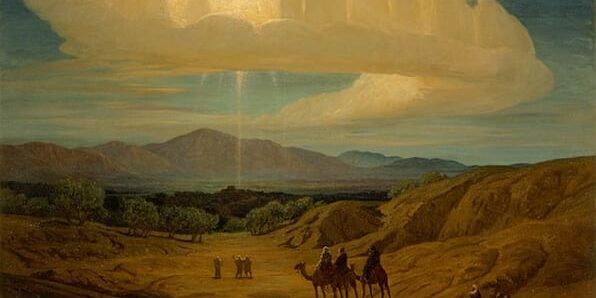
The star is described as rising “in the east”, moving ahead of the travellers from Jerusalem to Bethlehem. It then appears to “stand over” the place where Jesus was born.
Perturbed by the news, King Herod of Judea secretly sent the Magi to Bethlehem to search for the child and inform him. Matthew then continued: “…they went on their way, and the star they had seen when it rose went ahead of them until it stopped over the place where the child was. When they saw the star, they were overjoyed.”
Is Star of Bethlehem a comet?
The Star of Bethlehem is not present in the universe. This has puzzled astronomers as to what it could be.
Mark Matney, a planetary scientist at Nasa, believes he has discovered an answer to this mystery. His research, published on December 3 in the Journal of the British Astronomical Association, says that a comet is mentioned in Chinese records from 5 BC.
While there is debate about the actual date of Jesus’ birth, some historians place it between 6 BC and 5 BC.
According to Matney, the comet from the mysterious Oort Cloud could have come extremely close to Earth. He suggests this could be the ‘Star of Bethlehem’ that guided the Magi to baby Jesus.
If such a comet passes this close to Earth, it could appear as a starlike object rising in the daylit sky and then seem to stand still for a few hours.
“A comet could stay in one place if it was basically on a ‘collision course’ with Earth,” Matney was quoted as saying by the Scientific American magazine. “That’s exactly what you would expect of an object that’s going to pass very, very close to the Earth.”
For his research, Matney looked into Chinese records of a “broom star”, which has often been used to refer to comets due to its dynamic tail, that was witnessed in the spring of 5 BC.
The Nasa scientist reconstructed possible orbits for the Chinese comet, with one modelling technique showing that the object passed unusually close to Earth. Due to this, for a brief period, its motion nearly neutralised Earth’s rotation.
As per the Chinese records, this strange star continued to be in the same constellation for 70 days, too long for a comet. This led some astronomers to believe that the object was a bright nova with a rayed appearance.
However, not everyone is convinced by Matney’s theory. Ralph Neuhäuser, an astrophysicist at Friedrich Schiller University Jena in Germany, told the magazine that the Chinese record could be misleading. “The older the record, in general, the less information is left,” he said.
What are the other theories?
The comet theory for the Star of
Bethlehem is not new. In fact, over centuries, there have been more than 400 scholarly interpretations of the Star of Bethlehem. According to the famed astronomer Johannes Kepler, the object was a rare conjunction of Jupiter and Saturn in 7 BC.
Such conjunctions would result in two planets coming very close in the night sky, appearing as an unusually bright dot or ‘star’.
Another theory is that the star was actually a supernova, the powerful explosion of a big star. “They can be very bright, because stars get tens of thousands brighter when they go supernovae, it can take a star that’s not currently visible and make it visible. So something would literally appear in the sky when a supernova goes off,” according to Dr Matt Bothwell, Public Astronomer at the University of Cambridge.
With inputs from agencies
End of Article