With both her parents working as scientists in the United States Army, it was only natural for Zari McCullers to go into the “family business” when she got the chance. She discusses her career path, how she became focused on the science of addiction, and how making music keeps her grounded when she’s not making science.
Never one to back down from a challenge, Zari McCullers picked up the 100-pound marimba as her instrument of choice back in ninth grade. These days, she’s traded it for the “lighter” harp —and when she’s not in the lab, you can often find her making music.
Now a biomedical sciences PhD candidate in the Department of Neuroscience and Experimental Therapeutics at Penn State College of Medicine, McCullers works under the mentorship of Yuval Silberman, PhD. Her research explores sex differences in diet- and alcohol-induced binge behaviors in mice, focusing on the neuroimmune and neuroendocrine mechanisms that drive these interactions. Since binge eating and binge drinking often co-occur, her work aims to uncover the shared brain pathways that may explain how, and why, these behaviors develop.
McCullers earned her Bachelor of Science from Towson University in Baltimore before completing the NIH PREP Scholar Program at Louisiana State University Health Sciences Center in New Orleans. A chance encounter with the Endocrine Society booth at a neuroscience convention sparked her interest in becoming a member— connecting her scientific pursuits with a long-standing fascination for endocrinology. She is currently a Federation of American Societies for Experimental Biology (FASEB) Howard Garrison Advocacy Fellow, representing the Endocrine Society and the American Society for Experimental Therapeutics and Pharmacology.
Endocrine News caught up with McCullers to discuss her journey to Penn State, her passion for neuroscience, and the lessons she’s learned along the way.
Endocrine News: What inspired you to pursue a career in research science?
Zari McCullers: I decided to pursue STEM because first, both of my parents were scientists in the United States Army, based at the United States Army Medical Research Institute of Infectious Diseases. Having family members who were in STEM was inspirational and a driving force in me deciding to choose life sciences in college. Even then, I really didn’t know what I wanted to do as a career, and I really didn’t understand what research was until I did a summer research internship at Alabama A&M University in environmental science. I absolutely loved doing research and being able to contribute to knowledge in general.
Later, I was fortunate to get a postbaccalaureate position at LSU Health Science Center in New Orleans through NIH PREP and they placed me in an addiction neuroscience lab. It was my first time working with animals and I came to love doing addiction research because it’s easy for so many people to understand that studying impacts of alcohol use and drug use is important. Many people have been touched in some way by the impacts of addiction and so it’s very translational in a way that I hadn’t experienced before. That’s when I decided to pursue biomedical science research, with a focus on studying addiction.
“Many people have been touched in some way by the impacts of addiction and so it’s very translational in a way that I hadn’t experienced before. That’s when I decided to pursue biomedical science research, with a focus on studying addiction.” — Zari McCullers, PhD student, Department of Neuroscience and Experimental Therapeutics, Penn State College of Medicine, Hershey, Pa.
EN: Can you pinpoint one of the biggest lessons you’ve learned in your career?
McCullers: I think the biggest lesson is that whatever career that you want to pursue, and this is specifically for those getting a PhD in life sciences, is that it should be a top priority to pave your own way. Most likely, the main pathway that’s going to be taught to you is how to stay in academia and become a PI because all that’s around you are PI’s. So, if you want something other than that, you have to make that pathway for yourself at an early point. If you want to go into industry, then it’s on you to pursue those opportunities outside of lab to make those connections and to get those additional mentors. If you want to go into policy like me, it’s on you to talk with your program directors and make sure you make yourself competitive enough to make that segue.
EN: What do you think the future for your field looks like?
McCullers: Well, for biomedical research and for students going into graduate school, it’s going to be competitive because funding is changing, and priorities are shifting. I think it’s just imperative that students make good choices in undergrad to really to set themselves apart. Also, the top huge fellowships and programs that everybody talks about might not be the best pathway going forward. It might be something smaller and closer to home, so thinking outside the box is going to be a big theme.
EN: Where do you see yourself in the next five to 10 years?
McCullers: I’m not 100% sure, but I have a tiny door open for possibly a postdoctoral fellowship. If I were to do a postdoc, there’s this very specific project that I want to work on. It’s the Adolescent Brain Cognitive Development study, which I’ve had the opportunity to conduct research within a part-time capacity. But I have a much larger plan for pursuing science policy. I really enjoy program management and program design. Program management could deal with broadening participation, policy education, STEM capacity building, and mentoring in science, maybe someday at a federal level, but I’m hoping to make an impact at the state level or for a private nonprofit first. These kinds of programs need people to run them, and I want to be one of those people.
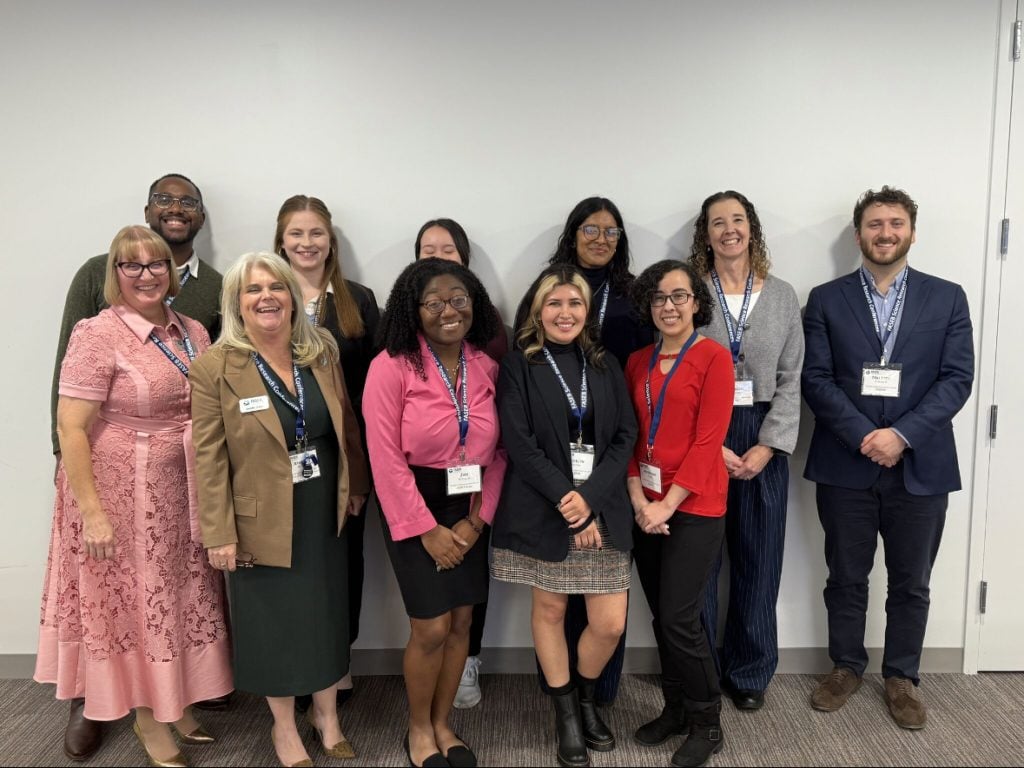
FASEB’s Howard Garrison Advocacy Fellow cohorts and program directors at the2025 FASEB Science Policy Symposium. Pictured are (back row, left to right): Rodney Williams, Jillian Cox, Jessica Chen, Anika Zaman, Rebekah Kendall, and Matthew Steinsaltz; Front row (left to right): program directors Jennifer Zietzer, deputy executive director, FASEB, and Yvette R. Seger, chief science policy and workforce development officer, FASEB, Zari McCullers, Jocelyn Olvera, and Alejandra Flores.
EN: How do you unwind when you’re not in the lab?
McCullers: I’ve been doing performing arts since the fourth grade. I started out in the concert band and stayed with music through high school and college where I minored in music. I played an instrument called the marimba, which is a melodic percussion instrument that looks like a xylophone. And then, when I got to grad school, I switched from marimba, because it was too heavy and too big, to the harp, which is also very heavy and big! I’ve been playing the harp since starting grad school, so it’s been four years. I’ve also done a little bit of theater. So, the performing arts have been my main thing outside of lab.
Shaw is a freelance writer based in Carmel, Ind., and a regular contributor to Endocrine News. She writes the monthly Laboratory Notes column.