This post was originally published on here
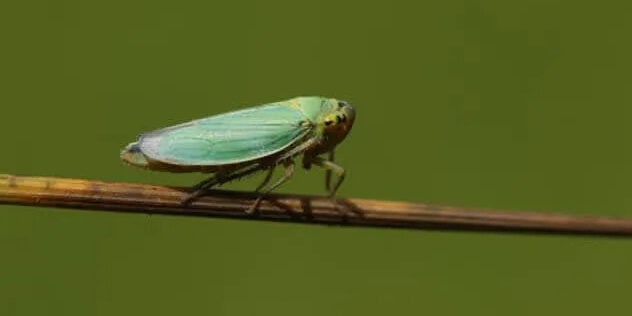
A Green Leaf-hopper, Cicadella viridis, resting on a plant stem. (photo credit: STOCK PHOTO)
A tiny insect is wreaking havoc on Europe’s sugar beet industry, not by biting plants, but by spreading bacteria that rob crops of their value.
Once a specialist feeder, the reed leafhopper has rapidly evolved into one of the world’s most destructive crop pests, and scientists now believe its hidden bacteria are the key to its explosive spread, according to a study published last month.
Just years ago, the reed leafhopper (Pentastiridius leporinus) fed on only reed grass. Still, today the species “is now a pest of sugar beet, potato, carrot, and onion,” according to the study by the Max Planck Institute for Chemical Ecology (MPG) and the Fraunhofer Institute for Molecular Biology and Applied Ecology (Fraunhofer IME).
Advertisement
Advertisement
The peer-reviewed study examined how the reed leafhopper harms crops. Curiously, the insects themselves don’t harm the plants, rather, the bacteria they transmit cause plant diseases.
Using methods such as advanced sequencing and fluorescence in situ hybridization, the researchers, led by MPG group leader and project lead Heiko Vogel, attempted to identify the bacteria. These methods enabled the researchers to pinpoint which tissues each bacterium occupies within the insect, helping the team determine which microbes were essential symbionts and which were harmful plant pathogens.
The team found that among at least seven bacteria hosted by the insect, two were responsible for plant diseases. These are Candidatus Arsenophonus phytopathogenicus, which causes SBR, and Candidatus Phytoplasma solani, which causes stolbur.
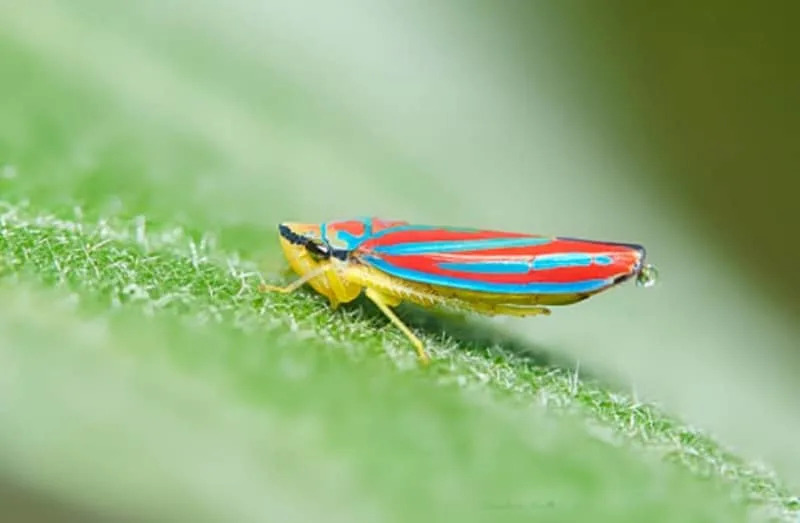
Close-up of a colorful leafhopper insect on a green leaf with a water droplet. (credit: STOCK PHOTO)
“We showed that the reed leafhopper hosts at least seven species of bacteria,” Vogel explained. The leafhopper appears to be completely dependent on three of these species. Two other bacteria cause the plant diseases Syndrome basses richesses (SBR) and stolbur.”
Advertisement
Advertisement
“These pathogens are transmitted from leafhoppers to host plants, contributing largely to the harmful effects of leafhoppers,” he continued.
Syndrome basses richesses (SBR), caused by Candidatus Arsenophonus phytopathogenicus, hurts sugar beets, lowering their sugar content. Stolbur, caused by Candidatus Phytoplasma solani, manifests differently across crops and generally leads to low yields. Sugar beet is one of Europe’s most important industrial crops, meaning outbreaks of SBR can carry major economic consequences.
Three of the other bacteria are nutritional symbionts that produce essential amino acids and B vitamins, enabling the leafhopper to survive on nutrient-poor plant sap. These include members of the genera Purcelliella, Vidania, and Sulcia.
Major shift in species in under a decade
This expanded nutritional support may explain how the leafhopper shifted from a single reed-grass host to several major crops in less than a decade. Researchers suspect that these microbes may help the insect tolerate chemical defenses in a broader range of crops.
Advertisement
Advertisement
Despite a growing understanding of the reed leafhopper’s microbiome, researchers still do not know how the insect manages to avoid the defense mechanism of host plants. However, the research in this study suggests that symbionts, as well as disease-causing bacteria, may play a role.
The research team plans to continue investigating interactions between bacterial symbionts in the reed leafhopper. One suggested method is to inhibit the production of certain proteins in the species. Researchers argue that understanding how microbes shape insect behavior is essential for predicting future outbreaks.
“We are currently developing dsRNA-based sprays in Giessen for the environmentally friendly and targeted control of reed leafhoppers and other pests,” says Andreas Vilcinskas of Fraunhofer IME. If successful, the technology could offer farmers a targeted alternative to conventional pesticides.