This post was originally published on here
For centuries, human civilisation has nurtured a fascination with a life that refuses to end in an abrupt full stop. Immortality is perhaps a vision that humans have chased since time immemorial, a wish to remain forever young, to defy age and death.From the tiniest seedling to the tallest tree, nature is a story of growth, change, and eventual decline. Age is woven into every living thing. Seasons come and go, leaves wither, and organisms live out their natural lifespans. Humans are no different, our bodies, like the rest of the natural world, follow a cycle of birth, maturity, and eventual decay. Yet unlike most creatures, humans have long been fascinated by the idea of transcending this natural order, imagining ways to halt the march of time, defy ageing, and even live forever.
IPL Auction 2026
Myths, literature, and science fiction have only deepened this fascination, portraying immortality as the ultimate triumph over ageing and death. Through rose-tinted lenses, immortality appears to promise freedom from the frailty and decline of old age along with the tantalising allure of acquiring the extraordinary power of living forever on the planet.Yet for most, immortality has remained symbolic, achieved through deeds, goodwill, or the legacy one leaves behind, rather than in the flesh. Nearly all religions speak of an afterlife, offering visions of existence beyond death and keeping alive humanity’s enduring hope for life eternal. Yet to remain forever in a vessel of flesh and bone, to resist the cumulative effects of ageing and, in essence, discover a “potion of immortality,” remains a subject of debate among mortals, scientists and futurists alike.The longest verified human lifespan belongs to Jeanne Calment, who lived 122 years and five months, a record that still stands. Born 14 years before the Eiffel Tower rose above Paris and roughly 15 years before the first films flickered across screens, she witnessed a world teetering on the edge of modernity. The year after her birth, Tolstoy published Anna Karenina, and Alexander Graham Bell patented the telephone. Jeanne led a quiet life, yet an extraordinarily long one, standing as a testament to the upper bounds of human longevity, at least for now.
Myths, legends and the quest for eternal life spans across ages
Throughout history, humans have sought to unravel myths and explore theories in their quest to cheat death and defy ageing in countless ways.From the legendary Fountain of Youth legend, a mythical spring believed to imbue immortality or grant perpetual youth to anyone who drank from it or bathed in its waters. While this tale is often linked to 15th and 16th-century explorers in the Americas, searches for such miraculous waters predate the Age of Exploration by centuries. Ancient historians also recorded similar stories: Herodotus, the Greek historian of the 5th century BC, wrote of the Macrobians, their name literally meaning “long lived”, people reputed for their extraordinary longevity, which he attributed to the water they drank. These myths reveal humanity’s enduring fascination with life unbounded by time, a dream that has inspired explorers, writers, and scientists alike.Literature and films have further popularised this fascination. Stories such as Oscar Wilde’s,The Picture of Dorian Gray-a philosophical fiction and gothic horror novel, in which Dorian Gray’s character gained immortality after his soul was trapped in a painting, allowing him to not age or be affected by disease. Similar to the legend of a Doctor Faustus selling his soul to the devil for knowledge, Gray traded his soul for eternal youth.

.
Films like Tuck Everlasting, which tells the story of Winnie Foster, a 10-year-old girl who discovers a family with the secret of immortality after drinking from a magical spring, and The Age of Adaline, which revolves around the plot of one woman who becomes immortal through a scientific fluke, explore the temptations and consequences of eternal life, reflecting both our hopes and fears.
Why do humans age?
But why do humans age in the first place? The answer lies at the cellular level. Cells, the building blocks of life, have internal clocks. Over time, DNA accumulates damage, telomeres—the protective caps at the ends of chromosomes shorten, and cells lose their ability to divide. Oxidative stress and inflammation add to the wear and tear, gradually impairing organs and tissues. This process, known as senescence, is the biological engine of ageing, a mechanism evolved to balance growth and survival.
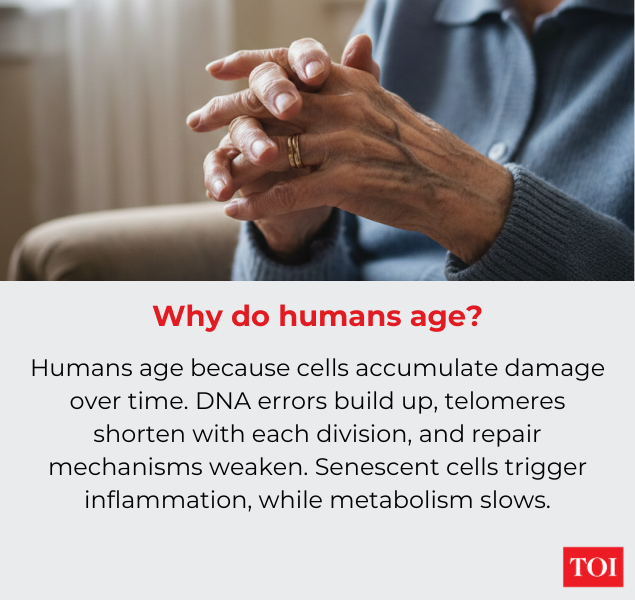
Why do humans age?
Modern science, however, is pushing the boundaries of this natural process. Researchers are exploring ways to slow, reverse, or even repair cellular damage. Senolytic drugs aim to remove “zombie” cells that no longer function properly. NAD+ boosters and molecules like metformin are being studied for their ability to enhance cellular metabolism and longevity. Gene editing tools such as CRISPR, along with stem cell therapies, offer the tantalising possibility of repairing damaged DNA and regenerating tissues. Humans age due to a combination of cellular damage, telomere shortening, senescence, metabolic decline, oxidative stress, and chronic inflammation. These processes progressively impair organs and tissues, leading to the physical and cognitive effects of aging. Evolutionary trade-offs explain why aging persists despite its detrimental effects.

An AI-generated image
The race is not just academic. Billionaires and tech visionaries are pouring billions into longevity research, funding private labs and biotech startups in the hope of extending human life. Companies are investigating ways to combine AI, genetics, and pharmaceuticals to push the boundaries of biology. Some view this as the next great frontier, comparable to space exploration—the ultimate human challenge: defying death itself.
- Sam Altman, CEO of OpenAI, has invested heavily in Retro Biosciences, a biotech startup aiming to develop therapies that could extend healthy human lifespan and reverse aspects of cellular aging; Altman has put in large seed funding (about $180 million) and is helping lead a major fundraising push for later‑stage development.
- Jeff Bezos (Amazon founder) and investor Yuri Milner are major backers of Altos Labs, a high‑profile company focused on cellular reprogramming and rejuvenation with the goal of halting or reversing aging processes.
- Brian Armstrong, CEO of Coinbase, co‑founded NewLimit, a startup that uses genetic and epigenetic programming to try to restore youthful cell states, and has raised significant funding for its research.
- Peter Thiel (PayPal co‑founder and early tech investor) and Joe Lonsdale (co‑founder of Palantir via his firm 8VC) have also put money into NewLimit and other longevity ventures through private funding.
- Other tech and longevity figures such as Peter Diamandis, who co‑founded longevity‑focused ventures like Human Longevity Inc and Fountain Life are involved in funding or building ecosystems around life‑extension research.
Yet, while life extension may be within reach, true immortality remains elusive. Biological systems are inherently complex, and there are limits to how much cellular machinery can be repaired or replaced. Ethical and social considerations further complicate the picture. Who would have access to life-extending technologies? How would societies manage longer lifespans in terms of resources, work, and inequality? Even if science could slow ageing indefinitely, the philosophical and psychological implications of living for centuries are profound.
Can humans be immortal?
Immortality can be imagined in different ways. One notion is biological immortality, where humans extend life so far that disease and ageing no longer claim us. Another, more speculative concept is digital immortality, becoming effectively invisible to death through technological means such as AI mind uploading, preserving consciousness and personality of a person or other futuristic interventions. However, this concept remains entirely hypothetical, with no empirical evidence currently supporting its feasibility. While science is exploring ways to extend lifespan and healthspan, true physical immortality remains far from reach, and even extended life cannot protect against accidents or external hazards. Distinguishing between these ideas helps separate the dream of living longer from the philosophical and ethical debates about what it truly means to be immortal.Brian K. Kennedy, a leading scientist in ageing and healthy longevity, has served as a Distinguished Professor of Biochemistry and Physiology at the Yong Loo Lin School of Medicine since 2017. His research focuses on understanding the biology of ageing and exploring ways to extend human healthspan.In a conversation with Peter Attia MD, Kennedy addressed the possibility of true immortality. When asked whether physical immortality, the ability to stop ageing entirely is achievable or impossible, he said:“I don’t believe it’s truly possible. The odds that you can achieve that level of change in ageing is not zero, but close. I’m sceptical that can be done, and I think that’s fair to say, but I wouldn’t rule out the possibility. Of course, nobody is ever going to be immortal in the absolute sense, because you’re going to get hit by a bus sooner or later. What people are really asking about is immortality in terms of not dying from ageing.”On whether humans could ever reach a point where resilience is so high that death from disease becomes impossible, Kennedy added:“I’ve seen nothing so far that suggests it’s possible, but that doesn’t mean it could never happen.”Peter then underscored how physical frailty is evident once ageing takes over, even remarkable centenarians, who survive well beyond 100, still show the signs of ageing. “They may be healthy for longer, but they still look and feel like they are in the final years of their lives.”
Lessons from nature
Nguyen and Malekahmadi, in their paper “Keeping up with the Immortal Jellyfish: Biological Immortality in Animals and Humans” (2023), define biological immortality as the state in which an organism does not die from intrinsic ageing or the natural breakdown of cells over time; its mortality rate does not increase with age. Examples of biologically immortal organisms include the Turritopsis dohrnii jellyfish, Hydra, flatworms, tardigrades. These organisms employ different mechanisms: lobsters maintain high telomerase activity to preserve telomere length and support continuous cell division; Hydra rely on FoxO genes to sustain stem cell activity and immune function; tardigrades use cryptobiosis to pause metabolism in extreme conditions; and the immortal jellyfish uses transdifferentiation to revert cells to an earlier developmental stage.Currently, humans cannot achieve biological immortality. Human physiology differs fundamentally from these organisms, and we lack the cellular mechanisms required to prevent intrinsic ageing. While studying these species may yield insights into improving human healthspan, ageing in humans is embedded in complex biological systems that cannot yet be safely altered to stop ageing altogether.“Humans are mortal, and as such, thinking of immortality is not something we might naturally consider achievable outside science fiction,” Professor Rob Salguero-Gómez, Professor of Ecology and E.P. Abraham Tutorial Fellow at Pembroke College, University of Oxford, and Professor Aziz Aboobaker, Professor of Comparative and Functional Genomics at the University of Oxford, said in an article published by the University of Oxford titled ‘Immortal? Not so much.’
The future of longevity race
Scientists are now focusing on healthspan, the period of life spent free from serious disease rather than simply lifespan. Interventions that slow ageing, delay chronic disease, and preserve cognitive function may soon allow people to live longer, healthier lives without achieving full immortality. The emphasis is shifting from the fantastical dream of living forever to a realistic goal: living better for longer.The ethical, social, and economic challenges remain. Who will have access to advanced longevity therapies? How will society adapt to significantly longer lifespans in terms of work, retirement, and resource management? Even if technologies exist, will humans embrace the psychological realities of extended life, including the emotional strain of outliving family and friends? These questions are as important as the science itself.
The ethical debate
Even if science eventually finds a way to halt ageing or achieve biological immortality, the question remains: should humans live forever? Would it be as fascinating as it is portrayed in books, literature, and mythical stories? Ethical, social, and environmental considerations make the debate very complex. Overpopulation, resource scarcity, and widening inequality could be amplified if only some people had access to life-extending technologies. On a personal level, endless life might bring unforeseen psychological challenges span from boredom, loss of purpose, or the emotional burden of outliving loved ones. Philosophers argue that mortality gives life meaning, shaping priorities, ambition, and the way we experience love, loss, and achievement. Jonathan Swift’s classic Gulliver’s Travels (1726) also explores this idea cleverly, Gulliver learns of the Struldbruggs, people who are immortal. At first, he envies their endless life, imagining centuries of wisdom and wealth. But he soon discovers the truth about their harsh lived reality. They continue to age, growing frail, forgetful, and decayed, yet cannot die. Swift uses the Struldbruggs to show that immortality, without vitality or human connection, can be more curse than blessing which is a cautionary reflection on humanity’s obsession with living forever or being stuck in the same phase of life defying ageing, meddling with nature. Imagine a person living for hundreds of years, chained to the same identity, haunted by memories that span generations, boxed in a life that could become as much a burden as a gift. Perhaps that is why the age-old caution endures: be careful what you wish for.