This post was originally published on here

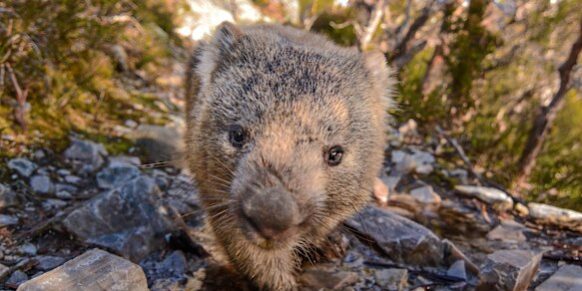
When Kate McMahon was finishing her science degree she found herself with the odd task of moving wombat poo around, to see how the animals would react.
“I’d catch up with my friends and they’d ask, ‘what were you up to today?’ and I’d have to tell them that I’m playing with wombat poo,” McMahon said. “The [national park] rangers certainly thought I was a bit strange.”
Wombats are mostly solitary creatures but they share a communal latrine with others of their kind. They will typically pile their droppings – famously small cubes like charcoal briquettes – on top of rocks or logs.
Dr Scott Carver, formerly at the University of Tasmania and now at the University of Georgia in the United States, had established in earlier research that the unique shape and structure of a wombat’s lower intestine creates the square droppings.
Carver and his collaborators won the 2019 Ig Nobel Prize for physics, a satirical award for science that makes people “laugh, then think”.
While scientists already knew how the wombat poo came out square, McMahon’s honours thesis, supervised by Carver, tried to answer why.
In research that has now been published in the Journal of Zoology, McMahon and her co-authors found that wombats use their poo to communicate with one another.
Studying the bare-nosed wombat (Vombatus ursinus), the researchers first examined the skull structure of the animals. Four wombats that had been injured in road collisions were euthanised, allowing the researchers to do cranial dissections.
They found the wombats have a “vomeronasal organ”, sometimes described as a second nose. Other animals – such as snakes, lizards, rodents, horses, cattle, dogs, cats, lemurs and elephants – also have this organ, and research has found its purpose is to detect pheromones and other semi-volatile chemicals for social cues, mating, and predator or prey detection.
The research also included field surveys on Maria Island in Tasmania, where McMahon collected wombat scat. Chemical analysis suggested that the droppings were individually distinct, and was probably how the short-sighted animals could tell each other apart.
McMahon also collected scat and transported it to a latrine more than 500 metres from the first location. She observed wombats spent a long time investigating the new smells.
“It was really exciting to look at their chemical composition and find that they were individually distinct,” McMahon said. “That linked in so beautifully with our experimental testing, showing that they did tend to investigate for longer when new scents were introduced to their landscape from unfamiliar wombats.”
“In a way they’re not solitary, they’re just not having the physical contact, but they’re having the social contact through odour to know who’s around and who’s doing what.”
Professor Peter Banks, a biologist at the University of Sydney who was not part of the research, said several species use latrines as socialisation centres and send messages through odour.
 Caitlin Fitzsimmons is the environment and climate reporter for The Sydney Morning Herald. She was previously the social affairs reporter and the Money editor.Connect via email.
Most Viewed in Environment