This post was originally published on here
STATEN ISLAND, N.Y. — A Staten Island elementary school is working to change the way students are learning how to read through a staff-wide commitment to implement a “science of reading” curriculum using a new, free course available to all city public school teachers.
In 2023, New York City announced a stronger emphasis on literacy and reading for public school students. The multi-pronged, long-range campaign aims to ensure students become confident readers — with each school district choosing a research-backed curriculum to use across all classrooms. It officially began in Staten Island’s District 31, which encompasses all general education schools in the borough, in the 2024-2025 school year.
Now, a year later, the district is continuing its work to build foundational skills when it comes to literacy among students.
PS 42 in Eltingville is a strong example of implementing a “science of reading” curriculum.
This school year, school staff across Staten Island — and schoolwide at PS 42 — took a free course from The Reading Institute, a non-profit organization founded by Dr. Katie Pace Miles, that delivers free, evidence-based tutoring and research-aligned professional development.
The 10-hour Science of Reading Intro Course is an asynchronous, video-based professional learning program. It covers phonemic awareness, orthographic mapping, phonics, fluency, comprehension, writing, and literacy.
“Moving into the science of reading, the course really allowed all the professionals to understand the why behind it and what happens to your brain when you’re actually reading. And I think that was a big ‘Aha!’ for a lot of the adults within the district,” said Christine Chavez, deputy superintendent for District 31.
PS 42 in particular is “so far ahead” because it is immersing its entire staff in the course, according Chavez.
A common language
The course helps school staff understand the “why” behind how children learn to read.
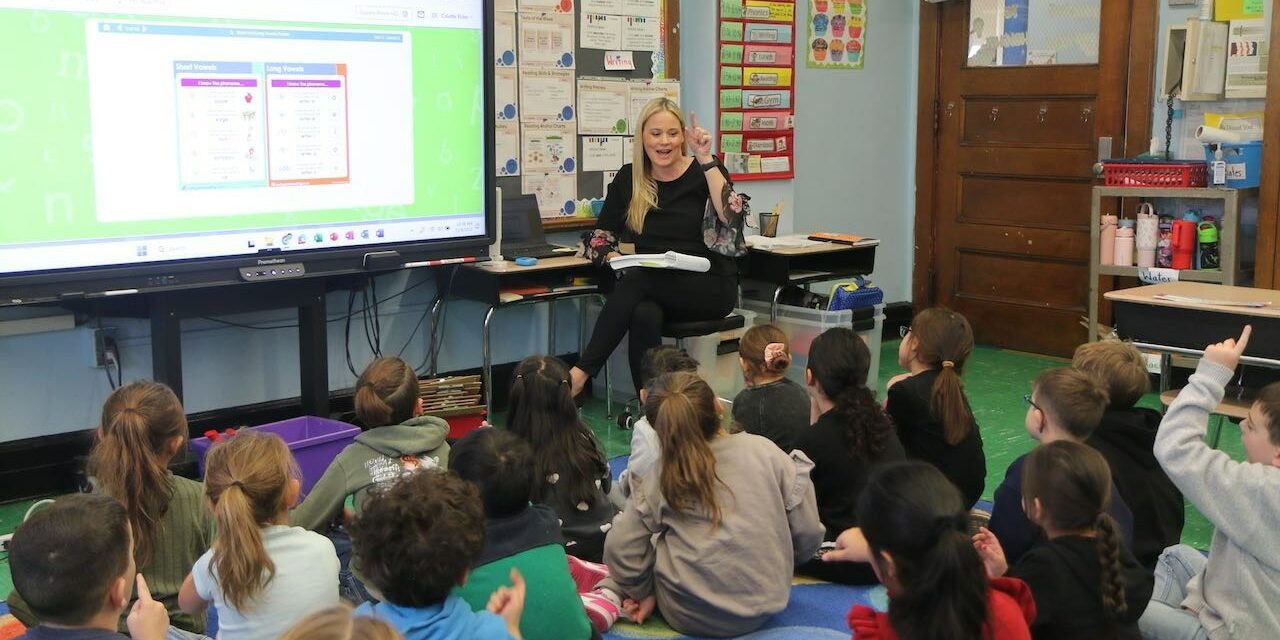
It has created a common language among educators — including teachers and paraprofessionals, and even cluster teachers like media and physical education teachers — to use this “science of reading” curriculum in all lessons.
“Why wouldn’t we be focusing on a systemic practice?” asked Brian Sharkey, principal of PS 42. “…We hope that this is a practice that is continually deepening …Everyone’s involved and so now we’re starting to see in our conversations and observations, and informal and formal talking with children — we’re starting to reap the benefits and see the outcomes, which is beautiful.”
Pace Miles explained that children have a finite amount of mental energy to give at any moment in time, so it becomes a balancing act for educators when teaching both phonics and comprehension.
“What we hope is that in pre-K through second grade, we are mastering some of this encoding and decoding so that can flip our mental energy and have it very heavy on the comprehension side of things, where the decoding becomes automatic,” she explained.
The coursework supports both veteran and new teachers, said Sharkey. All teachers at PS 42 are learning the course together.
Teachers ‘on the same level’
“It’s helping us all be on the same level, you know, no matter if you have two years of teaching or 20 years of teaching … It’s proven. It’s science,” said Colette Elder, a first-grade teacher at PS 42, who has been teaching for over 24 years.
In first grade, students are learning about phonemic awareness — blending the phonics to know what sounds each letter makes and how those letters come together to create words, and those words come together to create sentences. That’s when the fluency happens, Elder explained.
“So you have to start at the science of reading, it starts at the basics. The number one thing is phonemic awareness and it builds upon that, and that’s how children’s brains learn to work, by mapping things in small increments. But it has to be explicit. I think what this course has done for everybody, it’s given all teachers across grade bands in our entire school, we have the same common language when we talk about it. So it took a lot of guesswork out of it,” said Elder.
For students who aren’t reading at grade level, teachers learn to meet students where they are in their learning. Fourth-grade teacher Jessica Ciaccio explained that her students should already have that structure of phonemic awareness and fluency. If they don’t, educators start to work backward and learn where the rift began.
“Taking that and building on what they’re supposed to know how to do already — because it’s less learning to read and more reading to learn — if they don’t have that learning to read piece, reading to learn is going to be really hard for them,” said Ciaccio. “It’s building on what I learned in the course and working backward with the kids. You kind of know that there’s a rift somewhere and trying to find it is the piece that I’m working on.”
Improving student outcomes
The course has improved student outcomes by building foundational skills, boosting student confidence, and helping teachers pinpoint specific areas of struggle, like decoding or fluency — rather than just proficiency.
Schools like PS 42 have also utilized what is called a WIN Period, which stands for “What I Need.” It offers time for each student to work individually — whether that’s to get support, remediate, or enrich learning. So if a student needs to work on decoding, or work on fluency, they have the time to work on a skill individually with an educator.
New York City also introduced literacy screeners that are given to students three times a school year. They measure student progress, allowing schools to intervene to help youth throughout the year, rather than waiting for state tests, which only show proficiency.
“When we think about screeners, that’s something important … it’s not about proficiency,” said Allison Angioletti, district achievement and instructional specialist for District 31. “It’s telling you if a kid is on track to meet grade level by the end of the year or if they are at risk, based on how they perform on that.”
Aileen Dulski, assistant principal at PS 42, noted how the screeners help educators take a breath and meet students where they are in their learning.
“Some kids come up discouraged, but if they’re making small gains — although they might not be proficient, at grade level, they are making gains within that piece where it’s giving them the confidence to maybe try a book that they might not have previously but use all those skills for that piece,” said Dulski.
Free course available to NYC teachers
All of this work — the 10-hour course, screeners, WIN periods, and a strong emphasis on literacy from both the city and school district — has led to educators seeing growth among students in the way they are reading.
The Reading Institute is offering 3,000 free seats for the course for New York City public school teachers in the current school year, as well as free seats for City University of New York students. There is a low-cost access of $25 per person for all other educators statewide and nationwide.
In the 2024-2025 school year, 2,600 educators completed the 10-hour Science of Reading Intro Course, including 2,100 teachers in New York City public schools. According to survey results, participants showed a 34% increase in science of reading knowledge, and a 10% increase in linguistic knowledge.