This post was originally published on here
Scientists have laid bare Britain’s worst–case climate scenarios, and warn that we ‘need to prepare’.
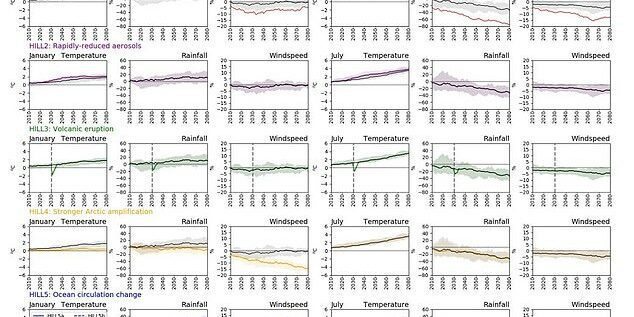
In a terrifying new study, researchers from the University of Reading reveal the six ways in which out–of–control climate change could devastate the country.
In one possible scenario which imagines global ocean currents collapsing, temperatures could plummet by 6°C (10.8°F) by 2050.
Meanwhile, the UK’s coastline might vanish beneath the waves as melting ice caps trigger sea levels to rise more than two metres by the end of the century.
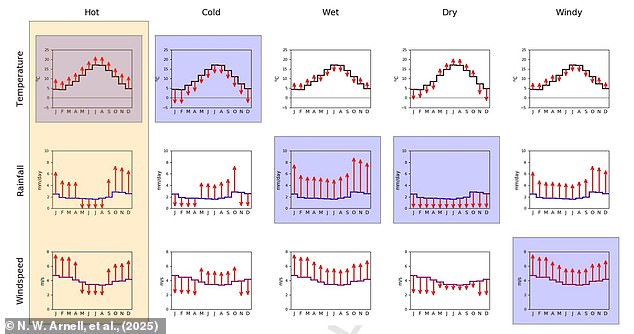
In addition to these long–term trends, the researchers have also mapped out the extreme months and seasons that ‘could occur at any time’.
They warn that hot months could see temperatures soaring 6°C (10.8°F) above average, while the chilliest winters would be 7°C (12.57°F) colder.
Professor Nigel Arnell, lead author of the study, told Daily Mail: ‘All the scenarios are physically plausible: they are unlikely, but not impossible.
‘We cannot put probabilities on them, but in my view they are sufficiently likely for us to have to be aware of them.’
In their study, the researchers used models to describe what could happen in scenarios where climate change goes far beyond what most scientists currently predict.
These six deadly scenarios represent the worst of the ‘high–impact low–likelihood’ risks that climate change could trigger.
First, Professor Arnell and his colleagues considered what would happen if global warming rapidly escalated.
Scientists believe that the planet might get a lot hotter due to feedback loops like the loss of the Amazon Rainforest or the thawing of the permafrost.
In the worst possible scenario, global temperatures might soar up to 4°C (7.2°F) above the pre–industrial average.
In the UK, these global changes would lead to baking hot, dry summers and mild, wet winters.
This is a perfect storm for what scientists call ‘climate whiplash’, which is where regions are pummelled by back–to–back periods of flooding and drought.
Professor Arnell says that some of the biggest risks to the UK are ‘heatwaves affecting people and infrastructure’ and ‘droughts affecting agriculture and water supplies’.
However, this is not the only reason that global warming might suddenly be much worse than expected.
Aerosol pollutants, such as the sulphur dioxide in car exhaust, are toxic and harmful to humans, but also help to keep the planet cool by reflecting sunlight back into space.
If the world manages to clean up its pollution levels far faster than the current trend, this means the world could get a hotter for a brief period.
If we started cutting emissions rapidly today, temperatures would peak at a maximum additional increase of 0.75°C (1.35°F) in 2040.
But it isn’t just heatwaves and droughts that Britain might need to contend with, as the mechanisms of climate change could also plunge us into perpetual winter.
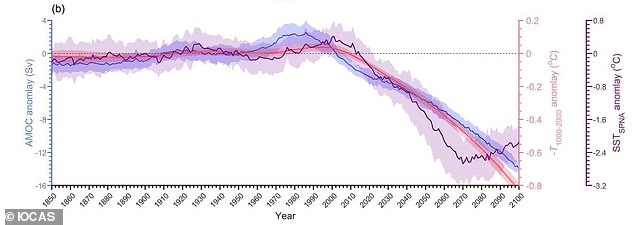
Scientists have recently started to warn that the melting of the polar ice caps risks destabilising the network of ocean currents that distribute heat around the planet.
In particular, experts are concerned that the Atlantic Meridional Overturning Circulation (AMOC) might eventually collapse if climate change is unchecked.
If this were to happen, it would trigger a chain reaction of global proportions, which would lead to the disappearance of the jet stream.
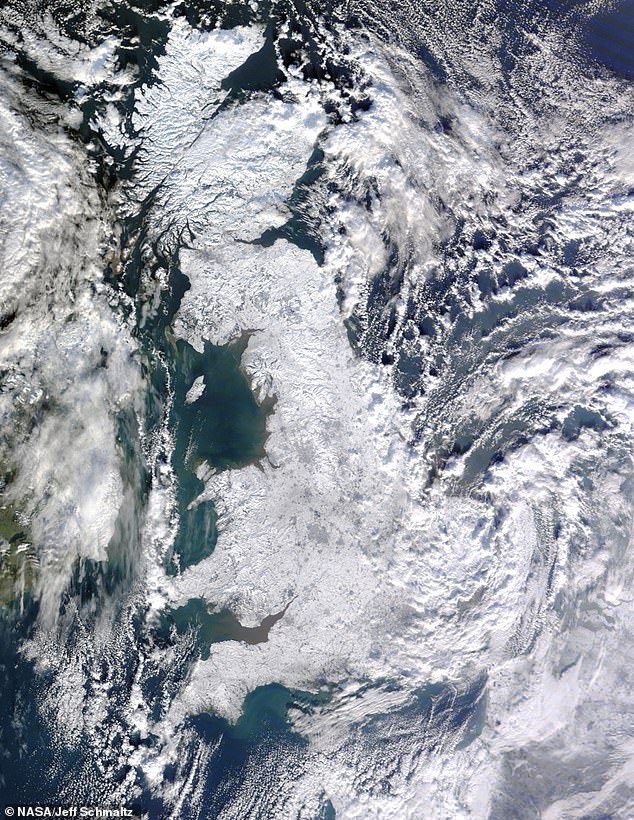
While the rest of the world would continue to warm due to the greenhouse effect, Europe would be plunged into a mini Ice Age without the jet stream to bring in warm air from the Atlantic.
If the collapse began in 2030, the researchers predict that the UK would be 6°C (10.8°F) colder by 2050.
Summer rainfall would plummet by up to 35 per cent, increasing the risk of drought, while winter rainfall would increase by 20 per cent over the north of the UK.
And if the ice caps continue to melt, rainfall won’t be the only thing soaking the UK.
Professor Arnell warns that the rapid retreat of glaciers in Greenland and Antarctica could cause sea levels around the UK to rise by up to 2.2 metres compared to current levels by 2100.
This would plunge low–lying coastal areas underwater and significantly increase the risk of coastal flooding.
Recent studies suggest that sea level rises of just 1.6 feet (0.5 metres) would flood three million buildings in the global south alone.
This is especially worrying as Professor Arnell says the UK is particularly vulnerable to flooding risks.
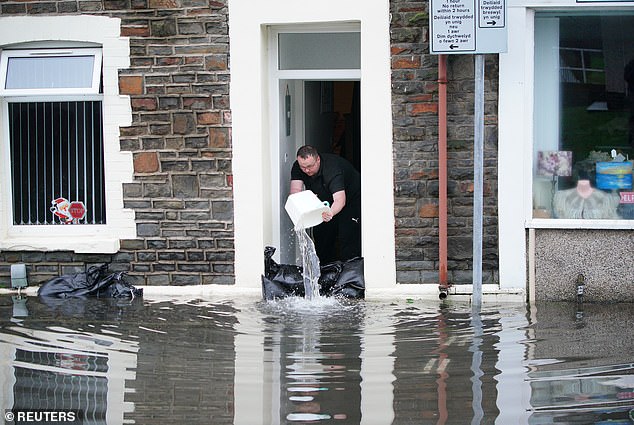
He says: ‘The Climate Change Committee concluded last year that we were not fully prepared for the worst consequences of climate change, and I agree with that.
‘In some cases – flood management and water supply planning, for example – we have the policies and the right strategies, but we are not necessarily delivering them very well or quickly enough.’
Research suggests that 3.2 million properties will be exposed to coastal and river flooding caused by heavy rainfall, storm surges, and high tides by 2050 under a worst–case climate scenario.
Meanwhile, 6.1 million properties around the country could be devastated by flash floods, with millions of unfortunate Britons threatened by both types of flooding.
These worst–case trends could also be exacerbated by individual disastrous months or seasons that could hit the UK at any time.
During wet months, the researchers warn that Britain might receive up to three times the average rainfall, while the most parched seasons would only see 10 per cent of average.
While the researchers say that these scenarios are not certain to occur, they are likely enough that policymakers need to start paying attention.
Professor Arnell adds: ‘We don’t necessarily need to plan or physically build for them, but need to make sure that our adaptation and resilience plans are sufficiently flexible that they can be upgraded if it starts to look as if some of these worst cases look more likely.’