This post was originally published on here
The Manhattan-sized interstellar visitor hurtling through space has captured the imaginations of UFO watchers for months and it is due to reach its closest point to Earth on Friday
A top space boffin has listed a whopping 15 anomalies found in to mysterious interstellar visitor 3I/Atlas – a day before it makes its closest approach to Earth.
Space agencies across the globe are using the fly-by to carry out a planetary defence exercise involving 21 countries as 3I/Atlas will pass Earth at a distance of 170 million miles on Friday, though they believe it be a harmless comet.
But theoretical physicist Avi Loeb has previously warned that world leaders should prepare for all eventualities – from a life-changing alien close encounter to a hostile threat – as the mystery 12-mile wide object hurtles towards us.
And now he has listed 15 anomalies he has found during months of watching the Manhattan-sized flying object.
Avi, professor of science at top US university Harvard, said the retrograde trajectory of 3I/Atlas is aligned to within 5 degrees with the ecliptic plane of the planets around the Sun, which he suggests the trajectory may have been planned.
He also believes its arrival time was fine-tuned to bring it to 29 and 54 million kilometers from Mars and Jupiter and be unobservable from Earth at perihelion, its closest point to the Sun.
He added the forecasted distance of 3I/Atlas during its encounter with Jupiter on March 16 next year is 53.6 million kilometers, close to Jupiter’s Hill radius, 53.5 million kilometers.
Avi said this match includes the non-gravitational acceleration that 3I/Atlas displayed near perihelion and the “rare coincidence” might mean the object intends to release technological devices at Jupiter’s Lagrange point.
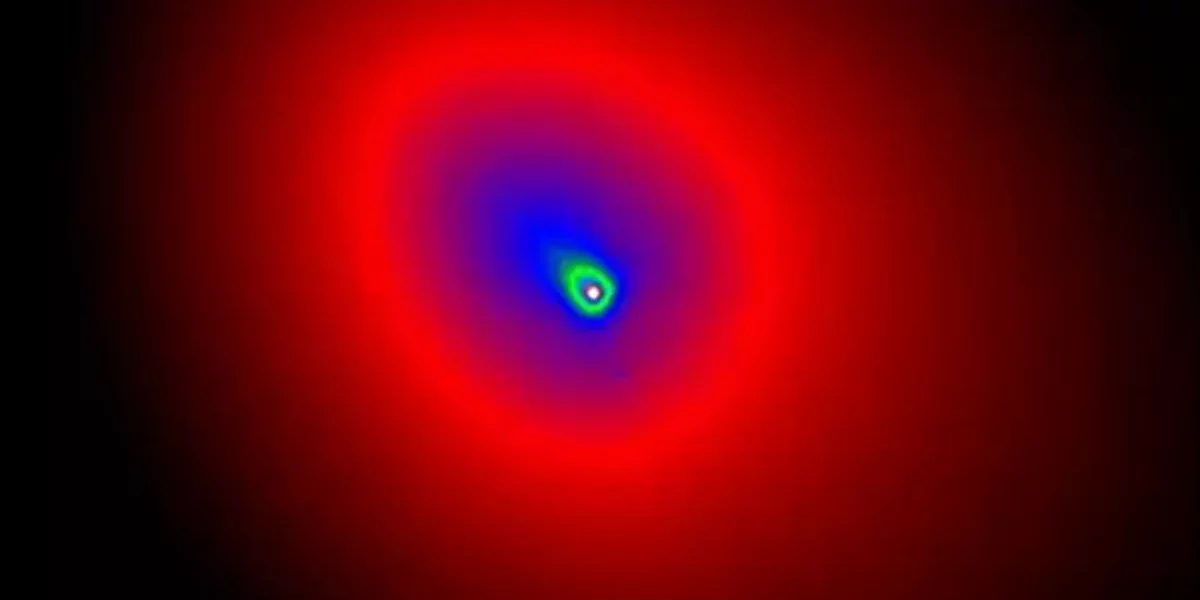
Analysis of a Hubble Space Telescope image from July suggests that the anti-tail before perihelion must have been in the form of a tightly collimated jet that is about ten times longer than it is wide, which he argued: “No known comet exhibited a physical sunward jet of this length.”
He also said the rotation axis of 3I/Atlas was aligned to within 8 degrees with the sunward direction when it entered the solar system, the probability of which was 0.5%.
Avi said the nucleus of 3I/Atlas is” much more massive” than previous interstellar comets observed in the Milky Way, while moving faster than both.
He added: “There might not be enough rocky material in interstellar space to deliver a natural iceberg of this mass once per decade to the inner solar system.
“This suggests that 3I/ATLAS may have targeted the inner solar system rather than being drawn at random from the reservoir of interstellar icebergs.”
He went on: “Near perihelion, 3I/ATLAS brightened faster than any known comet and was bluer than the Sun.
“Irrespective of the true nature of 3I/ATLAS, my New Year’s resolution is simple. Starting on the early morning of December 19, 2025, I will keep looking up in the direction 3I/ATLAS during my future daily jogs before sunrise.”
The mystery object was first discovered by amateur astronomers at the Asteroid Terrestrial-impact Last Alert System (Atlas) – a network of four telescopes in Hawaii, Chile and South Africa – which was set up to give an early warning of dangerous asteroids.
Current estimates show that it will get about 40 per cent further from the Sun than the Earth is, before heading back out into the galaxy. It has been gradually growing brighter as it approaches Earth, making it easier to see from the ground.
According to NASA, later this week 3I/Atlas “will be about 170 million miles away” – which is more than 700 times the distance between the Earth and the Moon.
At the moment, 3I/Atlas lies in the constellation Leo, and although it cannot be seen by the naked eye, amateurs with modest telescopes should be able to pick it up. It will look like a green smudge on the night sky.
The US space agency said: “At this distance, skywatchers looking east to northeast in the early pre-dawn morning could catch the comet right under Regulus, a star at the heart of the constellation Leo, the lion.
“To see the comet before it leaves our vicinity, you’ll need to be looking through a telescope with an aperture of at least 30 centimetres.”
For the latest breaking news and stories from across the globe from the Daily Star, sign up for our newsletter by clicking here.