This post was originally published on here
A newly validated magnetic state could open a path toward ultra-fast, high-density memory for future AI and data-center technologies.
A collaborative team of researchers from NIMS, the University of Tokyo, Kyoto Institute of Technology, and Tohoku University has shown that thin films of ruthenium dioxide (RuO2) display altermagnetism, a key characteristic of what is now considered the third basic category of magnetic materials.
Materials with altermagnetic properties could address key drawbacks of today’s magnetic random access memory, which relies on conventional ferromagnets. Because of this potential, they are drawing interest as candidates for future memory technologies that aim to deliver much higher speed and data density.
The study not only identifies RuO2 as a promising material for these applications but also points to a way to further improve its performance by carefully controlling the orientation of its crystal structure. These results were recently reported in Nature Communications.
Ruthenium dioxide (RuO2) has increasingly been studied as a possible platform for altermagnetism, which has been proposed as a third fundamental form of magnetism.
Traditional ferromagnetic materials used in memory devices make it relatively easy to write data using external magnetic fields. However, they are vulnerable to interference from unwanted stray fields, which can cause errors and place limits on how densely information can be stored.
Limitations of Existing Magnetic Materials
Antiferromagnetic materials, on the other hand, are robust against such external disturbances. However, because their atomic-level spins cancel each other out, it is difficult to electrically read information from them.
This has driven demand for magnetic materials that combine resistance to external disturbances with compatibility with electrical readout, and ideally also allow rewritability.
However, experimental results concerning altermagnetism in RuO₂ have been inconsistent worldwide, hindering a clear understanding of its fundamental nature. Moreover, the lack of high-quality thin-film samples with uniform crystallographic orientation has prevented conclusive experimental verification.
The joint research team successfully fabricated single-orientation (single-variant) RuO2 thin films with aligned crystallographic axes on sapphire substrates. They clarified the mechanism by which crystallographic orientation is determined through optimal substrate selection and fine-tuning of growth conditions.
Experimental Verification of Altermagnetism
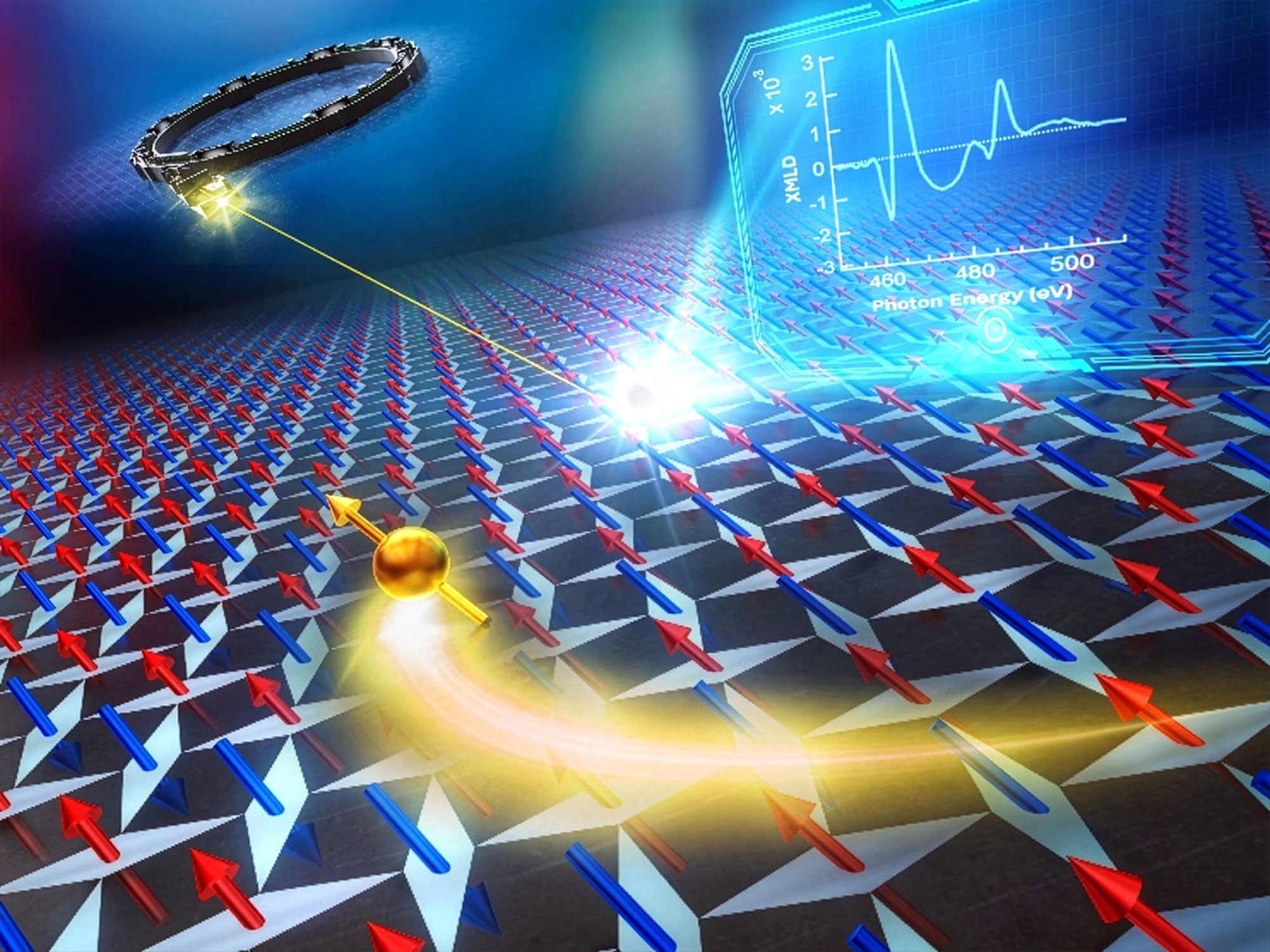
Using X-ray magnetic linear dichroism, the team identified the spin arrangement and magnetic ordering in which the net magnetization (N–S poles) cancels out. Furthermore, they observed spin-split magnetoresistance—a phenomenon in which electrical resistance varies depending on spin orientation—thereby electrically verifying the spin-splitting electronic structure.
The results of the X-ray magnetic linear dichorism were consistent with first-principles calculations on the magneto-crystalline anisotropy, demonstrating that the RuO2 thin films exhibit altermagnetism.
This finding strongly supports the potential of RuO2 thin films as promising materials for next-generation high-speed, high-density memory devices.
Building on these results, the research team aims to develop next-generation high-speed, high-density magnetic memory devices utilizing RuO₂ thin films.
Such devices are expected to contribute to more energy-efficient information processing by leveraging the inherently high-speed and high-density characteristics of altermagnetism.
Furthermore, the synchrotron-based magnetic analysis technique established in this study can be applied to the exploration of other altermagnetic materials and the development of spintronic devices.
Reference: “Evidence for single variant in altermagnetic RuO2(101) thin films” by Cong He, Zhenchao Wen, Jun Okabayashi, Yoshio Miura, Tianyi Ma, Tadakatsu Ohkubo, Takeshi Seki, Hiroaki Sukegawa and Seiji Mitani, 24 September 2025, Nature Communications.
DOI: 10.1038/s41467-025-63344-y
This work was supported by the JSPS Grants-in-Aid for Scientific Research (grant numbers: 22H04966, 24H00408); the MEXT Initiative to Establish Next-Generation Novel Integrated Circuits Centers (X-NICS) (grant number: JPJ011438); the GIMRT Program of the Institute for Materials Research, Tohoku University; and the Cooperative Research Projects of the Research Institute of Electrical Communication, Tohoku University.
Never miss a breakthrough: Join the SciTechDaily newsletter.
Follow us on Google and Google News.