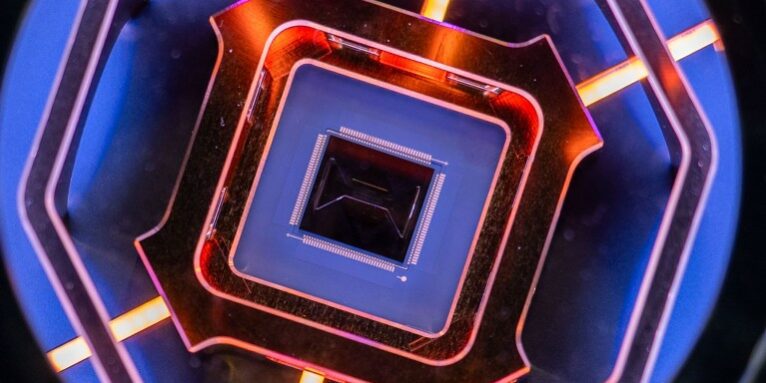
A quantum computer. The administration of US President Donald Trump has announced sizable spending prorammes for quantum information science and artificial intelligence.Credit: Kent Nishimura/Bloomberg/Getty
For much of US science, 2025 was a year of cancelled grants and budget anxiety — but a few fortunate fields came out ahead. Since President Donald Trump took office in January, artificial intelligence and quantum information science have sat at the top of his administration’s scientific priorities. And they don’t seem to be leaving any time soon.
But some researchers question the effectiveness of the administration’s programmes to promote quantum science and AI. And some argue that the administration’s strategies might be hampered by some of its other policy changes.
Here Nature examines three ways in which the administration aims to move quantum science and AI forwards.
Funding opportunities
Trump’s budget proposal for the NSF in 2026 largely spared quantum science and AI, with a 3% increase in AI funding and a 0.4% increase in spending on quantum science — in contrast to cancelled research grants and proposals for steep cuts in many other areas. And throughout 2025, both the NSF and the Department of Energy (DoE) have announced new investments in AI and quantum science, such as $100 million for AI projects at five US universities.
Steven Rolston, a quantum physicist at the University of Maryland in College Park and chair of the university’s physics department, says that the disparity between fields is visible there: faculty members in fields such as particle astrophysics face deep uncertainty about how much funding they’ll receive and how often they’ll have to reapply for awards. For quantum research, however, the biggest change is that the grant cycle has slowed down because of a US government shutdown and agency staffing changes. “I sort of have survivor’s guilt here,” Rolston says.
But quantum science and AI have not been immune to grant cuts. According to data from the non-profit website Grant Witness, NSF has cancelled 101 grants that mention ’artificial intelligence’ in their abstracts, and 68 grants that mention ‘quantum’ in their abstracts.
And although AI and quantum science escaped massive cuts, the administration’s funding increases for these areas “are negligible in scope”, says David Schatsky, an AI policy researcher at Harvard University in Cambridge, Massachusetts. “The 2026 budget doesn’t reflect — in dollar terms — an increase in focus or commitment to AI and quantum.” The NSF declined Nature’s request for comment, and the White House Office of Science and Technology Policy (OSTP) did not respond.
Joining forces
To pursue its priorities, the administration is also promoting both new and existing public–private partnerships, most prominently through an initiative called the Genesis Mission that was announced in November. The project, headed by the DoE, will make scientific data sets from the 17 US national laboratories available to private companies and academic researchers, who will use that data to build AI models to accelerate scientific research. Among the companies that have signed up to collaborate with federal researchers are Microsoft, IBM and OpenAI.
The administration has promoted public–private partnerships in quantum science as well. Under the National Quantum Initiative, which began during the first Trump administration, quantum-information research centres at five national labs partner with private quantum companies to create prototypes and test new technology. The DoE made an extra $625-million investment in the programme this year, and an executive order outlining the administration’s overarching approach to quantum science is expected soon, says Constanza Vidal Bustamante, a quantum-technology policy researcher at the Center for a New American Security, a think tank in Washington DC.
Enjoying our latest content?
Log in or create an account to continue
Access the most recent journalism from Nature’s award-winning team
Explore the latest features & opinion covering groundbreaking research