This post was originally published on here
Tarpon fishing peaked during President Franklin D. Roosevelt’s 1937 visit to Port Aransas, but the fishery collapsed in the 1950s, an issue scientists still study.
CORPUS CHRISTI, Texas — For decades, the Texas tarpon has been a symbol of coastal fishing mystique, earning anglers bragging rights and drawing visitors from across the country. But experts say the once-thriving fish is now difficult to find.
Researchers with the Harte Research Institute are studying what they believe are key factors behind the tarpon’s decline, including overfishing and habitat challenges along the Texas Gulf Coast.
Tarpon, often called the “silver king,” has deep roots in Port Aransas. The town was once nicknamed “Tarpon,” and the iconic Tarpon Inn still displays massive scales collected by anglers over the years. Fishermen once traveled long distances for the chance to hook the powerful species.
That popularity peaked in the early 20th century. When President Franklin D. Roosevelt visited Port Aransas on a fishing trip in 1937, tarpon fishing was at its height. But the fishery collapsed in the 1950s, leaving scientists searching for answers, questions that remain today.
Avid fisherman and Assistant Director John Blaha with the Coastal Conservation Association said tarpon are no longer common in local waters.
“It’s been something that’s been in my blood all the time,” Blaha said.
Blaha said tarpon once played a major role in the Port Aransas economy.
“A big part of the tourist economy in Port Aransas was tarpon,” he said. “Go to the Tarpon Motel, in their lobby they’ve got a whole wall of tarpon scales dating back prior to the ’30s and ’40s.”
Dr. Matt Streich, Director of the Center for Sportfish Science and Conservation at the Harte Research Institute, is leading a study focused on juvenile tarpon populations in the Coastal Bend.
“In Texas, there’s really no information on what constitutes good habitat for juvenile tarpon,” Dr. Streich said.
Researchers are spending hours in the field to get some of those answers.
“We’re doing some mark recapture tagging. Just putting in like a microchip, kind of like your pet would get, and when we recapture a fish, we scan it and we can see if it’s been caught before or not,” Streich said.
The team is also collecting data on different factors to guide future conservation efforts.
“By combining all that information, we can try to get an estimate of what’s good versus low-quality habitat,” Streich said.
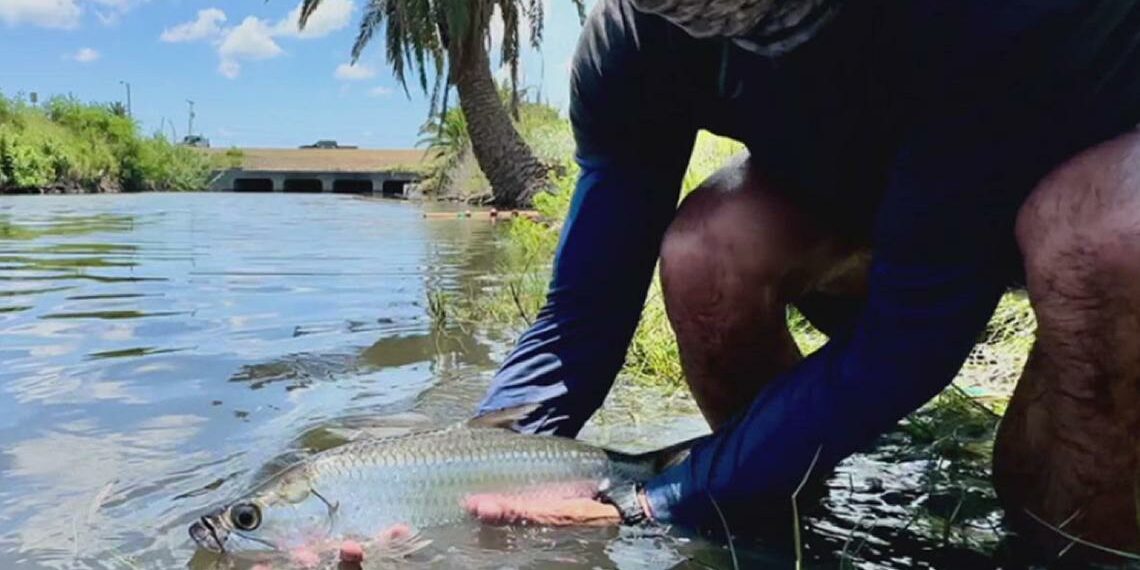
Dr. Streich said catch-and-release fishing is now considered the best practice for tarpon. Blaha agrees and encourages anglers to be mindful on the water.
“It’s a sport fish,” Blaha said. “Let’s respect that and take care of them.”
Researchers said the project is part of a larger, multi-phase tarpon study expected to continue for several years. Results from one survey are expected in early 2026.
In the meantime, experts urge fishermen across the Coastal Bend to follow conservation-minded practices to help protect the remaining tarpon population.