This post was originally published on here
COMMENTARY: ‘Few are those,’ said Albert Einstein, ‘who see with their own eyes and feel with their own hearts.’
The beginning is important. We all like to make a good first impression and get off to a good start. Aristotle reasoned that a small error in the beginning can lead to a large error in the end.
The first words of Genesis state, “In the beginning God created heaven and earth.” The best theory concerning the beginning of the universe, according to science — “The Big Bang Theory” — is in fundamental agreement with Scripture.
Philosophy had its beginning when philosophers sought the beginning of things on a material level. Religions began when people sought the beginning of things on a spiritual level. Civilization had a long and arduous beginning.
The early philosophers knew that an explanation for the way things come about cannot be found on the surface of things. They wanted to know the nature of that fundamental building block that served as the beginning of everything. They named that elementary factor the atom, which in Greek means “uncuttable.” We now know that the atom is not fundamental but houses a veritable universe within itself.
We ponder the beginning of human relationships and search for their beginnings. We like to keep up appearances. But when it comes to human relationships, these appearances are nothing but façades. A façade-to-façade relationship does not get to the core of who they are. Such relationships are considered inauthentic. A man and a woman can marry and remain strangers to each other. Who am I at the core of my being? Am I a stranger even to myself?
The word “core” is derived from the Latin cor and the Old French coeur, both referring to the heart. We speak of getting to the heart of the matter in the same sense as we speak of getting to the core of the problem.
When he became a cardinal, St. John Henry Newman took as his motto cor ad cor loquitur (“heart speaks to heart”). The phrase originated with St. Francis de Sales and signifies a deep relation between man and God as well as that between two human beings. It is comparable to the ‘I-Thou’ relationship articulated by Martin Buber.
When one heart is disenfranchised from another heart, a terrible loneliness sets in. Consider the poignant words of the Scottish poet William Sharp:
“Here in the heart of Summer, sweet is life to me still. But the heart is a lonely hunter that hunts on a lonely hill.”
We were made for heart-to-heart relationships. We are fractured when we are alone, deprived of the fullness of our being. Adam suffered from “cosmic solitude,” to quote St. John Paul II, before Eve came into his life.
The heart is cited more than 1,000 times in the Bible. It refers to the inner self, the seat of emotions, will and moral character. By no means does it refer to a physical organ.
We all have a heart, in this biblical sense, which can be exercised as a component of a heart-to-heart relationship. What is the foundation of such a relationship? What is its origin? What is its beginning? “Keep your heart with all vigilance, for from it flows the springs of life” (Proverbs 4:23). The heart is a beginning.
From the world of embryology, we know that at eight weeks the child in the womb has a heart that beats 150 times per minute (140 if it is a boy; 160 if it is a girl). World-class geneticist Jérôme Lejeune referred to these two rhythms as “the symphony of two hearts.”
The word “symphony,” according to its etymology, refers to things being brought together in harmony. Dr. Lejeune was not being unduly poetic. He was describing what is really going on between the mother’s heart and that of her child in the womb. He was alluding to the primitive foundation of a heart-to-heart relationship. He was pointing to the beginning and foundation of love.
The rhythm between the hearts of the mother and her child form the prototype of all authentic heart-to-heart relationships between human beings. It is a tragedy of enormous proportions that this message so often goes unrecognized. God speaks to us in whispers.
Scientists, despite their preoccupation with observation and experimentation, can, indeed, appreciate the importance of the heart. “Few are those,” said Albert Einstein, “who see with their own eyes and feel with their own hearts.”
Dr. Rollin McCraty, author of Science of the Heart: Exploring the Role of the Heart in Human Performance, claims that the heart sends more messages to the brain than vice versa. Then, there are men of science who are tireless in their search for the beginning of the universe but interrupt their search for the beginning of life for reasons that are purely political.
The Annunciation was a beginning, the beginning of a new life.
During her pregnancy, Mary’s heart beat in rhythm with that of her Child, forming the nucleus of a cor ad cor love. But that beginning preceded a larger beginning, the beginning of Christmas.
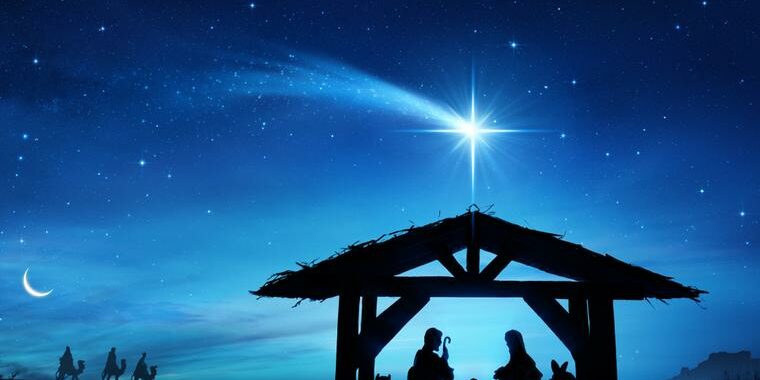
And where did it begin? For the most important beginning the world has ever known, in a stable where animals feed because there was no room for the Holy Family in the inn. It was the most improbable place for the beginning of an event that would change the world and would continue to change the world until the end of time.
Donald DeMarco, Ph.D., is a senior fellow of Human Life International.