This post was originally published on here
The brightest cosmic object of its kind ever detected may have helped astronomers solve the mystery of powerful, bright blue cosmic explosions.
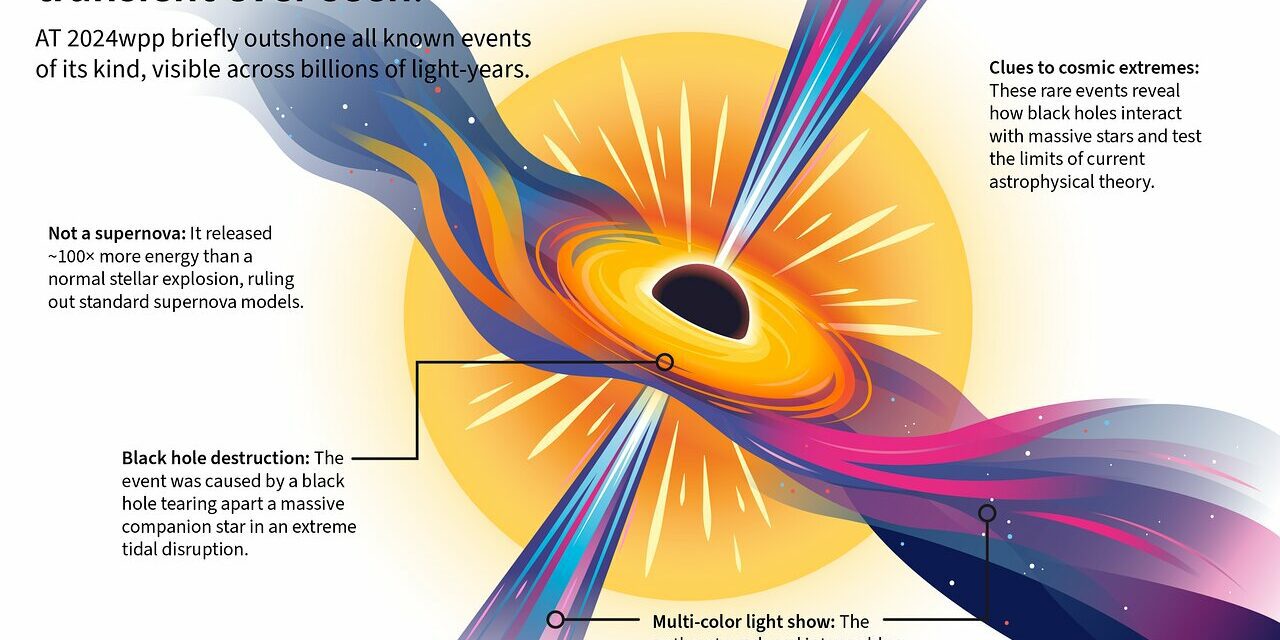
At the heart of the discovery is a signal from a so-called Luminous Fast Blue Optical Transient (LFBOT), designated AT 2024wpp, first spotted in 2024. The signal revealed to a team of scientists that LFBOTs are the result of extreme Tidal Disruption Events (TDEs), in which a black hole with a mass up to 100 times that of the sun, completely shreds a companion star in just a matter of days.
LFBOTs are so named because they are incredibly bright, visible at distances up to billions of light-years, shining high-energy light ranging from the blue end of the optical region of the electromagnetic spectrum through ultraviolet and X-ray wavelengths, and only last a few days. While the first LFBOT was spotted in 2014, it wasn’t until four years later that astronomers caught one in enough detail to properly analyse.
This 2018 event was designated AT 2018cow, leading to its nickname Tthe Cow,” with LFBOT that followed also getting zoological nicknames: the Koala (ZTF18abvkwla), the Tasmanian devil (AT 2022tsd), and the Finch (AT 2023fhn). AT 2024wpp doesn’t have its nickname yet, but the Wasp is a fairly good bet.
No ordinary Tidal Disruption Event
When researchers assessed AT 2024wpp, they found that it emitted around 100 times as much energy as the average supernova, seemingly ruling exploding stars out as a potential cause. In fact, to produce this much energy, an exploding star would have to convert around 10% of its mass instantly into energy via Einstein’s energy/mass relation E=mc^2 over the course of just a few weeks.
The team’s observations, using the Gemini South observatory, revealed an excess of near-infrared light from the source of AT 2024wpp, something only seen before around AT 2018cow, which is not associated with normal supernovas.
“The sheer amount of radiated energy from these bursts is so large that you can’t power them with a core collapse stellar explosion — or any other type of normal stellar explosion,” team member Natalie LeBaron of the University of California, Berkeley said in a statement. “The main message from AT 2024wpp is that the model that we started off with is wrong. It’s definitely not just an exploding star.”
TDEs are fairly common occurrences across the cosmos, happening when stars venture too close to ravenous black holes and are “spaghettified,” creating a noodle of stellar pasta that wraps around the culprit black hole like linguine around a fork. However, not all TDEs create an LFBOT, so the question is: what is so special about these particular TDEs?
The team theorizes that in the case of the TDE behind AT 2024wpp, the black hole has been parasitically feeding from a companion star for a long time. This resulted in the black hole being completely encased in a spherical shell of material. However, this shell is too far away from the black hole to be devoured by it.
However, the companion star eventually spirals close enough to the black hole to be spaghettified by its immense gravitational influence. This results in new stellar material slamming into the matter that the black hole has been stealing throughout the system’s history. This generated X-ray, ultraviolet, and optical blue light, seen as AT 2024wpp. Radio waves are generated when material from around the black hole is channelled to its poles, where it is accelerated to around 40% the speed of light and blasted out as jets. The team estimated that the star shredded in the event that launched AT 2024wpp has a mass around 10 times that of the sun and was a highly evolved star nearing the end of its life, called a Wolf-Rayet star, explaining the weak hydrogen emission seen around AT 2024wpp. Stars like this are thought to be common in actively star-forming galaxies like the one 1.1 billion light-years away from which AT 2024wpp erupted.
The team’s research has been accepted for publication in The Astrophysical Journal Letters and is currently available as a pre-peer-review paper on arXiv.