This post was originally published on here
Today is the day that astronomers, amateur stargazers and alien conspiracy theorists alike have been waiting for: interstellar comet 3I/ATLAS is as close to Earth as it will ever get.
The strange interloper in our solar system has for months attracted no shortage of public fascination as it whizzed its way first past Mars, and then the sun. Now, more than five months since it was first discovered, 3I/ATLAS has made its closest approach to Earth.
But lest you think that an extraterrestrial invasion is upon us, know that the comet still is not coming much within about 170 million miles of our planet Friday, Dec. 19. And if that’s not enough to calm your nerves, know that NASA and the world’s astronomers have spent weeks trying to quell the notion that 3I/ATLAS is an alien spaceship after a notorious Harvard professor popularized the conspiracy.
Advertisement
Advertisement
What 3I/ATLAS’s close approach to Earth does represent, however, is the best opportunity for scientists to study an object that formed deep in space in another star system before it someday leaves Earth’s cosmic neighborhood forever.
Want to know when and how you can watch 3I/ATLAS as it comes near Earth? Here’s everything to know.
3I/ATLAS: What to know about interstellar comet’s visit near Earth
What is 3I/ATLAS? Why scientists say it’s an interstellar comet
The interstellar comet 3I/ATLAS is nearing Earth and will on Dec. 19 come within about 170 million miles of our planet during its temporary visit to our solar system.
The object known as 3I/ATLAS made news in July 2025 when it was confirmed to be the third object ever discovered originating outside Earth’s solar system. When it was spotted, 3I/ATLAS was traveling 137,000 mph, according to NASA.
Advertisement
Advertisement
Observations of 3I/ATLAS’ speed and trajectory confirmed to astronomers that it formed in another star system and was ejected into interstellar space – the region between the stars, according to NASA. For possibly billions of years, the comet has drifted on a journey from the general direction of the constellation Sagittarius in the center of the Milky Way that recently brought it into our solar system.
Though astronomers don’t yet know exactly how big 3I/ATLAS could be, estimates range from a few hundred feet to a few miles across, according to the European Space Agency. But data from the Hubble Space Telescope helped astronomers estimate the size of the comet’s solid, icy nucleus as anywhere from about 1,400 feet to 3½ miles in diameter.
Unlike comets bound to the sun’s gravity, 3I/ATLAS is traveling on a hyperbolic orbit that eventually will carry it out of the solar system and back into interstellar space.
Are there photos of 3I/ATLAS? See all NASA images of comet
On Nov. 19, NASA released a trove of never-before-seen images of 3I/ATLAS that revealed new characteristics of the object.
Advertisement
Advertisement
A look at all of the photos NASA has released of 3I/ATLAS since its discovery, including detailed explanations of each, are available below.
Will 3I/ATLAS hit Earth? How close will it get?
The comet, which is not a danger to Earth, is projected to pass within about 170 million miles of our planet Friday, Dec. 19. That’s nearly twice the distance of Earth to the sun and more than 700 times the distance of Earth to the moon.
What time will 3I/ATLAS be closest to Earth?
Comet 3I/ATLAS will be closest to Earth around 1 a.m. ET Friday, Dec. 19, according to Space.com, citing calculations from NASA’s Jet Propulsion Laboratory’s Horizons system, which analyzes solar system data. However, the comet is so far from Earth that the way it appears to those watching from the ground should be consistent throughout the day.
Will you be able to see 3I/ATLAS from Earth? Where is it now?
Though 3I/ATLAS is to faint and far to be visible to the naked eye, viewers with even a small telescope can observe the comet in the predawn sky until spring 2026, according to NASA.
Advertisement
Advertisement
During the comet’s closest approach to Earth, skywatchers looking east to northeast could catch the comet right under the star Regulus – one of the brightest stars visible to Earth – in the constellation Leo, according to NASA’s December skywatching guide.
Watch livestream of 3I/ATLAS as it gets close to Earth
Those who want to catch a glimpse of the interstellar comet, even if it’s virtual, still have a chance.
The Virtual Telescope Project, which has several powerful telescopes at the Bellatrix Astronomical Observatory in Italy, plans to stream live images of 3I/ATLAS on YouTube beginning at 11 p.m. ET Friday, Dec. 19.
Here’s where to watch it:
How to track 3I/ATLAS with NASA simulator
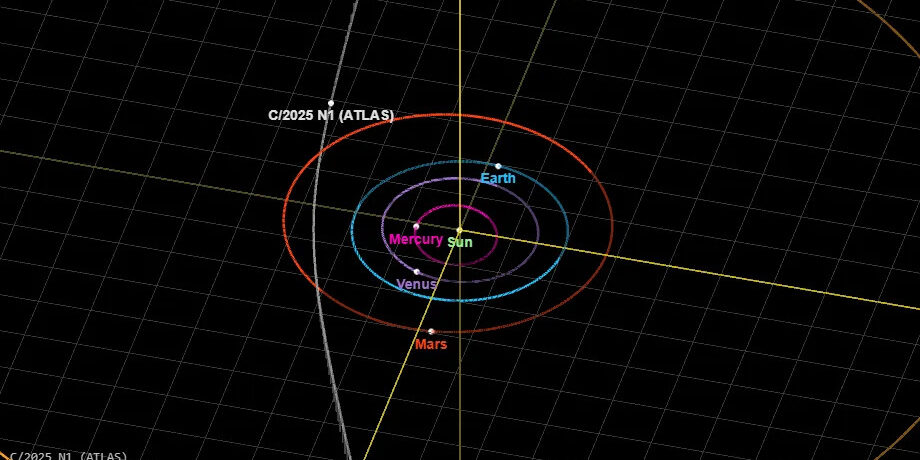
NASA’s online simulation Eyes on the Solar System shows the location and path of 3I/ATLAS as it moves through our solar system. You can also keep up to date with the comet’s movements where it’s catalogued by NASA’s Jet Propulsion Laboratory in Southern California.
Advertisement
Advertisement
Eric Lagatta is the Space Connect reporter for the USA TODAY Network. Reach him at [email protected]
This article originally appeared on Florida Today: What’s going on with 3I/ATLAS? Watch as interstellar comet nears Earth