
This post was originally published on here
on
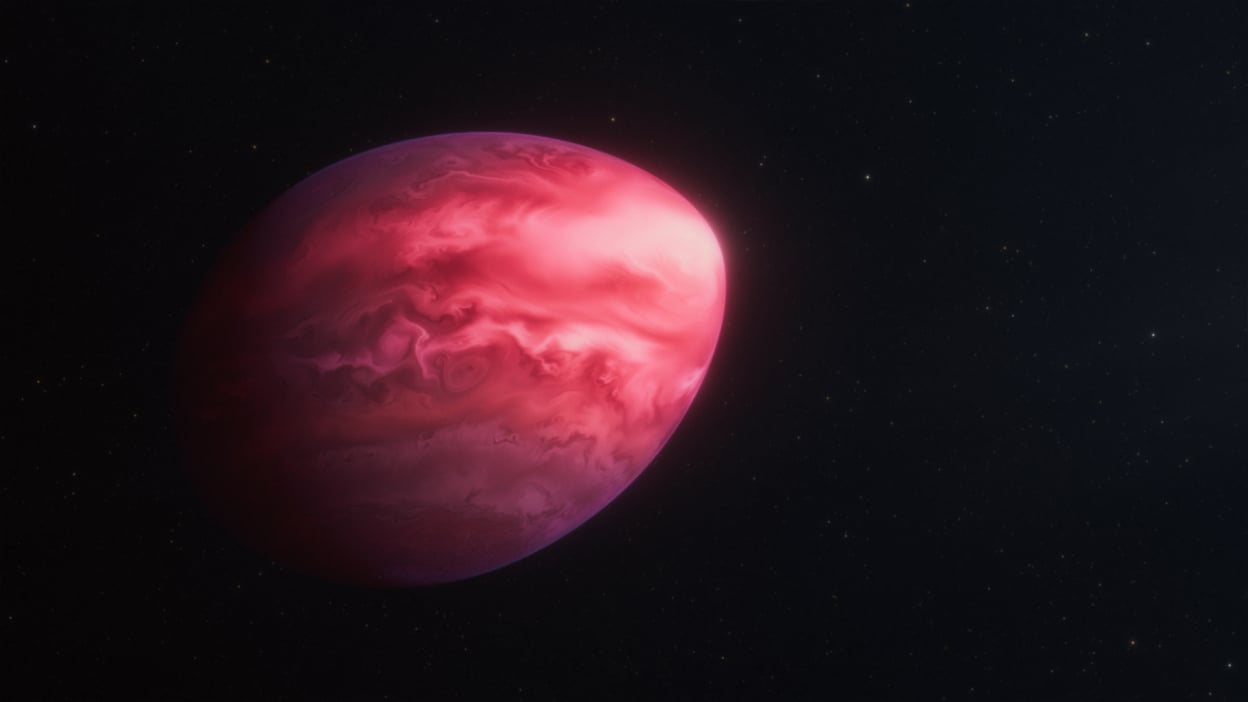
Credit: NASA / ESA / CSA / Ralf Crawford illustration
Astronomers have found a strange world outside the solar system that is ripe for science fiction — but it’s all real.
The exoplanet, dubbed PSR J2322-2650 b, has a helium-and-carbon atmosphere, something researchers say they’ve never seen before. The air could be full of soot clouds, and deep inside, carbon could even clump together into solid crystals, possibly forming diamonds.
This all takes place on a lemon-shaped planet that is orbiting a pulsar, a special type of neutron star that spins and strobes like a lighthouse in space. NASA‘s James Webb Space Telescope made the observations.
You May Also Like
“Our collective reaction was ‘What the heck is this?'” said Peter Gao, a coauthor on the new research based at Carnegie Earth and Planets Laboratory, in a statement. “It’s extremely different from what we expected.”
A giant planet as heavy as Jupiter with a carbon-heavy atmosphere, orbiting a dead star, does not fit any known planet model, challenging long-standing ideas about how worlds form and survive. The findings, published in The Astrophysical Journal Letters, suggest that planetary systems can exist under far more extreme conditions than scientists thought.
The new research revealed that powerful gravity from its nearby star, which lies about 750 light-years away from Earth, stretches and squeezes the planet into a lemon shape.
The planet orbits a pulsar, the crushed core left behind after a massive star explodes. This star, PSR J2322-2650, packs roughly the mass of the sun into a space of a city. As it rapidly spins, it sends out steady beams of energy.
“The planet orbits a star that’s completely bizarre,” said the University of Chicago’s Michael Zhang, the principal investigator on this study, in a statement.
The planet circles this pulsar at a distance of only about 1 million miles. For comparison, Earth sits close to 100 million miles from the sun. Because that orbit is so tight, a full year on PSR J2322-2650 b lasts less than eight hours.
When Webb looked at the planet’s atmosphere, scientists expected to see common gases, such as water vapor or methane. Instead, they found helium and simple forms of carbon. This kind of carbon should not exist by itself at such high temperatures, the researchers say, unless almost all oxygen and nitrogen are missing. No other known planet shows this pattern.
Temperatures on the planet range from about 1,200 degrees Fahrenheit on the cooler side to about 3,700 degrees on the hotter side.
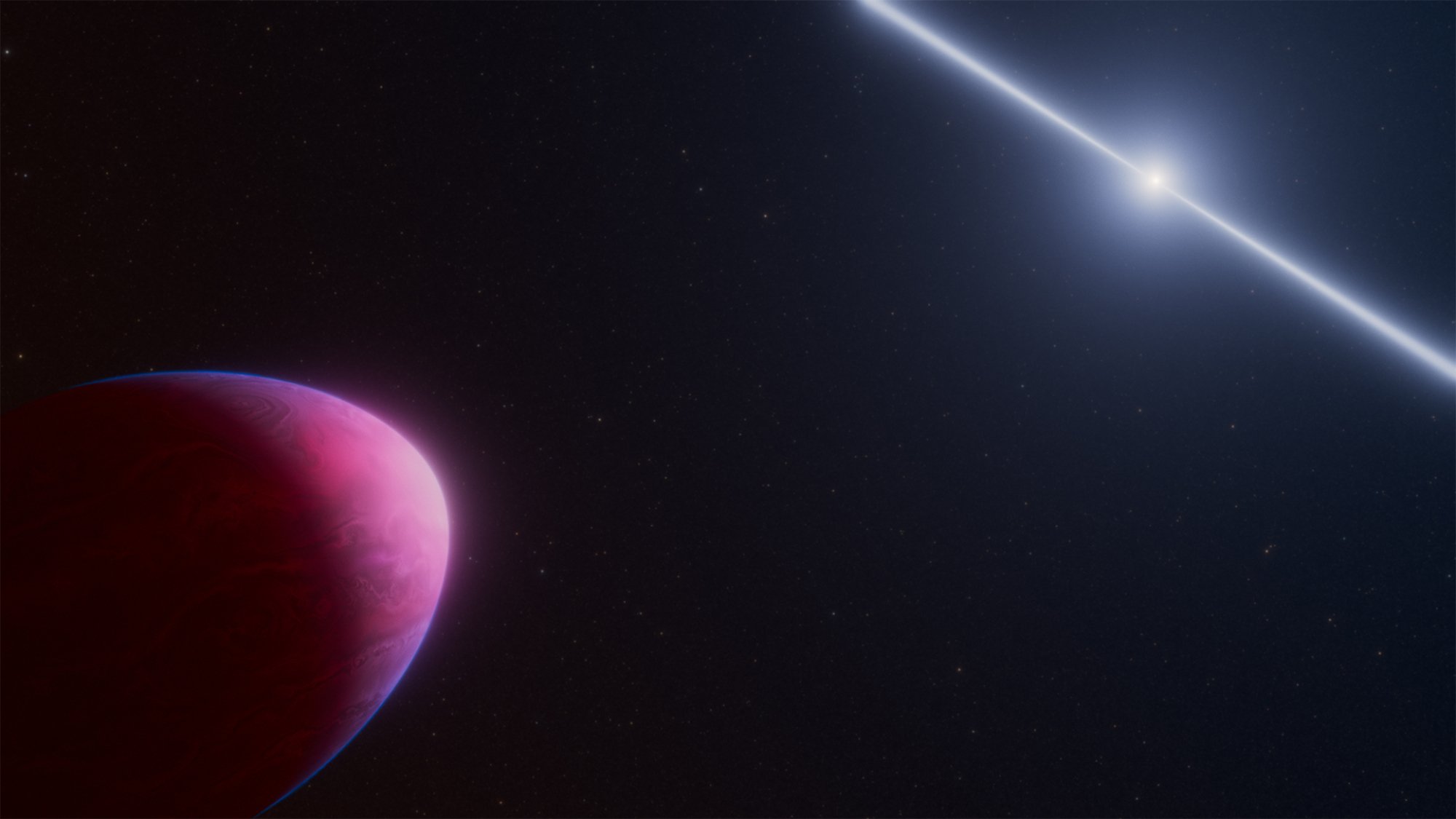
Credit: NASA / ESA / CSA / Ralf Crawford illustration
The binary system also resembles a rare setup referred to as “a black widow,” where a pulsar slowly strips material from a nearby companion. The difference here is that the companion is a planet — not another star.
No known process explains how such a carbon-heavy planet could form.
“But it’s nice to not know everything,” said coauthor Roger Romani of Stanford University in a statement. “I’m looking forward to learning more about the weirdness of this atmosphere. It’s great to have a puzzle to go after.”
Topics
NASA

Elisha Sauers writes about space for Mashable, taking deep dives into NASA’s moon and Mars missions, chatting up astronauts and history-making discoverers, and jetting above the clouds. Through 17 years of reporting, she’s covered a variety of topics, including health, business, and government, with a penchant for public records requests. She previously worked for The Virginian-Pilot in Norfolk, Virginia, and The Capital in Annapolis, Maryland. Her work has earned numerous state awards, including the Virginia Press Association’s top honor, Best in Show, and national recognition for narrative storytelling. For each year she has covered space, Sauers has won National Headliner Awards, including first place for her Sex in Space series. Send space tips and story ideas to [email protected] or text 443-684-2489. Follow her on X at @elishasauers.