This post was originally published on here
Microbes have a penchant to survive almost everywhere on Earth and in the most extreme conditions. This includes the desolate, practically sterile environment following volcanic eruptions.
In a recent Communications Biology paper, a team of ecologists and planetary scientists report the remarkable ability of microbes to repopulate the landscape nearly immediately after a volcanic eruption. So yeah—we’re essentially talking about microorganisms capable of settling down in freshly cooled lava. Importantly, the study represents the first time scientists have documented microbes moving into a completely new habitat that’s still in the process of forming; the lava, as it pours out from the Earth, effectively clears out anything that was there before.
Such unique dynamics have potent implications for studying how biological communities evolve, not just on Earth but beyond, according to the researchers in a statement.
A fiery move
Previous investigations on microbial resilience had mainly focused on microbes that were either already occupying or had successfully infiltrated a certain habitat, according to the paper. On the other hand, primary succession, or the “transition from an uninhabited to an inhabited environment, has rarely been documented in nature,” it added.
The researchers wondered if volcanic activity could give rise to such unlikely conditions on Earth and headed over to Iceland to monitor the Fagradalsfjall volcano.
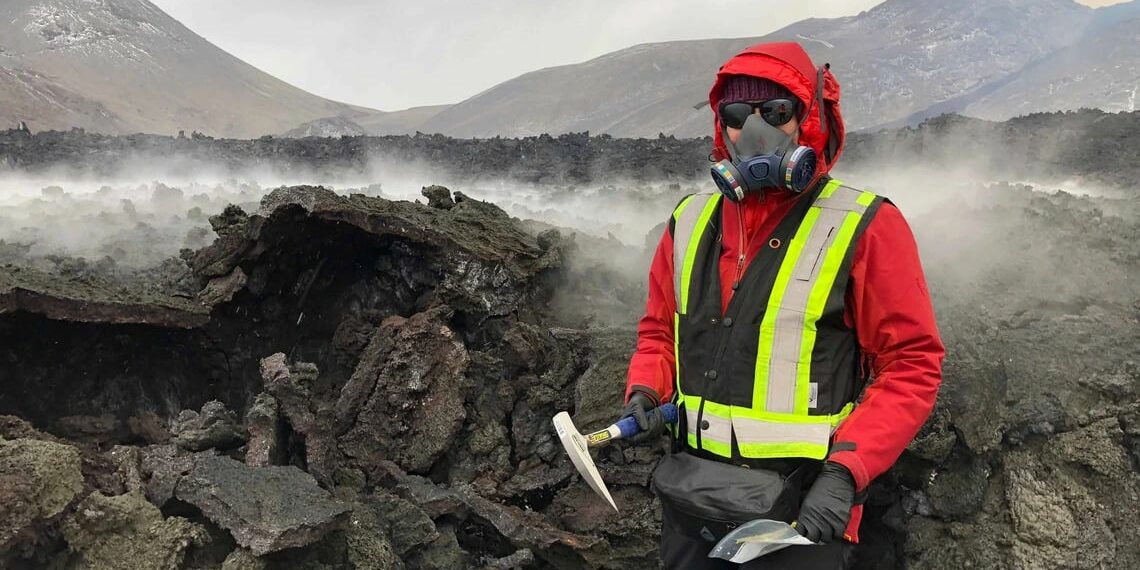
Study co-author Solange Duhamel stands next to a lava flow during investigations into microbial life near volcanoes. Credit: Christopher Hamilton (University of Arizona)
“The lava coming out of the ground is over 2,000 degrees Fahrenheit, so obviously it is completely sterile,” Nathan Hadland, study lead author and a doctoral student at the University of Arizona, said in the statement. “It’s a clean slate that essentially provides a natural laboratory to understand how microbes are colonizing it.”
Between 2021 and 2023—the study period—the volcano erupted thrice, unleashing intense bursts of gas, dust, and lava that engulfed a wide swath of the tundras nearby. Needless to say, the lava rocks contain little to no water or organic nutrients, meaning that, even if the microbes somehow survived the heat of the lava, they wouldn’t have anything to subsist on. But the researchers’ investigations suggested that didn’t really matter.
“Badass” colonizers
For their analysis, the researchers collected lava flows as soon as they were cool enough to gather, in addition to rainwater, aerosols, and rocks from surrounding areas. Then, they extracted DNA from these samples to assess whether and where microbes were present. Finally, they monitored the growth of this new microbe population. “Multiple metrics revealed that the lava flows analyzed in this study rapidly hosted microorganisms within hours and days of solidification,” the researchers noted in the study.
“The fact that we were able to do this three times—following each eruption in the same area—is what sets our project apart,” Hadland said.
Indeed, the researchers were able to confirm a first wave of “badass” microbes that survive initial conditions within hours and days of a volcanic eruption. These microbes most likely arrived via rainwater, according to the paper.
As conditions become less extreme with time, more microbes “move in” to the new community from more rain and adjacent areas, the paper explained. The microbial community did experience some declines in winter but overall maintained stability over three different eruptions.
“We were not expecting that,” said Solange Duhamel, study co-author and a biologist at the University of Arizona. “These lava flows are among the lowest biomass environments on Earth… But our samples revealed that single-celled organisms are colonizing them pretty quickly.”
Will Martians be microbial?
For the researchers, an obvious implication of the new study is whether similar biological processes may be at work on Mars. Although the volcanoes on the neighboring planet appear to have settled, scientists now know that it isn’t impossible for tiny organisms to make a home for themselves inside freshly solidified lava.
Additionally, volcanic activity injects heat into a planet’s system and releases volatile gases, “so the idea is that past volcanic eruptions could have created transient periods of habitability,” Duhamel added.
That said, all this stuff about Mars is a big assumption, the researchers admitted. But it’s certainly an impressive demonstration that life on the smallest scales will survive in the grandest of ways.