This post was originally published on here
For more than a decade, scientists have been aware of chromothripsis — the process in which a single chromosome breaks into pieces and is rearranged in random order, enabling cancer cells to evolve and resist treatment. However, a solid understanding of how that process is initiated was elusive until recently.
Chromothripsis occurs when errors in cell division concentrate individual chromosomes in small, fragile structures called micronuclei, according to UC San Diego Health Sciences in La Jolla. When that bursts, the chromosome is made vulnerable to nucleuses — enzymes that can break DNA apart.
A new study from UCSD researchers, published in the journal Science, identifies N4BP2 as the enzyme “uniquely capable of entering micronuclei and breaking DNA apart,” triggering chromothripsis.
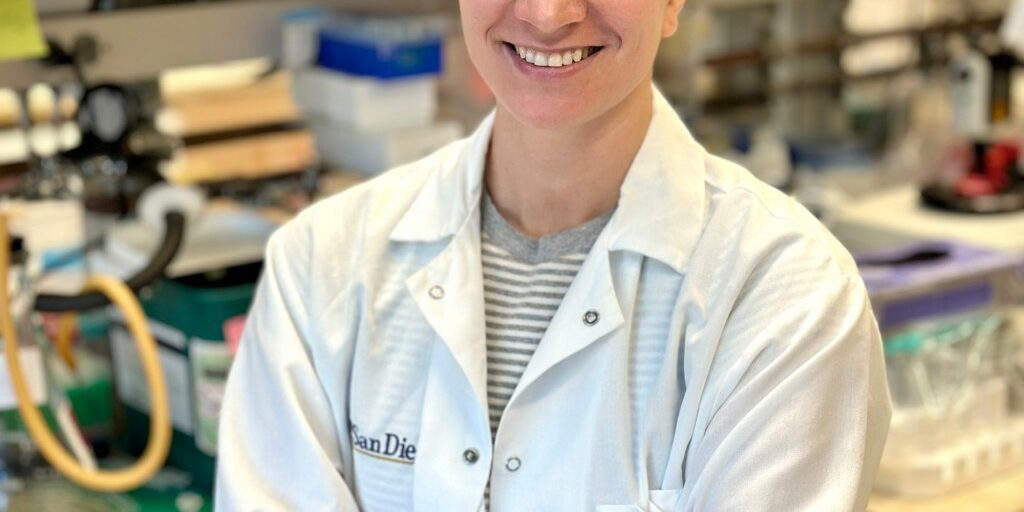
“If you imagine a book, [it’s] torn apart and then rebound with pages missing, pages upside down, duplicated — a lot of chaos in the process,” said Ksenia Krupina, a postdoctoral fellow at UCSD and first author of the study.
“This can reshape the genome of genetic material of a tumor in a single cell instantly. It will drive aggressive growth, it will drive resistance to treatment and it can make the disease unpredictable.”
Krupina said she hopes the new knowledge will create more possibilities for treating aggressive forms of cancer.
“The identification of this can both provide us the mechanism — how this happens — but also it can point us to what’s a potential therapeutic target,” she said.
To combat chromothripsis, researchers set out to answer the question “How does a chromosome become so catastrophically shattered all of a sudden?”
Their process involved taking every known and predicted human nucleus and removing them one by one from the cells through imaging-based screening.
When they did so with N4BP2, they found it sharply reduced chromosome shattering in cells. By contrast, forcing it into cells caused them to break, even if they were healthy.
In analyzing more than 10,000 human cancer genomes across different cancer types, they also found more chromothripsis and structural rearrangements associated with N4BP2. The cancers also carried higher levels of extrachromosomal DNA, or ecDNA — fragments strongly linked to treatment resistance and aggressive cancer growth.
The findings show that “ecDNA is not an isolated phenomenon but rather a downstream consequence of the much broader phenomenon of chromothripsis,” UC San Diego said in a statement.
Study senior author Don Cleveland, a UCSD professor of cellular and molecular medicine and a member of the university’s Moores Cancer Center, said identifying the breakdown of chromosomes offers “a new and actionable point of intervention.”
Work on the study dates to 2018, though Krupina said the COVID-19 pandemic delayed the process. ♦