
This post was originally published on here
Few sounds are more festive than the popping of a champagne cork.
But if you want your fizz to be perfect this Christmas, there is a scientific knack to it, according to the world’s leading expert on the physics of champagne.
If you want to get that pop just right, the champagne should be cooled to a temperature of precisely ten degrees Celsius which ensures the cork exits the bottle at 31mph.
It is at this temperature that true connoisseurs of the luxury beverage also say that its aroma and taste are the best.
But should your priority be the bubbles themselves, you can achieve the greatest amount of fizz by cooling the bottle further to six degrees – for each degree rise in temperature, around 100,000 bubbles are lost inside the bottle.
The timely advice comes from Gérard Liger–Belair, a professor of chemical physics at the University of Reims–Champagne–Ardenne in the heart of France‘s champagne–producing region, who has long studied the chemical processes behind the bubbles in the celebratory drink.
According to Prof Liger–Belair, how the champagne is treated can have a significant effect on the quality of the wine, especially its fizz factor.
The right glass and the way it is angled are crucial, he says.
A flute glass – a long–stemmed glass with a deep, tapered bowl and a narrower opening – is perfect.
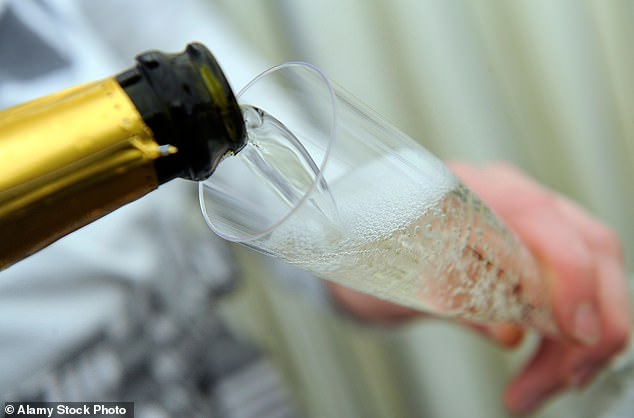
But the angle at which the champagne is poured into the glass is important, too. The wine should slide into the glass at an angle of around 60 degrees, in roughly the same way that you would pour a beer.
This ensures around 15 per cent more bubbles in your glass, his research shows.
Writing in the journal Sparkling Beverages, Prof Liger–Belair says: ‘Pouring a sparkling wine straight down the middle of a vertically oriented glass produces turbulence and traps air bubbles in the liquid, both of which force dissolved carbon dioxide to escape more rapidly from the wine.
‘To better preserve the dissolved bubbles and have more fizz when drinking, we should therefore treat champagne a little more like beer – at least when serving it.’
Carbon dioxide is the gas responsible for the bubbles in champagne and other fizzy drinks.
The gas is dissolved into the wine under pressure, and when the cork is popped, it escapes as bubbles.
The characteristic pop is caused by the sudden drop of pressure inside the bottle’s neck, which causes the carbon dioxide inside to rapidly expand.
‘The most fascinating fact about cork popping is the supersonic shock wave experienced by expanding gases released from the gaseous headspace under pressure in the bottleneck,’ adds Prof Liger–Belair.
It is estimated that Brits consume up to 23million bottles of fizz in an average year – with New Year’s Eve being the day when most bottles are sold.