This post was originally published on here
Researchers have introduced an innovative two-step excitation approach that makes it possible to efficiently generate and clearly separate different modes of hyperbolic polaritons.
An international collaboration of scientists has introduced a new approach for generating and manipulating extremely confined light–matter waves called higher-order hyperbolic phonon polaritons (HPhPs). Using this method, the researchers achieved record levels of wave quality and travel distance. The technique also takes advantage of a sharply defined boundary to produce an effect known as pseudo-birefringence, allowing the waves to be separated and directed based on their mode.
The findings, reported in Nature Photonics, point to new possibilities for building nanoscale optical components that could support fast information processing and highly sensitive chemical sensing.
As the demand grows for smaller and more efficient light-based circuits, researchers have increasingly focused on polaritons. These are hybrid states created when light interacts strongly with material excitations such as plasmons or phonons. Polaritons can compress light into dimensions far below its usual wavelength, pushing beyond the limits of conventional far-field optics.
The most tightly confined versions, known as higher-order polaritons, have remained difficult to access because they require far more momentum than standard single-step excitation techniques can provide.
A Two-Step Strategy for Momentum Boosting
To address this challenge, researchers from Shanghai Jiao Tong University and the National Center for Nanoscience and Technology (China), working alongside teams at CIC nanoGUNE and ICFO – The Institute of Photonic Sciences (Spain), designed a two-stage excitation method.
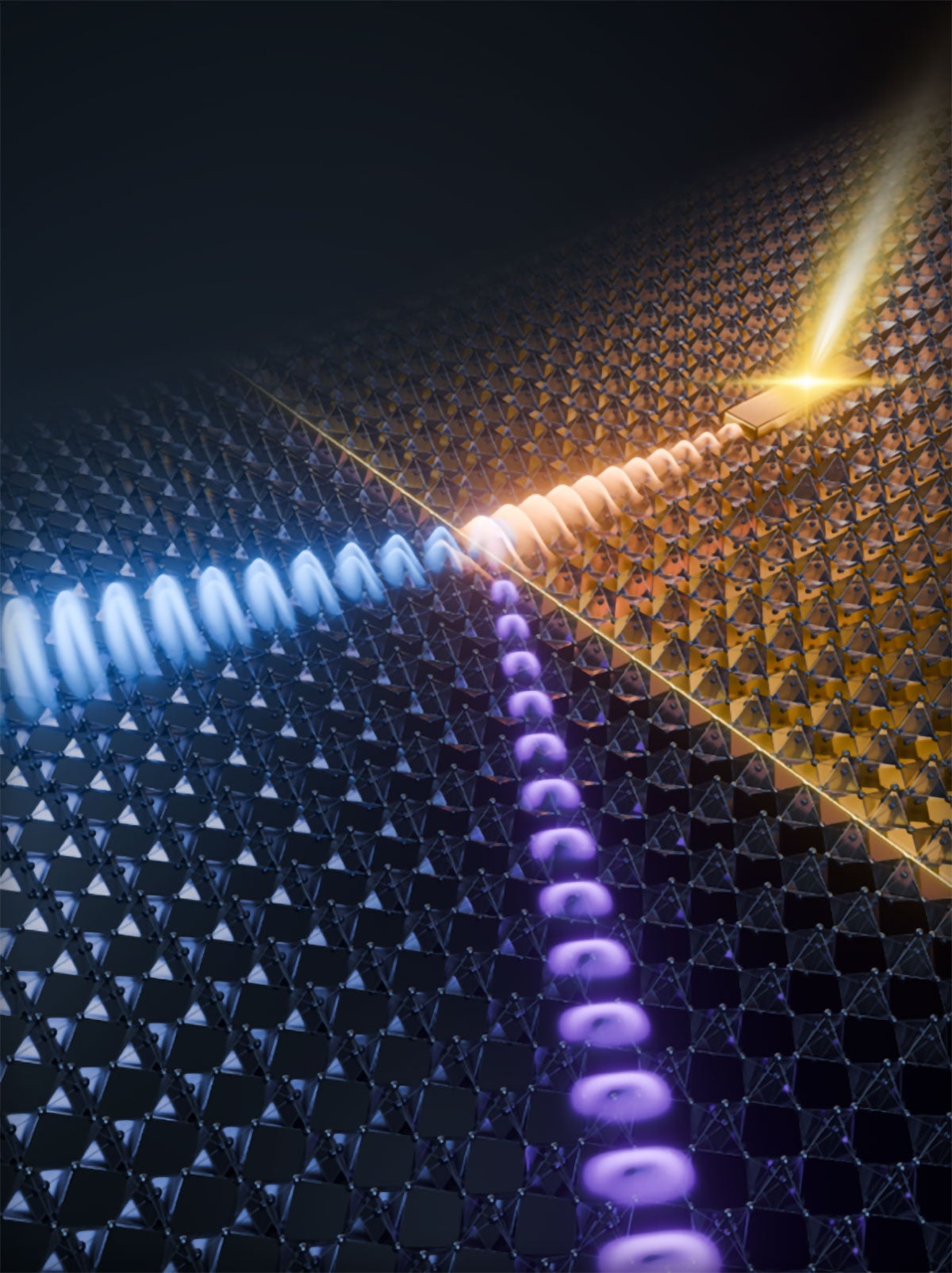
The process begins with a nanoscale gold antenna illuminated by light, which supplies an initial burst of momentum. This creates a fundamental, or zero-order, hyperbolic phonon polariton on a smooth biaxial MoO3 crystal slab positioned atop a single-crystalline gold substrate. The polariton then moves toward the edge of the gold layer, where the substrate suddenly ends, and the crystal extends into air. When the wave encounters this sharp boundary, it scatters, converting into higher-order phonon polaritons.
“Scattering the zero-order polariton at the boundary provides the large momentum boost needed to excite higher-order modes,” explains Prof. Rainer Hillenbrand, a lead author of the study. “We found that this two-step method substantially enhances the excitation efficiency compared with traditional single-step excitation techniques.”
This enhanced excitation efficiency, combined with an ultra-smooth, low-loss air-suspended MoO3 slab, allowed the team to observe higher-order polaritons of unprecedented quality. The waves achieved a record-high quality factor of ~45 and a long propagation distance, demonstrating potential for next-generation photonic technologies.
A new way to steer nanolight
The most striking result of this new polariton excitation technique is a phenomenon the team calls “pseudo-birefringence.” At the sharp gold-air boundary, different polariton modes are spatially separated while preserving their polarization. The fundamental and higher-order modes bend at different angles, causing them to propagate in entirely different directions.
“We have effectively created a traffic controller for light on the nanoscale,” says Prof. Qing Dai, another lead author. “This ability to sort different orders of hyperbolic polaritons is a new tool for designing ultra-compact photonic circuits. It is similar to the birefringence effect in certain crystals, but here it occurs without any change in the light’s polarization and is more than ten times stronger.”
This powerful mode-sorting effect could be harnessed for mode-division multiplexing, a technique that uses different wave shapes to carry multiple independent data streams along a single nanowaveguide, dramatically increasing information-processing capacity. Other potential applications include novel optical filters, waveplates, and highly sensitive on-chip biosensors.
Overall, the work provides a foundational platform for manipulating light at the nanoscale, with far-reaching implications for future nanophotonics, on-chip communication, and information processing technologies.
Reference: “Boundary-induced excitation of higher-order hyperbolic phonon polaritons” by Na Chen, Hanchao Teng, Hai Hu, F. Javier García de Abajo, Rainer Hillenbrand and Qing Dai, 3 October 2025, Nature Photonics.
DOI: 10.1038/s41566-025-01755-5
Never miss a breakthrough: Join the SciTechDaily newsletter.
Follow us on Google and Google News.