
This post was originally published on here
Scientists have identified a previously unknown natural compound produced by heat-loving cyanobacteria that helps protect against ultraviolet radiation.
Natural sunscreen ingredients can protect the skin from damaging radiation while reducing the risk of allergic reactions. In a recent study, scientists identified a previously unknown compound called β-glucose-bound hydroxy mycosporine-sarcosine that is produced by heat-loving cyanobacteria when they are exposed to UV-A/UV-B radiation and high salt conditions.
Unlike known mycosporine-like amino acids (MAAs), this compound is formed through an alternative biosynthetic route. The discovery offers new opportunities for industrial biotechnology focused on developing naturally derived UV-filtering substances.
Cyanobacteria are photosynthetic microorganisms that release oxygen and are well known for their ability to thrive in extreme environments. To cope with intense stress, they synthesize a wide range of chemical compounds, including both primary and secondary metabolites. Among these are mycosporine-like amino acids (MAAs), which are small, water-soluble molecules that absorb ultraviolet (UV) radiation.
MAAs help protect cells from UV damage and also function as antioxidants by neutralizing stress-related reactive oxygen species (ROS). Although all MAAs share a similar core structure, the many forms identified so far differ significantly in their chemical makeup, which affects how they function biologically.
The Need for Safer Sunscreen Alternatives
As concerns grow over increased UV exposure and rising rates of skin cancer, researchers are actively searching for biologically derived compounds that can provide effective sun protection. Conventional chemical sunscreens can block UV radiation, but they are often linked to skin irritation, allergic responses, and other unwanted effects.
In contrast, MAAs are biocompatible and widely regarded as safe for human use, making them especially attractive for sustainable biotechnology and the large-scale production of natural sunscreen ingredients.
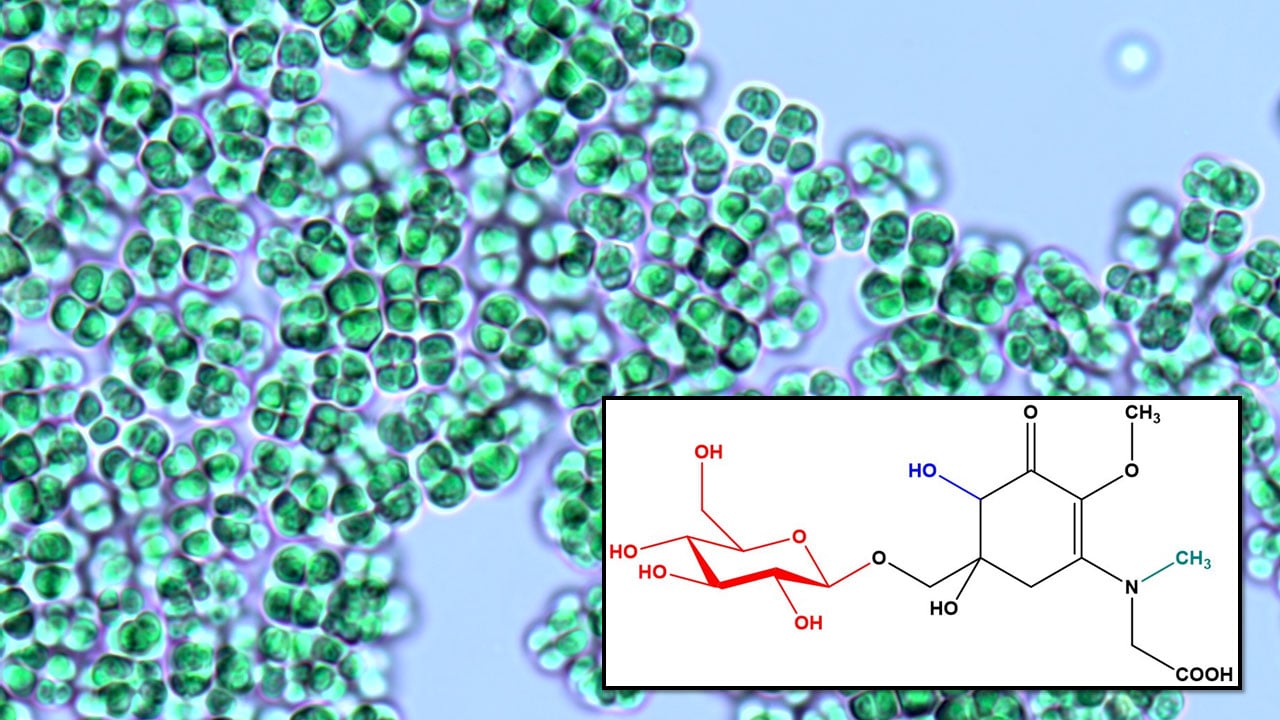
In a new study, a team of researchers led by Professor Hakuto Kageyama from Meijo University and Professor Rungaroon Waditee-Sirisattha from Chulalongkorn University has discovered a novel MAA molecule from thermal cyanobacteria inhabiting hot springs in Thailand. The discovery also contributes to understanding the survival strategies of these cyanobacteria, surviving extreme environmental conditions.
“Understanding stress-responsive biosynthesis in extremophilic cyanobacteria may accelerate industrial biotechnology for natural pigment and antioxidant production,” mentions Prof. Kageyama, while talking about the motivation behind the study. The findings were recently published in the journal Science of The Total Environment.
Structure and Biosynthesis of GlcHMS326
The team isolated eight thermophilic cyanobacterial strains from the Bo Khlueng hot spring in Ratchaburi Province, Thailand. Under experimental setup, the Gloeocapsa species BRSZ strain produced a novel UV-absorbing compound in response to UV-A and UV-B exposures.
This compound, identified as β-glucose-bound hydroxy mycosporine-sarcosine (GlcHMS326), was further analyzed for a detailed understanding of its structure and functional mechanism. This novel compound undergoes triple chemical modifications—glycosylation, hydroxylation, and methylation—which have not been reported in cyanobacteria-derived MAAs before. Genetic analysis showed that these cyanobacteria possess a unique branch of genes that are associated with these modifications.
Functional Advantages Under Environmental Stress
GlcHMS326 production is strongly induced by UV-A and UV-B irradiation and salt stress. Interestingly, even though the cyanobacteria are obtained from hot water springs, this particular MAA production is not associated with thermal stress.
The chemical modifications in GlcHMS326 contribute to its unique structural and functional properties. Methylation can enhance the stability, UV absorption properties, and antioxidant capacity of MAA compounds. Glycosylation of MAAs has been proposed to enhance their stability and support photoprotection and antioxidative defense.
This compound shows higher free-radical scavenging property compared to canonical MAAs, suggesting that the derivatized structure of GlcHMS326 contributes to its enhanced antioxidant potential.
Ecological and Biotechnological Significance
The findings of this study contribute to understanding how cyanobacteria living in extreme environments have uniquely evolved metabolic pathways to produce a special natural UV-absorbing substance. This unique MAA plays a pivotal role in abiotic stress tolerance for Gloeocapsa species and likely serves multiple functions in this thermophilic cyanobacteria.
Highlighting the importance of the study, Prof. Waditee-Sirisattha mentions, “Cyanobacteria are deemed unique among the microbial world. Our recent study underscores that extremophilic cyanobacteria are not only ecologically important but also represent a key area of research for multiple disciplines.”
Future Applications in Sustainable Sunscreens
The significance of this compound lies in its diverse functionality and the potential for sustainable, large-scale production using the cyanobacterial “biofactories.”
This compound can be utilized as an alternative to certain synthetic UV filters that raise environmental concerns, supporting the development of eco-friendly sunscreens. Its antioxidant activity also hints at its potential applications in anti-aging, skincare, and pharmaceutical formulations.
“This discovery reminds us that nature still holds many chemical surprises. Extremophilic cyanobacteria reveal uncommon molecules that can inspire new directions in basic science and sustainable biotechnology,” concludes Prof. Kageyama.
Reference: “Discovery of a novel natural sunscreen from thermophilic cyanobacteria with a potentially unique biosynthetic pathway and its transcriptional response to environmental stresses” by Sasiprapa Samsri, Taiki Aono, Sophon Sirisattha, Yasuhiro Nishikawa, Osamu Hara, Stephen B. Pointing, Hakuto Kageyama and Rungaroon Waditee-Sirisattha, 1 December 2025, Science of The Total Environment.
DOI: 10.1016/j.scitotenv.2025.181006
This work was supported by the following research grants: Thailand Science research and Innovation fund Chulalongkorn University (FOOD_FF_68_121_2300_022) (to Rungaroon Waditee-Sirisattha), The Singapore Ministry of Education MOE-T2EP30123-0007 (to Rungaroon Waditee-Sirisattha & Stephen B. Pointing), the research grant from Hibi Science Foundation (to Hakuto Kageyama), Japan Society for the Promotion of Science KAKENHI Grants 24K08623 (to Hakuto Kageyama), and Postdoctoral Fellowship, the Second Century Fund (C2F), Chulalongkorn University (to Sasiprapa Samsri).
Never miss a breakthrough: Join the SciTechDaily newsletter.
Follow us on Google and Google News.