This post was originally published on here

The identity of a Roman-era skeleton found in Eastbourne – known as the Beachy Head Woman – has been revealed, scientists said.
Previous theories surrounding the Beachy Head Woman, whose remains were uncovered in the basement of Eastbourne Town Hall in 2012, suggested her origins were in sub-Saharan Africa, leading her to be hailed as ‘the first black Briton’.
Later research suggested she may have originated from the Mediterranean.
However, new DNA analysis by scientists at the Natural History Museum and University College London has revealed she was ‘of local British ancestry’.
Their findings have been published in the Journal of Archaeological Science.
The article reads: “Initial osteological analyses indicated possible sub-Saharan origin, with Beachy Head Woman thus presented as one of the earliest Africans in Britain.
“However, her story was complicated by subsequent (unpublished) biomolecular analyses, which suggested she likely grew up on the south coast of Britain and had recent European ancestry.
“Here we present high quality ancient DNA data indicating that Beachy Head Woman has a strong genetic affinity to individuals from rural Britain during the Roman occupation and modern day Britons.
“We find no signals of admixture that would suggest recent sub-Saharan ancestry.
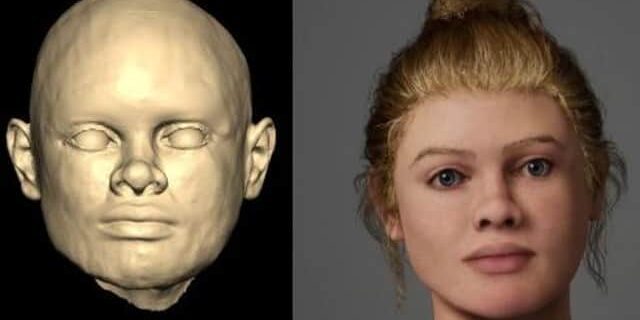
“Phenotypic predictions suggest she had blue eyes, intermediate (between pale and dark) skin pigmentation and light hair.
“Combined, our multiproxy approach indicates that Beachy Head Woman was of local British ancestry.”
Senior author on the paper, Dr Selina Brace, said: “Our scientific knowledge and understanding is constantly evolving, and as scientists, it’s our job to keep pushing for answers.
“Thanks to the advancement of technology that has occurred in the past decade since Beachy Head Woman first came to light, we are excited to report these new comprehensive data and share more about this individual and her life.”
Dr William Marsh, who performed the latest DNA analysis, added: “By using state-of-the-art DNA techniques and newly published genomes, we were able to determine the ancestry of the Beachy Head Woman with much greater precision than before.
“We show she carries genetic ancestry that is most similar to other individuals from the local population of Roman-era Britain.”