This post was originally published on here
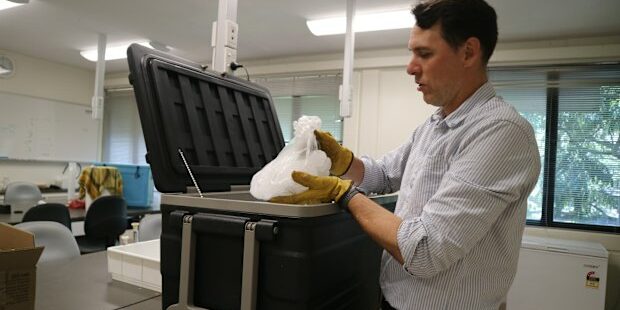
Matthew Mason walks down the corridor of a quiet University of Queensland science building, rolling a portable freezer behind him along the carpeted floor.
The associate professor in environmental engineering has been out collecting hail.
Carefully saved by residents after recent storms in Greater Brisbane, the specimens will be entered into the hail library.
University of Queensland Associate Professor Matthew Mason handling donated hail for the hail library.Credit: Dominique Tassell
The hail library is an international database of hail, collected and catalogued so scientists can better understand the severe weather phenomenon.
Mason estimates he has made two or three journeys out to collect hail this year, following a season more active than normal.
In the lab, he pulls several “giant or gargantuan” stones out of the portable freezer, individually packaged and labelled, and transfers them to a small chest freezer against the wall – labelled “Hail Research Only”.
“It’s nothing too exciting.”
The morning this masthead visits, Mason is handed a bag of hailstones a woman’s grandchildren collected from their backyard in a bucket. The chunks have slightly melted then refrozen together in one large lump.
The woman tells Mason she thinks they won’t be studied, but he has to take them because she promised the children he would.
“There are some good ones in here,” he says in the lab as he inspects the lump of ice, rotating it in his bare hands before it becomes too cold to touch.
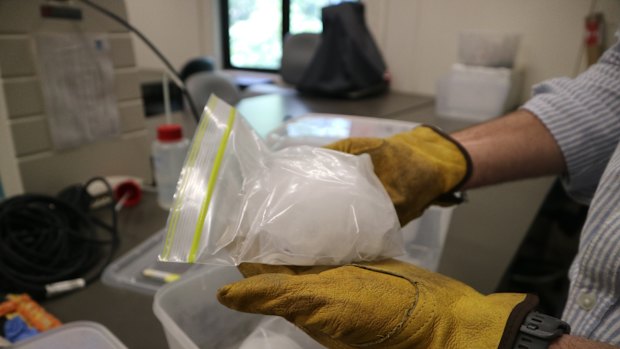
A large hailstone donated from a recent storm.Credit: Dominique Tassell
But that grandmother also hands Mason a 15-centimetre hailstone that will help scientists learn more about how hail forms and travels, and the damage the stones can inflict.
Hail this storm season has already triggered an Insurance Catastrophe declaration, after more than 16,000 claims were lodged across more than 140 postcodes following a single storm.
Mason has collected “hefty” stones from one house, that are of similar size but different shape.
“This is another thing that we’re interested to understand – that variability you’ll get at a single location.”
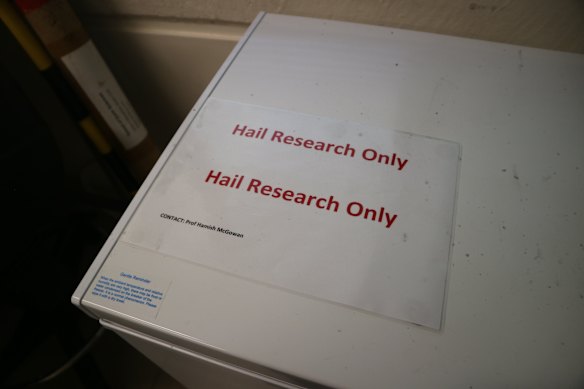
Hailstones are stored and recorded at the University of Queensland.Credit: Dominique Tassell
The melted then refrozen hailstones pose a question: How do you accurately measure something that melts before you can get to it?
“That’s a real problem with trying to collect [hail] in this way,” Mason says. “Actually storing it is super, super hard.”
Some stones may not be fully frozen when they hit the ground, and storing them means freezing them completely.
“Even the best efforts to store them, you’re actually changing what it is that we’re looking at anyway.
“So, yeah, it’s complicated.”
Photos taken just after impact help scientists determine how large the hail initially was.
Scientists weigh and measure the hailstones, then take pictures from every angle so they can create a 3D scan or print.
“We take those scans and we print them out, and we can test them in a wind tunnel to look at what the forces are on the stone from a range of different directions,” Mason says.
This helps scientists understand the drag coefficient on the stone, or how much resistance it experiences when travelling through the storm.
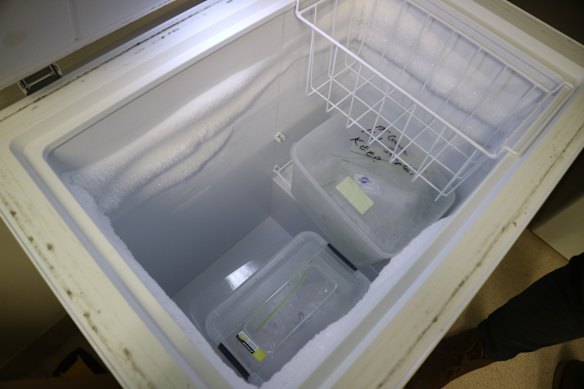
Donated hail is collected then stored in a chest freezer at the University of Queensland, known as the hail library.Credit: Dominique Tassell
“If we understand the drag coefficient, we’ll understand how fast it’s falling.
“If we understand the mass and the speed that it’s falling, then we can determine the energy that it’s going to impart on anything it hits.”
After its size is recorded, a hailstone can be cut open and examined. The internal layers and core will tell the story of how it formed.
Under a project called Hail Net, the team at UQ will collect hail and wind data from 10 hail-prone locations across south-east Queensland over the next seven years.
For the first time, hail and wind are being studied in tandem to assess what happens when both occur at once.
The monitoring stations are in urban, semi-rural and rural locations to assess hail damage on infrastructure including solar panels and different types of crops.
“Even small hailstones can wipe out certain crops in the early stages of growth,” Mason says.
Some crops, such as pineapples and avocados, can take years to recover from damage.
The research could lead to infrastructure being more hail-resistant.
The data will also help researchers better understand the relationship between hail detected by radar in the sky and what hits the ground.
Researchers further aim to set up a publicly accessible website that will provide real-time information about the hail being measured at each station.