This post was originally published on here
Is it cropdusting Earth with toxins?
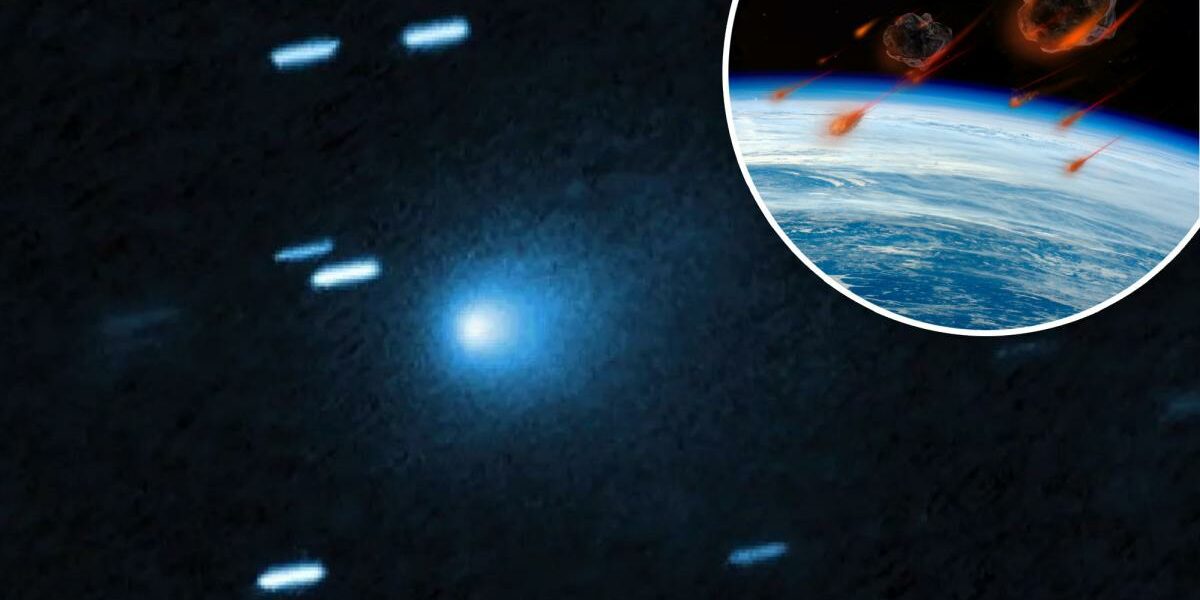
When 3I/ATLAS made its fly-by of Earth on December 19, Harvard scientist Avi Loeb wondered if it could’ve delivered an early Xmas present — poison debris raining down on our planet.
“Will any of the material shed by 3I/ATLAS arrive on Earth?” the astrophysicist posited in a new post on Medium.
He referenced a widespread concern that the gas plume around 3I/ATLAS — which was spotted glowing green during its approach to the Sun — is known to “contain cyanide and hydrogen cyanide.”
“Hydrogen cyanide at large concentrations is a poison,” Loeb previously told the Post, noting the gas’s use as a chemical weapon during World War I.
The scientist noted observations by the Atacama Large Millimeter/Submillimeter Array (ALMA), a radio telescope in Chile that detected amounts of methanol and hydrogen cyanide in the cosmic body over the fall.
This made him wonder if the interstellar comet represented “a serial killer spreading poison” — like an intergalactic cyanide tablet.
Fortunately, we don’t need to brace for deep impact — Loeb speculated that solar wind would prevent any potentially poisonous payload from reaching us.
“Given the mass loss rate measured by the Webb Space Telescope, the gas around 3I/ATLAS would be swept up by the solar wind at a distance of just a few million kilometers (several million miles) from 3I/ATLAS,” he wrote.
For reference, ATLAS was 170 million miles away from Earth during its closest approach on December 19.
Loeb theorized that tiny dust particles, which measure less than a micrometer, would be swept away by solar radiation pressure while larger objects would burn up in Earth’s atmosphere, provided they measured less than three feet.
Debris larger than that, meanwhile, would have a negligible chance of impacting the planet due to the speed of the comet’s off-gassing and its distance from Earth.
“Given the mass loss rate of 3I/ATLAS, there are less than a million of these large objects released in recent months,” wrote Loeb, noting that their far-off origins implies that “the closest among them will never get closer than ten times the Earth’s radius.”
However, he cheekily noted that the outcome could be different if said projectiles can “maneuver by technological propulsion.”
Loeb, who has stuck to his guns regarding ATLAS’ potential artificial origins, previously theorized that 3I/ATLAS’ bizarre trajectory suggests that it’s dispatching “satellites” to Jupiter to gather intel for an “extraterrestrial civilization.”
Loeb told The Post that the comet 3I/ATLAS could use its time near gas giant— which it will reach on March 16, 2026 — to “seed” it with additional probes.