This post was originally published on here
In a breakthrough that could transform chemical manufacturing and environmental safety, researchers in South Korea have developed a novel biocatalytic method to convert the toxic chemical formaldehyde into a high-value compound.
The team, led by Professor Jeong-Sun Kim at Chonnam National University, and including Dr. Taner Duysak—the first author of the study—has engineered a cascade of enzymes that selectively turns formaldehyde into enantiopure L-glyceraldehyde, a chiral C3 compound used in pharmaceuticals and rare sugar synthesis.
Their findings were officially published in the International Journal of Biological Macromolecules on 1 November 2025.
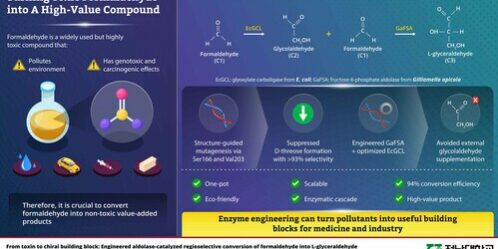
Using a structurally engineered fructose-6-phosphate aldolase (GaFSA) derived from Gilliamella apicola, the researchers catalyzed a carbon–carbon bond formation between glycolaldehyde (GALD) and formaldehyde.
Early trials produced a large amount of D-threose byproduct, but “structure-guided mutagenesis via Ser166 and Val203—key determinants of regioselectivity—lowered D-threose formation with over 93% selectivity under mild aqueous conditions,” the study reports.
The team also developed a one-pot method that generates GALD in situ, eliminating the need for external supplementation.
“This one-pot, eco-friendly, and scalable enzymatic cascade reached a conversion efficiency of about 94% from 25 mM formaldehyde at pH 7.5 and 40 °C, with minimal byproducts. The reaction proceeds entirely in water, under ambient pressure, without toxic reagents or organic solvents, requiring only natural cofactors for EcGCL activity,” says Dr Duysak.
The research highlights how enzyme engineering can turn a dangerous pollutant into a safe and valuable chemical.
Dr Duysak emphasizes its potential: “It promotes not only environmental detoxification in the form of the safe removal of formaldehyde from industrial waste streams but also green chemistry. L-glyceraldehyde is a renewable raw material that serves as a crucial precursor for rare sugars such as L-sorbose and L-psicose and chiral intermediates used in drug development. As a C3 compound, it is a key player in many biochemical pathways. L-glyceraldehyde can facilitate the development of novel compounds with antibiotic, anti-cancer, and other therapeutic effects.”
Experts say this method could pave the way for a greener chemical industry, enabling the conversion of hazardous waste into useful products, supporting eco-friendly pharmaceuticals, and inspiring broader adoption of biocatalytic cascades for sustainable chemical manufacturing worldwide.