This post was originally published on here
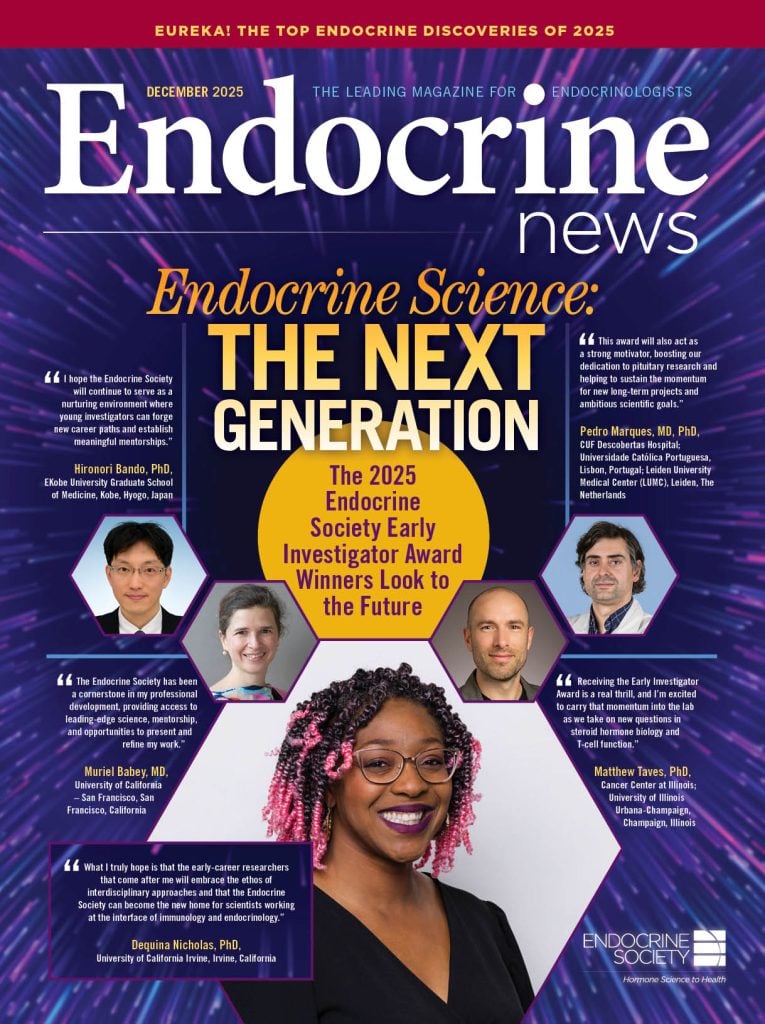
Endocrine scientists have taken over the December issue of Endocrine News! As another year wraps up, we take a closer look at the remarkable endocrine discoveries in endocrine science as well as the researchers who did the discovering! For the ELEVENTH consecutive year, we are running “Eureka! The Year’s Biggest Discoveries in Endocrine Science.” This year’s roundup is once again compiled by Kelly Horvath who spoke with editors from the Endocrine Society’s scientific journals for their input on new discoveries that could easily affect the future of endocrine science and treatment. This year’s edition clocks in at well over 4,000 words, further proof of how vital endocrine science and endocrine researchers are to the future of human health.
In this month’s cover story, we let the up-and-coming endocrine scientists tell their own stories in the “2025 Researchers Roundtable” where I talk with this year’s Early Investigator Award winners who all presented their research at ENDO 2025 in San Francisco in July. These presentations were such an exciting highlight as people piled into the seminar room to learn about the latest breakthroughs in endocrine science presented by these five researchers from around the world who’ve spent their fair share of waking hours at the bench! When asked how he thought receiving the Early Investigator Award would impact his goals as an endocrine scientist, Pedro Marques, MD, PhD, an endocrinologist at CUF Descobertas Hospital and assistant professor and researcher at the Medical Faculty of Universidade Católica Portuguesa in Lisbon, Portugal, and at the Leiden University Medical Center (LUMC), Leiden, The Netherlands, says he feels it will advance his career further and help him establish himself as a leading clinician-scientist in the field of pituitary and neuroendocrinology. “It validates my past and current work, and it enhances its visibility in the world-stage of endocrine research,” he says. “The credibility and recognition in academia is really important, and this is something that this award may significantly impact,” adding that he also things that receiving the ward will further motivate him and boost his dedication to pituitary research.
In “A Change of Heart,” Glenda Fauntleroy-Shaw talks to the recipient of the 2026 Edwin B. Astwood Award for Outstanding Research in Basic Science, Christopher Glass, MD, PhD, about how endocrinology lured him away from cardiology so many years ago. He also discusses his lab’s macrophage research and what he tells his postdocs about “the intersection between three different facets of biomedical science.” He says the first facet is a need to latch on to a problem that you’re absolutely passionate about solving, and the second facet is making sure that solving that problem intersects an unmet medical need. The third factet is simple: “It has to be fundable,” Glass says. “You cannot do science without money, and it costs more than ever to push our boundaries of knowledge to the next level.”
Senior Editor Derek Bagley takes a look at a growing problem facing scholarly publishers in recent years: predatory journals. In “Quality Time,” Endocrine Society journal editors weigh in on this phenomenon and how the Society is combatting it. The Journal of Clinical Endocrinology & Metabolism Editor-in-Chief Paul M. Stewart, MD, FRCP, says that the publishing team has been working on a global footprint because the pressure is especially intense on scholarly publishers in developed countries. “And we’ve all seen over the years the odd figure that’s probably been incorrectly doctored and we’ve been through that kind of thing,” Stewart says. “That’s in no ways excusable, but that’s really nothing compared to what we’re seeing now. There’s no biological reason why anybody in their life would ever measure the association of serum rhubarb with thyroid function tests.”
It would be extremely easy to devote every issue of Endocrine News to the endocrine scientists around the world, that’s why this annual basic science issue is always such a treat. However, you can rest assured that online and in print, we will always play our part in championing endocrine researchers and how their discoveries are improving health for all of us. Feel free to reach out if you have any ideas or suggestions: [email protected].