This post was originally published on here
From mind-bending discoveries to playful explainers, these are some of our favorite—and most popular—science videos of 2025.
For breaking science news, unexpected discoveries and stories that make you see the world differently, follow us on TikTok, Instagram and YouTube.
Brand-New Color Drops
One of the most talked about stories of the year explored the limits of human perception. Scientists successfully stimulated the experience of a brand-new color, called “olo,” by firing lasers into participants’ retinas to activate only “green” cone cells. The result is a teal-like hue that exists outside the visible spectrum.
Advertisement
Advertisement
Hey, Scientific American. Welcome to My Lab
We also took viewers deep into the field—literally. Chief multimedia editor Jeffery DelViscio traveled to Greenland for a feature story. There he filmed a tour of an underground lab where researchers drill down into the ice to extract cores that, layer by layer, record thousands of years of climate history.
Science’s Silly Side
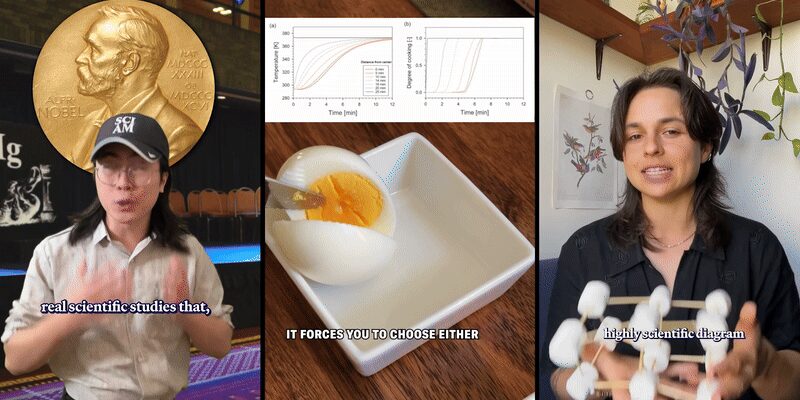
This year also marked the start of our collaboration with science communicator Tom Lum, who covered the Ig Nobel Prizes. a parody of the Nobel Prizes that honors discoveries that “make people LAUGH, then THINK.”
Serious—But Still Fun!—Science
We also broke down each of this year’s three actual Nobel Prizes in science. For the Nobel Prize in Chemistry, senior multimedia editor Kelso Harper explained the prizewinning discovery of metal-organic frameworks (MOFs), materials with enormous implications for energy, storage and environmental science. (Fun fact: Harper worked in a MOF lab in college!)
New Blood Type Also Dropped
Advertisement
Advertisement
Science news continues to surprise us daily. Whether it’s the discovery of a brand-new blood type or the realization that the total number of known blood types has now grown to 48!
Making Music beyond the Grave
In a more macabre vein, associate editor for mind and brain Allison Parshall explored the eerie story of a deceased composer is still making music via brain cells grown from his blood.
The Perfect Egg
Not all of our science coverage was so serious. We leaned into the delightfully absurd in some of our most watched videos, such as this deep dive into how to cook the most scientifically perfect egg. It’s tedious work, but the results are delightfully tasty.