This post was originally published on here
Reindeers may not have noses that glow red in the night, but they do have a marvelous body part that changes color in winter darkness.
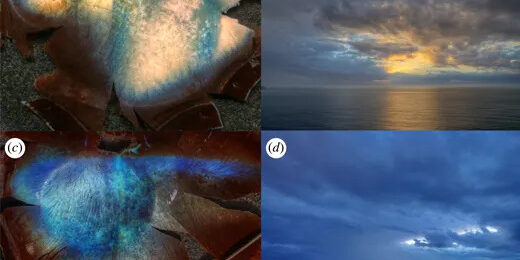
In 2013, scientists discovered that reindeer eyes change hues with the seasons, reflecting the color of the Arctic sky.
If you look into the eyes of an Arctic reindeer (Rangifer tarandus) in the summer, when the days are long and the Sun is bright, you will see shining back a gold and turquoise glow, similar to the emerald reflection of cats’ eyes in the night.
Advertisement
Advertisement
In wintertime, however, when darkness reigns, a reindeer’s eye does something unique. It turns a stunning, deep blue.
Related: Why Blue Eyes Aren’t Really Blue (And What Makes Green So Rare)
The creature hasn’t morphed into a white walker, or anything fantastical like that. This is a natural metamorphosis – a unique adaptation that scientists suggest may serve as reindeer ‘sunglasses’.
Reindeer feed at twilight, and during the Arctic winter, twilight can last for more than a third of the day, casting an extremely blue light over the icy landscape. Artists call twilight “the blue hour” for a reason.
Advertisement
Advertisement
To aid in the reindeer’s ability to see lurking wolves and yummy lichen in the dimness, scientists think that the animal’s eyes may have evolved to reflect more blue light in winter. This gives the low light another pass through the retina, allowing more information to be gleaned by the eye’s photoreceptors.
As such, the reindeer gets a brighter view of the twilit landscape (up to a thousand times brighter), but the trade-off is an image with significantly less resolution, like looking through misted glass.
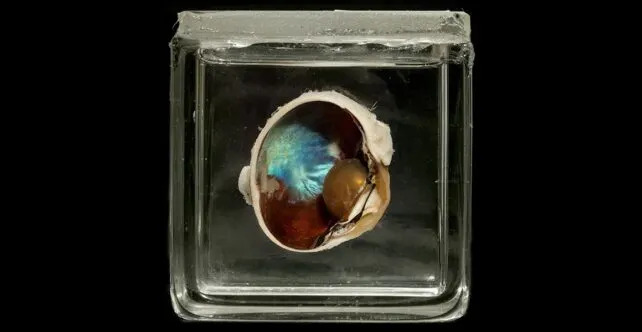
Like many mammals, reindeer have a light-reflecting layer called the tapetum lucidum inside each eye, which sits behind the retina.
But no other mammal is known to have a tapetum like the reindeer’s. Its structure seems to depend on the season.
Advertisement
Advertisement
In a 2022 article for The Conversation, ophthalmologist Robert Fosbury compared it to a tire change.
“During very cold conditions, you let some air out of the tyres to increase traction on the ice,” he explained. “The reindeer lets fluid out of its tapetum to reveal a better view of its surroundings.”
The exact mechanisms behind the change in structure are not yet known, but researchers think it has to do with fluid in the eye.
In 2022, Fosbury and colleagues studied the difference between the eyes of reindeer that had died in summer and those that had died in winter.
Their findings support the idea that constant dilation of the pupils in low light affects the eyes’ fluid balance, possibly causing structural changes in the tapetum.
Advertisement
Advertisement
Unfortunately, the scientists were unable to compare structures of the same tapetum across both seasons, but based on their results, they say it is “clear that any difference is small.”
“We have yet to understand how the seasonal structural change in the eye is triggered and the biochemical pathways that bring it about,” the researchers admitted.
“However the change is triggered, it clearly must be reversible.”
To solve the mystery, it may be necessary to study reindeer eyes in autumn and spring, to see how they gradually transition between their winter and summer hues.
For now, the eyes of the Arctic reindeer appear to be unique. Yet there may very well be other mammals out there living in low-light conditions with similar adaptations.